A practical 2026 guide to biomass boiler grants through the Boiler Upgrade Scheme. It explains the £5,000 grant, rural and off gas grid rules, fuel storage checks, emissions requirements and when a heat pump may be a better option.
Why biomass boiler grants matter in 2026
Biomass boilers are not the right answer for every home. They are larger than most gas or oil boilers, they need fuel deliveries, they need storage space, and they still involve burning wood fuel. For the right rural home, though, a biomass boiler can be a serious low carbon heating option, especially where the property is off the gas grid and a heat pump is difficult to design.
That is why the Boiler Upgrade Scheme still matters. GOV.UK lists a current grant of £5,000 towards a biomass boiler. The same consumer guidance lists £7,500 towards an air source heat pump, £7,500 towards a ground source heat pump and £2,500 towards an air to air heat pump.
The important point is that the biomass route is narrower than the heat pump route. GOV.UK says you can get a grant for a biomass boiler only if the property is off the gas grid, in a rural location, and the boiler has an emissions certificate showing that polluting emissions are kept to a minimum.
This guide explains what to check before you treat that £5,000 grant as part of your budget.
The short answer
The Boiler Upgrade Scheme can provide £5,000 towards a biomass boiler in England and Wales.
The grant is installer led. Ofgem says MCS certified installers apply for and redeem Boiler Upgrade Scheme vouchers on behalf of property owners. In practice, the grant should normally appear as a deduction from the quote rather than money paid to the homeowner.
For biomass, the main eligibility checks are stricter than many people expect. The home must be off the gas grid, it must be in a rural location, and the boiler must have an emissions certificate. GOV.UK also says you cannot get a grant to install a biomass boiler in a self build property.
If those checks are not clearly satisfied, do not assume the grant will be approved. Ask the installer to confirm the route in writing before you commit.
What counts as a biomass boiler
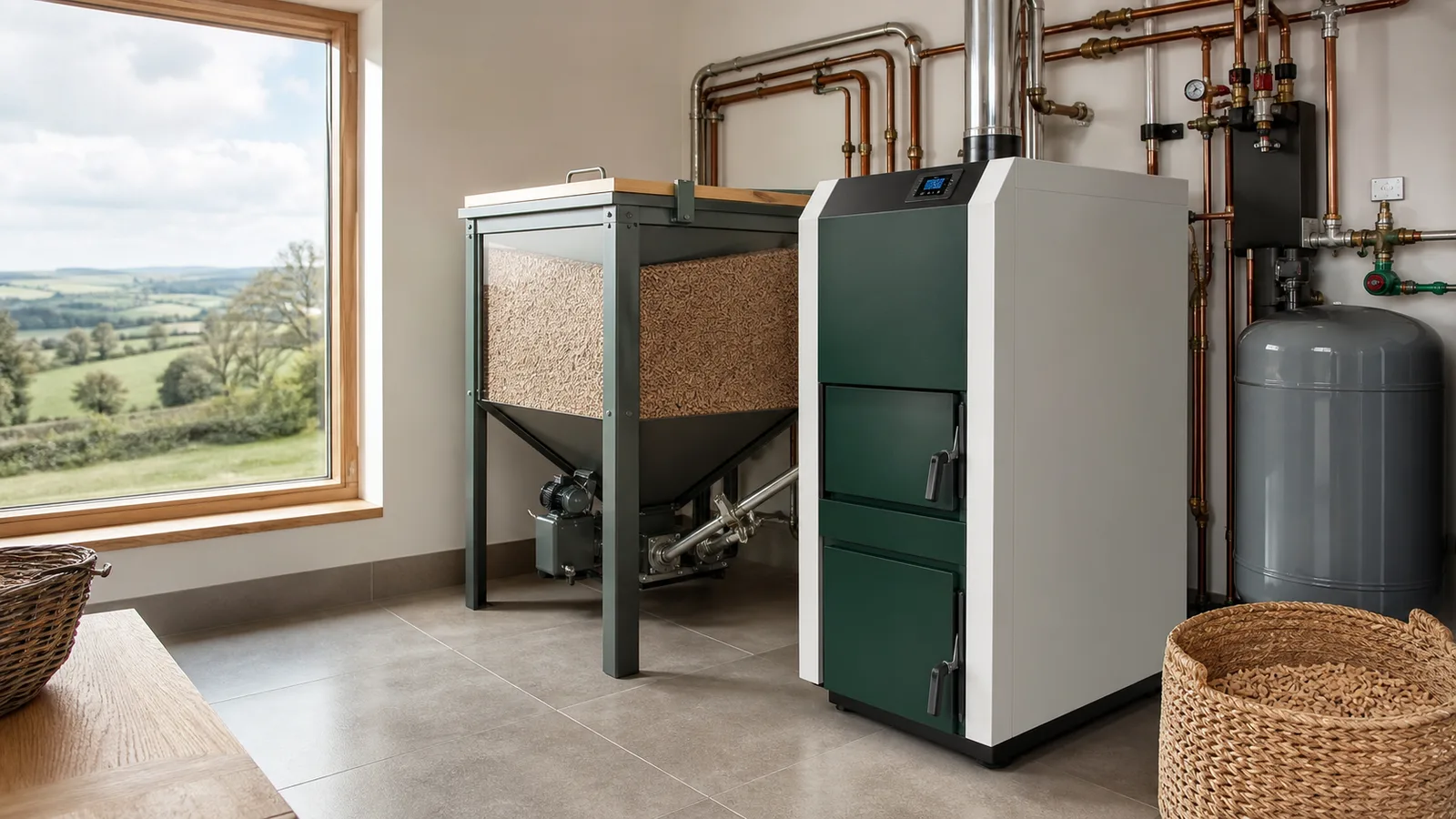
Energy Saving Trust explains that biomass heating uses organic material such as wood to produce energy. For home heating, the common fuels are logs, pellets and chips.
A biomass stove usually heats a single room. A biomass boiler is different because it connects to central heating and hot water, so it can replace a standard oil or gas boiler in a suitable home.
Most domestic grant enquiries are about pellet boilers. Pellets are easier to control than logs and can be fed automatically. Logs can be cheaper where there is a good local supply, but they usually need more manual handling and more drying and storage discipline.
The fuel choice affects the whole project. It changes the storage requirement, delivery access, maintenance routine, running cost and day to day convenience.
The £5,000 Boiler Upgrade Scheme grant
The Boiler Upgrade Scheme is designed to reduce the upfront cost of low carbon heating. GOV.UK lists current grants of £5,000 towards a biomass boiler.
The scheme is not a general home improvement grant. It supports eligible low carbon heating systems, installed through the correct route, at eligible properties. The installer must handle the voucher application and the installation must meet scheme standards.
GOV.UK says the system must meet certain standards, including minimum efficiency levels. It also lists 45kWth as the maximum capacity for individual systems.
For most homeowners, that means the first question is not only whether biomass is attractive. The first question is whether the property, boiler, installer and design all fit the scheme rules.
Rural and off gas grid rules
Biomass boiler grants are aimed at a specific type of home. GOV.UK says the property must be off the gas grid and in a rural location.
That makes biomass more relevant for village, farm, hamlet and remote homes where mains gas is unavailable and fuel delivery is already part of normal life. It is less likely to fit a suburban property with mains gas nearby.
If you are unsure whether your home is classed as rural for this scheme, ask the installer to check the Ofgem property owner guidance and confirm the position before quoting. If the rural status is uncertain, the grant should not be treated as guaranteed.
The off gas grid check should also be practical. Look at the current heating fuel, the local gas network position and the evidence the installer will use when submitting the application.
Emissions certificate requirement
The biomass boiler must have an emissions certificate showing polluting emissions are kept to a minimum.
This rule matters because biomass is lower carbon than fossil fuel heating only when the fuel source, appliance, installation and operation are suitable. Burning wood still produces air pollutants, including particulate matter and nitrogen oxides.
Energy Saving Trust advises that modern compliant appliances, dry fuel, proper installation and regular flue maintenance are important for limiting pollution. It also warns that homes in areas with existing air quality issues should consider alternatives.
Ask the installer for the product details and emissions evidence before signing. If the boiler cannot meet the emissions requirement, the grant route is not ready.
When biomass can make sense
Biomass can suit homes with high heat demand, enough plant room space, good delivery access and a reliable fuel supply.
It can be especially relevant where a heat pump is possible but expensive or awkward, or where the household already manages solid fuel, oil or other delivered fuels and has outbuildings or external storage space.
It can also suit some larger rural properties where a wet central heating system is already in place and the household wants a heating system that feels closer to a boiler than a heat pump.
Even then, biomass should be compared with an air source heat pump, a ground source heat pump, high heat retention storage heating and insulation first. The best option is the one that fits the building, budget, comfort needs and maintenance expectations.
When a heat pump may be better
For many homes, a heat pump is simpler to live with than a biomass boiler.
A heat pump does not require wood fuel deliveries, pellet storage, ash handling or regular boiler sweeping. It still needs good design, radiator checks and sensible controls, but the daily routine is usually lighter.
The grant support can also be higher for heat pumps. GOV.UK lists £7,500 towards an air source heat pump and £7,500 towards a ground source heat pump.
That does not mean a heat pump always wins. Some rural homes are complex, exposed, large or difficult to upgrade. The point is that biomass should be selected because it fits the property, not because the word grant appears beside it.
Cost and fuel checks
Energy Saving Trust says an automatically fed pellet boiler for an average home costs around £18,000 including installation.
That figure is useful as a starting point, not a quote. Your actual cost can change with boiler size, fuel store, flue route, hot water cylinder work, controls, pipework, plant room changes, removal of the old system and access constraints.
Energy Saving Trust also says pellet costs can be around £400 per tonne where there is room for a large fuel store that can take several tonnes at a time. Smaller deliveries may cost more. Logs can be cheaper in some areas, but they need space, drying time and more manual work.
Before choosing biomass, ask for a running cost estimate based on your heat demand and a realistic local fuel price. A low installation quote is not enough if the fuel supply is awkward or expensive.
Space and storage
Biomass boilers are larger than gas or oil boilers, and the fuel needs a suitable store.
Energy Saving Trust says wood boilers are larger and need space to store the fuel. That area must be accessible for deliveries and suitable for feeding the boiler.
This is where many projects become practical rather than theoretical. A home may qualify on paper but still be a poor biomass candidate if there is no dry storage, no delivery access, no sensible flue route or no convenient way to move fuel.
Ask the installer to show exactly where the boiler, fuel store, flue, controls and service access will go. If the layout only works with awkward compromises, pause and compare other options.
Flue, building rules and planning
A biomass boiler needs a safe flue. Energy Saving Trust says biomass systems normally need a flue that meets regulations for wood burning appliances, often a new insulated stainless steel flue.
It also says all new wood heating systems must comply with building regulations, and you should always check whether planning permission is needed.
That is especially important for listed buildings, conservation areas, smoke control areas and homes close to neighbours. A flue can affect appearance, maintenance, emissions and planning risk.
Ask who is responsible for checking building regulations, planning, smoke control and commissioning. The answer should be clear before the project starts.
Maintenance and household routine
Biomass boilers need more hands on maintenance than many heating systems.
Energy Saving Trust says biomass boilers should be swept regularly, with chimney and flue sweeping at least twice a year, preferably before and after the heating season. It also recommends an annual maintenance check.
Some pellet boilers have automatic cleaning functions. Others need more manual cleaning. Log systems usually need more frequent loading and fuel handling.
Be honest about the routine. If nobody in the household wants fuel deliveries, ash removal, cleaning and flue checks, biomass may become a frustration even if the grant is available.
Running cost context
Running cost comparisons need care because biomass fuel, oil, LPG, electricity and gas prices move differently.
Ofgem says the price cap from 1 July to 30 September 2026 is £1,862 per year for a typical direct debit dual fuel customer in England, Scotland and Wales. It lists average direct debit unit rates for that period of 26.11p per kWh for electricity and 7.33p per kWh for gas.
Those numbers are useful context, but they do not tell you whether biomass will be cheaper than your current oil, LPG or electric heating. Biomass costs depend on fuel type, local supply, delivery volume, boiler efficiency, building heat demand and maintenance.
Ask for a like for like estimate. It should show assumed annual heat demand, fuel use, fuel price, service cost and expected comfort outcome.
Warm Homes Local Grant and biomass
Warm Homes Local Grant is a separate route in England. GOV.UK says it supports low income privately owned homes with EPC ratings from D to G.
The published overview says measures can include insulation, solar panels and an air source heat pump if suitable. It does not make biomass the standard route for eligible households.
That means households should not confuse the two schemes. The Boiler Upgrade Scheme is the main named route for a biomass boiler grant. Warm Homes Local Grant may still be relevant if insulation or a different low carbon heating solution is more suitable after a local authority survey.
For many homes, insulation first will improve the result whichever heating system comes later.
Documents to ask for
Before signing a biomass boiler quote, ask for written confirmation of the scheme route and the design.
- Confirmation that the property is off the gas grid.
- Confirmation that the property meets the rural location requirement.
- The proposed boiler make, model and capacity.
- The emissions certificate evidence.
- Confirmation that the installer is MCS certified for the relevant work.
- A quote showing how the £5,000 grant is deducted.
- Fuel storage and delivery details.
- Flue design and building rules responsibility.
- Annual maintenance requirements.
- A realistic running cost estimate.
Keep these documents with the quote. If a grant application is delayed or refused, clear paperwork makes the next step easier.
Questions to ask the installer
- Why is biomass better for this property than an air source heat pump.
- What fuel type are you assuming.
- How many tonnes of fuel could I need in a typical year.
- Where will fuel be stored.
- Can delivery vehicles access the store safely.
- What cleaning will the household need to do.
- How often will the flue be swept.
- What happens if the voucher is refused.
- What warranties apply to the boiler and controls.
- What handover information will I receive.
Good installers should welcome these questions. If the answers are vague, the design is not mature enough.
Internal links for deeper planning
If biomass is only one option, compare it with heat pump grants, air source heat pumps, MCS certified installers, heat loss surveys, Warm Homes Local Grant, loft insulation, solid wall insulation, smart heating controls and EPC checks.
Those checks help avoid a common mistake. The grant is important, but the heating system must still fit the fabric of the home.
The bottom line
Biomass boiler grants in 2026 are useful but specific. The headline figure is £5,000 through the Boiler Upgrade Scheme, but the property must be off the gas grid, rural, and matched to an eligible boiler with the right emissions evidence.
For the right rural home, biomass can be a practical replacement for oil or other delivered fuels. For many homes, a heat pump or insulation led plan may be simpler, cleaner and easier to maintain.
The safest route is to check eligibility first, compare technologies honestly, and insist on a written design from an MCS certified installer before treating any grant as secured.