
Infrared heating, designed for the room and installed properly.
Cucumber Eco provides infrared heating contractor and installer services across the UK. We survey the property, calculate room heat loss, specify IR heating panels and controls, check the electrical supply, install and commission the system.
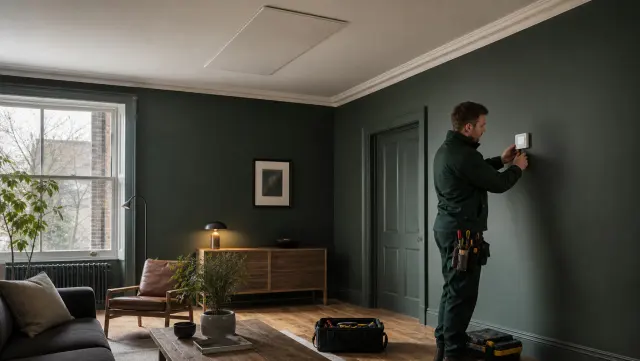
Good IR heating starts with heat loss, panel position and control.
An infrared panel is simple to operate, but a reliable installation still needs property data and electrical design. Panel output, mounting position, thermostat sensing and occupancy pattern all affect comfort and running cost.
Survey and heat-loss calculation
We inspect construction, insulation, glazing, room dimensions, exposure and intended use so panel output is based on the space rather than floor area alone.
Request an infrared heating surveyPanel selection and positioning
Wall and ceiling panels are compared for coverage, furniture layout, mounting height and the surfaces or occupied zone that need to receive radiant heat.
Read how infrared heating worksElectrical capacity and circuits
A qualified electrician checks the consumer unit, available load, cable routes, protection and switching before installation is confirmed.
Discuss the property electricsThermostats, zoning and schedules
Each room or zone receives suitable temperature sensing and time control so heat follows occupancy rather than running as an uncontrolled background load.
Plan controls and electricity useProfessional panel installation
Panels are mounted securely at the specified clearances, connected through the designed electrical arrangement and labelled for future inspection and maintenance.
Speak to an IR heating installerCommissioning and handover
We test operation, explain the controls, record the installed equipment and give the owner or occupier a practical operating guide.
Start an installation enquiry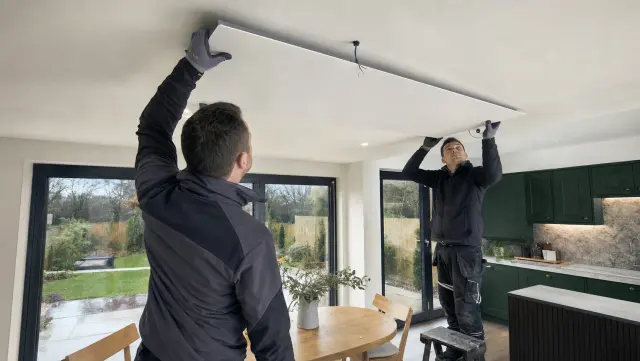
Fast, quiet radiant heat with more freedom in the room.
Infrared heating can feel comfortable quickly because radiant energy warms occupants and room surfaces instead of relying only on warm air circulation. Ceiling-mounted panels can release valuable wall space, while the lack of a wet system removes pipework, pumps and radiator maintenance.
The technology is especially useful where rooms are occupied intermittently, where individual zones need independent schedules, or where a well-insulated property has a relatively low heating demand. Panels operate silently and the system has few moving parts.
Direct electric heat can still be expensive when used for sustained whole-home demand. We compare the heat loss, expected hours of use, electricity tariff and alternatives before recommending infrared heating as the right route.
- ResponsiveRadiant comfort starts quickly without waiting for a complete wet heating circuit to warm.
- FlexiblePanels can be zoned by room and fitted to walls or ceilings where the design allows.
- QuietNo fan, compressor or circulating pump is needed at the point of heat.
- SimpleThere is no water-filled heating circuit and routine maintenance is limited.
- ControllableThermostats and schedules can match heat delivery to real occupancy.
Infrared heating services should combine room-by-room design with qualified electrical installation.
Cucumber Eco is an infrared heating contractor supporting residential landlords, homeowners and commercial property owners in the UK. Our infrared heating services cover heat-loss assessment, panel selection, wall or ceiling positioning, electrical design, thermostats, installation, commissioning and handover.
A professional infrared heating installer should specify enough output for the design conditions without oversizing an uncontrolled system. Panel coverage and thermostat location matter because radiant exposure, room surfaces and air temperature all contribute to comfort.
People searching for IR heating companies should compare more than panel price. Ask who completes the heat-loss calculation, who is responsible for the electrical work, how each zone is controlled, what warranty applies and what running-cost assumptions are being used.
Evidence first, then a defined next step.
Each stage should reduce uncertainty about the property, the technical scope, the funding or payment route and the party responsible for delivery.
Assess
Survey room dimensions, construction, insulation, glazing, exposure and occupancy.
Design
Calculate heat loss, choose panel output and location, then specify circuits and controls.
Install
Mount panels, complete electrical work and configure each heating zone.
Commission
Test the system, explain operation and hand over the equipment record.
Answers before you commit.
Direct information on suitability, cost, evidence and responsibility.
Infrared panels emit radiant energy that warms people, furniture and building surfaces in their line of exposure. Those warmed surfaces then release heat into the room, so comfort is not created only by heating the air.
It can be suitable in some well-insulated, low-heat-demand homes, but it is not the automatic answer for every property. Whole-home use needs room-by-room heat-loss calculations, electrical capacity checks and an honest comparison with heat pumps and other systems.
Infrared is direct electric heating, so every unit of heat uses electricity. Good zoning may reduce wasted heating in intermittently used rooms, but running cost depends on heat loss, hours of use, controls and tariff. We do not promise a universal saving.
The number depends on calculated heat loss, available panel outputs, mounting position and coverage. A large room may need more than one panel to distribute radiant comfort effectively.
Ceiling panels often provide clear coverage and preserve wall space. Wall panels can suit rooms with appropriate clear sightlines. The right position depends on room geometry, furniture, mounting height and the intended occupied zone.
No. Infrared panels provide space heating only, so the property needs a separate hot-water system such as a cylinder, heat-pump water heater or another suitable arrangement.
Yes. Solar and battery storage can support the property electricity strategy, but winter heating demand and solar generation do not always coincide. The systems should be modelled using realistic seasonal demand and tariff assumptions.
Yes, subject to survey and local delivery availability. IR heating can suit offices, studios, halls, workshops and other spaces where targeted zones or intermittent occupancy make radiant heat useful. Electrical load, mounting safety and controls remain essential.
Ask an infrared heating contractor to design the system, not just sell the panels.
Tell us the property type, rooms, insulation, existing heating and intended use. We will identify the survey and installation route worth taking.