Solid wall insulation can make a major difference to older UK homes, but it needs careful survey work, moisture planning and the right grant route. This guide explains 2026 costs, Warm Homes Local Grant eligibility, BUS links and what homeowners should check before choosing internal or external insulation.
Solid wall insulation is one of the bigger home energy upgrades a household can make in 2026, but it is also one of the upgrades that can make the biggest difference to older properties. If your home has solid brick, stone, earth, timber frame or other non cavity external walls, there is no empty cavity to fill. The wall has to be insulated either on the inside face or the outside face.
That makes solid wall insulation more complex than cavity wall insulation. It usually costs more, takes more planning, and needs more careful moisture design. It can also change how rooms feel in a way that smaller upgrades cannot. Done properly, it can cut heat loss, reduce draughts, improve comfort and prepare a home for lower temperature heating such as an air source heat pump.
The timing matters because the Warm Homes Plan and Warm Homes Local Grant have brought fabric upgrades back into focus. Eligible households in England can now apply for council led support where the home is privately owned, has an EPC rating of D, E, F or G, and the household meets the income, postcode or benefits route. Wall insulation is one of the measures that can be considered through that route.
This guide explains how solid wall insulation works in 2026, what it can cost, what grant routes may apply, how it links with BUS funded heat pumps, and what to check before you let anyone quote.
What is solid wall insulation
Solid wall insulation is an extra insulating layer added to a wall that does not have a fillable cavity. The insulation can be fitted outside the property as external wall insulation, or inside the property as internal wall insulation.
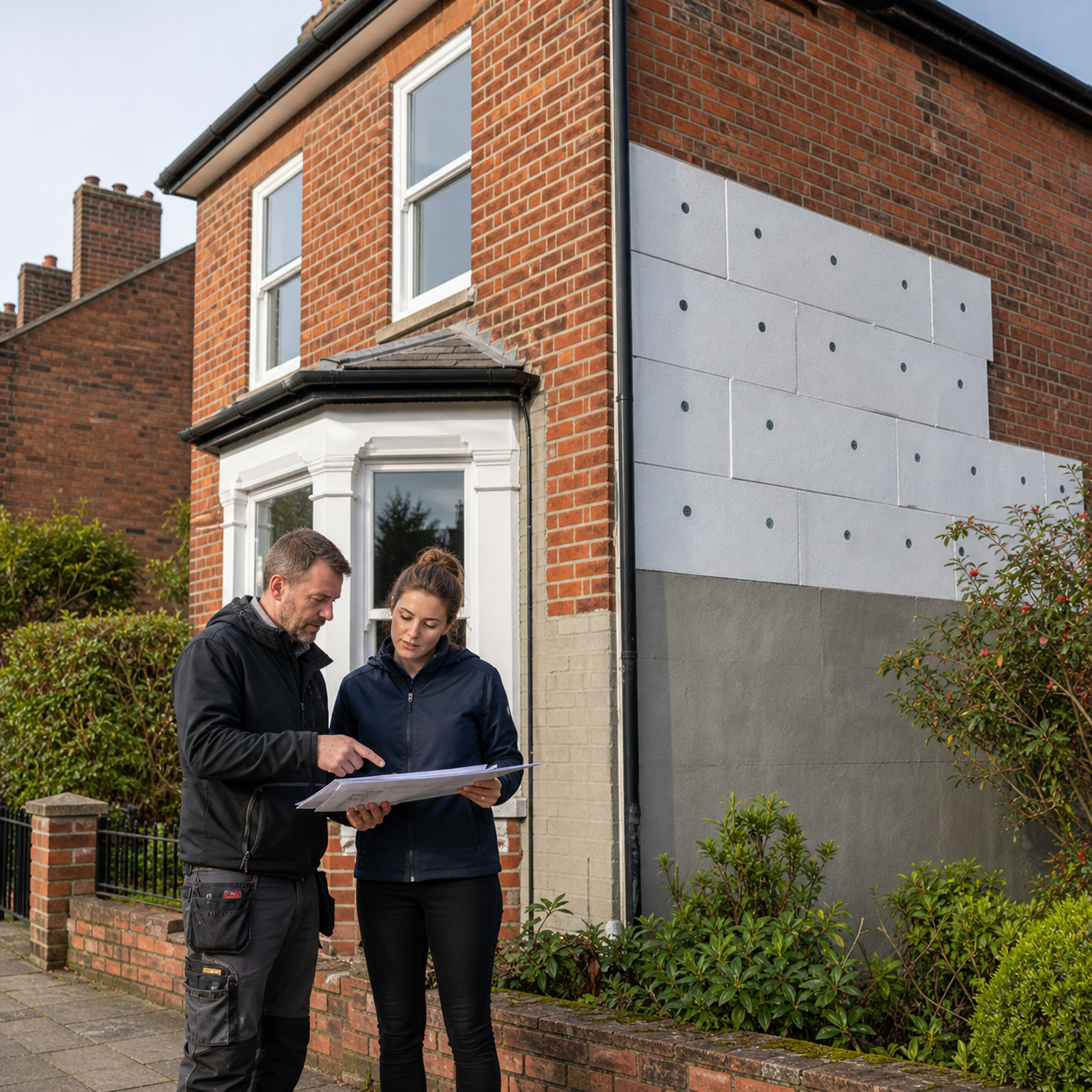
External wall insulation usually involves fixing insulation material to the outside wall and covering it with render, cladding, brick slips or another weatherproof finish. It wraps the home from outside, which means the internal floor area is preserved and daily life inside the property may be less disrupted. It can also refresh the appearance of tired external walls.
Internal wall insulation is fitted to the inside face of external walls. This can mean rigid boards, an insulated stud wall, or insulating plaster systems. It is usually less expensive than external insulation, and it can be useful where the outside appearance must not change. The trade off is disruption inside the rooms, loss of some floor area, and the need to move sockets, skirting boards, radiators and fixed furniture.
Both approaches need a proper survey. Older homes often manage moisture through breathable walls, natural ventilation and traditional materials. Adding insulation changes heat flow and moisture behaviour, so the right system depends on the building, not just the budget.
Which homes are most likely to have solid walls
Energy Saving Trust says homes built before the 1920s are more likely to have solid external walls. Many Victorian, Edwardian and early twentieth century homes fall into this group, although age alone is not proof. Some older homes have unusual construction, and some newer walls can still be non standard.
A simple clue is the brick pattern. If the outside wall shows a mix of long brick faces and short brick ends, the wall may be solid. If the wall shows a regular pattern of long brick faces only, it is more likely to be a cavity wall. Wall thickness can also help. Energy Saving Trust says a brick wall between 260mm and 350mm is likely to be a cavity wall, while a narrower brick wall is probably solid. Stone walls tend to be solid no matter how thick they are.
If the wall is rendered, clad, painted or made from stone, do not guess. A retrofit assessor, surveyor or experienced installer should confirm the wall type before any recommendation is made.
Why solid wall insulation matters in 2026
Walls are a major heat loss route. Energy Saving Trust says around 33% of all heat lost in uninsulated homes escapes through the walls. That figure is why wall insulation can have a larger comfort impact than many smaller measures, especially in homes with exposed gable walls, end terraces, detached walls or thin solid brick construction.
The April to June 2026 Ofgem price cap is £1,641 per year for a typical direct debit dual fuel household. Ofgem lists average direct debit rates of 24.67p per kWh for electricity and 5.74p per kWh for gas during that period, with standing charges of 57.21p per day for electricity and 29.09p per day for gas. The exact saving from insulation depends on your property, heating system, usage and tariff, but reducing heat demand is still the part of the bill you can control most directly.
Solid wall insulation is also relevant because heating technology is changing. A home with high heat loss often needs larger radiators, higher flow temperatures or a larger heat pump. A fabric upgrade can reduce heat demand before a heat pump is designed. That does not mean every heat pump project needs solid wall insulation first, but it does mean older solid wall homes should be assessed carefully before any heating replacement.
How much does solid wall insulation cost
Energy Saving Trust gives typical installation costs of around £18,000 for external wall insulation and around £12,000 for internal wall insulation, based on a typical three bedroom semi detached house in Great Britain. It also gives a wider typical cost range of £12,000 to £18,000 for solid wall insulation.
Those figures are useful starting points, not fixed quotes. Real project costs depend on wall area, access, scaffolding, finish, window details, existing damp, roof overhangs, rainwater pipes, utility boxes, ventilation needs and the level of making good afterwards.
External wall insulation often costs more because it may need scaffold, render or cladding, detailing around openings, changes to sills, adjustments to downpipes, and sometimes work at roof edges. Internal insulation can cost less, but the saving can narrow if rooms need full redecoration, radiators need moving, kitchens need removing, or services have to be altered.
The cheapest quote is not automatically the best quote. A solid wall insulation failure can be expensive to repair because the insulation is part of the building fabric. The survey, design, ventilation strategy and guarantee matter as much as the thickness of the board.
Internal wall insulation or external wall insulation
The right choice depends on the property and how the occupants live.
When external insulation usually fits best
External wall insulation is often best when the outside appearance can change, the walls are accessible, and the homeowner wants to avoid losing internal floor area. It can be especially useful when the property already needs exterior repairs, new render, roof work, window work or gutter work. Combining jobs can reduce duplicated scaffold and make the project more efficient.
When internal insulation may be more practical
Internal wall insulation is often considered when the outside appearance cannot change, such as in some conservation areas, terraces with shared street character, or homes where external boundaries make access difficult. It can also be phased room by room, although whole house planning is still important. Internal insulation is disruptive because rooms may be unusable during work and because fixtures usually need removing and refitting.
Moisture risk is different for each route. Internal insulation can make the original external wall colder, which may increase the risk of moisture forming inside the wall if materials and ventilation are wrong. External insulation usually keeps the wall warmer, but it must not cover unresolved damp, poor pointing, defective render, blocked vents or rainwater faults.
The moisture check is not optional
Solid wall homes are often older homes, and older homes do not always behave like modern sealed buildings. Traditional brick, stone, earth, lime and timber can absorb and release moisture. If the wrong insulation or finish traps moisture, it can cause damp, mould, decay or failure of the insulation system.
Before installing solid wall insulation, the installer or assessor should check wall condition, roof edges, gutters, downpipes, pointing, render, ventilation, air bricks, flood risk and exposure to driving rain. Energy Saving Trust specifically warns that repairs and maintenance should be completed before wall insulation is added, because unresolved damp or defective external fabric can be trapped by the new system.
A good design should include ventilation. Insulation can reduce uncontrolled draughts, which is often positive for comfort, but homes still need controlled fresh air. Extract fans, trickle vents, air bricks and underfloor ventilation may all need attention. Never allow an installer to block intentional ventilation without explaining the replacement strategy.
Can solid wall insulation be funded
The main current funded route for eligible households in England is the Warm Homes Local Grant. GOV.UK says the grant is for homes in England that are privately owned, including owner occupied and privately rented homes, with an EPC rating of D, E, F or G. Household income must usually be £36,000 a year or less, although postcode and benefit routes may also apply.
What the grant can cover
GOV.UK lists wall, loft and underfloor insulation among the improvements that may be suggested after a home survey. It also lists air source heat pumps, smart controls and solar panels. If the council agrees works, the council organises and pays for the agreed improvements. GOV.UK says occupants do not need to pay, although landlords may need to contribute for some improvements.
The local authority guidance says the Warm Homes Local Grant begins delivery in 2025, supports low income households, and has been allocated £500 million. The public application page says councils will usually contact applicants within 10 working days to get more information and arrange a home survey.
Not every applicant will get solid wall insulation. The survey decides what is suitable. A property might receive another measure first, or a combination of measures, depending on the home, budget, condition and local delivery rules.
How the Warm Homes Plan fits in
The Warm Homes Plan is the wider government policy direction behind a major upgrade programme for UK homes. Energy Saving Trust describes it as investing close to £15 billion in improving homes to cut energy bills. The plan puts more attention on insulation, lower carbon heating and practical support for households that would not otherwise be able to pay for upgrades.
For solid wall homes, the important point is that grant support is moving towards whole house thinking. A wall insulation job should not be treated as a single product sale. It should sit within a plan for fabric, ventilation, heating, controls and future works.
That is especially true where the household may later want solar panels, a heat pump, new windows or room in roof insulation. External wall insulation can interact with windows, roof edges, gutters and services. Internal wall insulation can interact with radiators, sockets, kitchens and room layouts. Planning the order properly can prevent paying twice for the same disruption.
How BUS connects with wall insulation
BUS is not a wall insulation grant. It is a heating grant for eligible low carbon heating systems in England and Wales. The current approved BUS values from GOV.UK are £7,500 for an air to water heat pump, £2,500 for an air to air heat pump, £7,500 for a ground source heat pump and £5,000 for a biomass boiler. These values are effective from 28 April 2026.
Even though BUS does not fund wall insulation, solid wall insulation can still affect a BUS project. A heat pump design starts with heat loss. If the walls leak a lot of heat, the system may need more output and the homeowner may need more emitter upgrades. Reducing heat loss can improve comfort and may make lower flow temperatures easier to achieve.
The practical sequence is simple. Check fabric first, check grant eligibility second, then design heating. A household that qualifies for Warm Homes Local Grant may be able to address wall insulation or other fabric measures before a heat pump is considered. A household using BUS without Local Grant support may still choose to do insulation privately if the survey shows a strong case.
What a good survey should include
A proper solid wall insulation survey should be more than a quick look at the outside wall.
- Confirm the wall type and construction.
- Check the EPC and current heating system.
- Inspect damp, pointing, render, roof edges, gutters and downpipes.
- Assess ventilation, air bricks and extract fans.
- Consider flood risk and exposure to driving rain.
- Check whether the property is listed or in a conservation area.
- Identify services, meters, pipes, cables, vents and external fittings.
- Review internal disruption, room sizes and redecoration needs.
- Explain whether internal or external insulation is more suitable.
- Provide a written design, guarantee route and clear scope.
If the survey does not mention moisture or ventilation, treat that as a warning sign.
Planning permission and older homes
Some external wall insulation projects need planning permission, especially where the outside appearance changes, the home is listed, or the property sits in a conservation area. Energy Saving Trust advises checking with the local council where appearance may be affected.
Older and listed buildings need extra care. It is often possible to improve them, but the materials and detailing matter. Breathable systems may be needed. Lime based finishes, specialist boards and traditional detailing can be more appropriate than standard modern solutions in some buildings. A general insulation installer is not always the right person for a sensitive historic property.
Internal wall insulation can avoid changing the outside face, but that does not make it automatically safer. It can still change moisture movement and room ventilation. The design should match the construction.
What homeowners should ask before signing
Before agreeing to solid wall insulation, ask the installer or scheme provider direct questions.
- What wall type have you identified and how did you confirm it.
- Why are you recommending internal insulation or external insulation.
- What repairs are needed before insulation starts.
- How will moisture risk be managed.
- What ventilation changes are included.
- What happens to air bricks, vents, pipes, cables and meters.
- What finish will be used and how will it be maintained.
- What rooms or elevations are included.
- What guarantee is provided and who backs it.
- What happens if defects appear after completion.
You should also ask for at least three quotes where you are paying privately. For funded work, ask for the same technical clarity even if the council or scheme provider is managing procurement.
Is solid wall insulation worth it
Solid wall insulation is most likely to be worth considering when a home has uninsulated solid walls, high heating demand, cold rooms, surface condensation risk, exposed external walls, or a planned wider retrofit. It can be particularly relevant for detached homes, end terraces, older semis and properties where wall heat loss dominates the comfort problem.
It may be less straightforward where the property has unresolved damp, poor external condition, severe exposure, flood risk, heritage constraints, very limited internal space or a short ownership horizon. In those cases, the answer may still be yes, but only with better design and a realistic budget.
For many households, the strongest case is not payback alone. It is comfort, healthier rooms, lower heat demand, better EPC performance and readiness for future heating changes. With Warm Homes Local Grant now available through councils for eligible homes, households that could not afford the work privately should check their eligibility rather than assume solid wall insulation is out of reach.
The bottom line
Solid wall insulation in 2026 is a serious retrofit measure, not a quick add on. It can reduce heat loss, improve comfort and support future low carbon heating, but it needs careful survey work, moisture planning and the right grant route.
If your home is older, cold, expensive to heat and likely to have solid walls, start with three checks. Confirm the wall type. Check your EPC and eligibility for Warm Homes Local Grant. Then get a proper retrofit assessment before choosing internal or external insulation.
For the right home, done in the right order, solid wall insulation can be one of the most valuable fabric upgrades available.