A practical 2026 guide to heat batteries, covering the planned Boiler Upgrade Scheme expansion, current grant timing, running cost questions, tariff checks and when a heat battery may suit a British home.
Why heat batteries are becoming a 2026 search topic
Heat batteries are moving from niche product searches into mainstream home heating conversations. The reason is not only technology. It is policy timing.
The government has now published a Boiler Upgrade Scheme phase 2 summary business case for 2026 to 2030. That document says the scheme is intended to expand the supported technology mix during the next phase. It specifically says heat battery applications are expected during 2026 to 2027.
That does not mean every household can claim a heat battery grant today. The current GOV.UK public page for what you can get under the Boiler Upgrade Scheme lists air source heat pumps, ground source heat pumps, biomass boilers and air to air heat pumps. It does not yet list heat batteries as a current claim option.
So the sensible message for June 2026 is clear. Heat batteries are worth watching now, but homeowners should check the live scheme rules before signing anything.
The short answer
A heat battery stores heat so it can be released later for space heating or hot water. In a home, that may appeal where the property is hard to serve with an outdoor heat pump unit, where space is tight, where the owner wants to use flexible electricity tariffs, or where a fabric first upgrade plan is still developing.
The Boiler Upgrade Scheme is currently worth £7,500 for air source heat pumps, £7,500 for ground source heat pumps, £5,000 for biomass boilers and £2,500 for air to air heat pumps. GOV.UK also says there is one grant per property and hybrid heat pump systems are not eligible.
For heat batteries, the important point is timing. The government business case says applications are expected during 2026 to 2027. Until heat batteries appear in the current claim guidance, households should treat them as an upcoming or emerging grant route, not a guaranteed live grant claim.
What a heat battery does
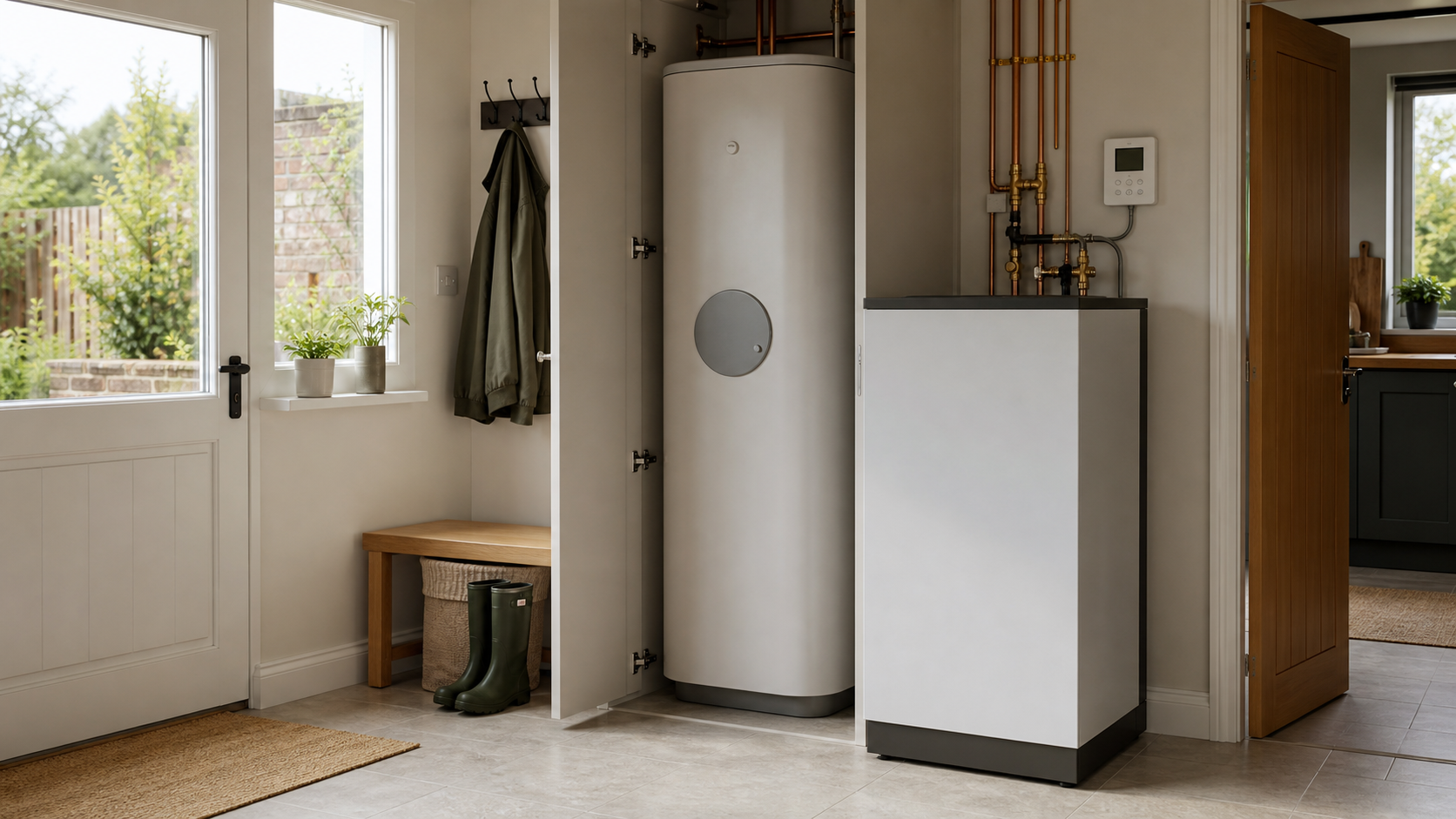
A heat battery is a thermal store. It takes energy in, stores it as heat, then releases that heat when the home needs it.
That makes it different from a normal electrical battery. A normal battery stores electricity. A heat battery stores heat. It may still be powered by electricity, but the output is heat for the home rather than electricity for sockets.
In practical terms, a heat battery may be used for hot water, space heating, or both, depending on the product and system design. Some households may look at heat batteries as an alternative to direct electric heating, old storage heaters or a gas boiler replacement. Others may consider them alongside solar panels or flexible tariffs.
The core question is not whether the product sounds clever. The core question is whether it can meet the heat demand of the home at an acceptable running cost.
What the Boiler Upgrade Scheme says today
The Boiler Upgrade Scheme is a grant scheme for England and Wales. Ofgem says the scheme is installer led, and that property owners need an MCS certified installer.
Current public GOV.UK guidance lists grant values of £7,500 for an air source heat pump, £7,500 for a ground source heat pump, £5,000 for a biomass boiler and £2,500 for an air to air heat pump.
GOV.UK also says there is one grant per property. It says hybrid heat pump systems are not eligible.
Those rules matter because households can be told about future changes before the claim process is actually open. If a quote mentions a heat battery grant, ask where the live claim guidance is, who applies, what standard applies, and when the voucher can be redeemed.
What the new business case adds
The 2026 to 2030 Boiler Upgrade Scheme phase 2 summary business case is the reason heat batteries are now a live planning topic.
It says phase 2 has a budget of £2,392 million over the period 2026 to 2030. It also says heat battery applications are expected during 2026 to 2027.
The same document describes the preferred option as a reformed Boiler Upgrade Scheme intended to support heat pumps and heat batteries. It also says the scheme is expected to offer vouchers to support heat pumps and heat batteries.
That is a strong policy signal. But a policy signal is not the same as a household application page. For now, the safest customer advice is to watch the official guidance and ask for written confirmation before relying on any heat battery grant figure.
Why running costs need careful checking
Heat batteries are usually electric heating systems. That means running cost depends heavily on electricity price, charging pattern, heat demand, controls and tariff choice.
Ofgem says the typical direct debit dual fuel price cap is £1,862 per year from 1 July to 30 September 2026. The average direct debit unit rates for that period are 26.11p per kWh for electricity and 7.33p per kWh for gas, including VAT.
Those unit rates do not mean a heat battery is automatically expensive or cheap. They show why the design has to be honest. Electricity is priced differently from gas, and the whole point of a heat battery may be to charge at better times or work with a specific tariff.
A quote should explain the expected annual heat demand, the charging schedule, the tariff assumption and the controls. Without those, a running cost estimate is too vague to rely on.
Where a heat battery might make sense
A heat battery may be worth exploring where a home needs low carbon heating but has constraints that make other options harder.
That could include a property with limited outside space, a flat where outdoor equipment is complicated, a home with noise or planning sensitivities, or a household looking to replace older electric heating. It may also suit homes where the owner wants a simpler electric heating system with stored heat.
It is not automatically the best option for every home. Air source heat pumps remain the main grant backed low carbon heating route for many properties. Ground source heat pumps can suit some larger sites. Modern high heat retention storage heaters can still make sense for smaller electrically heated homes.
The right answer depends on the building, the occupants, the existing heating, the available tariffs and the practical installation route.
What to ask before accepting a quote
Use these checks before signing.
- Is the heat battery grant live under current GOV.UK guidance.
- Which installer applies for the grant.
- Which standard or certification route applies.
- What heat demand has been calculated for the home.
- Can the product meet space heating and hot water needs.
- What tariff is assumed in the running cost estimate.
- What happens if the tariff changes later.
- Where will the unit be installed.
- What electrical work is required.
- What warranty and handover documents are provided.
These questions are not difficult. They are normal checks for a major heating upgrade.
Why a heat loss survey still matters
A heat battery does not remove the need to understand the home. The installer still needs to know how much heat the property loses and when that heat is needed.
A proper survey should look at room sizes, insulation, windows, ventilation, hot water use, existing emitters, electrical supply, controls and household routines.
This matters because stored heat has to be managed. If the home loses heat quickly, or if the tariff window is short, the design may need more careful planning.
It also matters for comfort. A heating system can look impressive on paper and still disappoint if the rooms, controls and occupant habits have been ignored.
Heat batteries and insulation
The cheapest heat is usually the heat the home does not need. Before committing to a new heating system, check the fabric of the property.
Loft insulation, wall insulation, floor insulation, draught proofing and glazing can all affect heat demand. They can also affect comfort and the size of any heating system.
This does not mean every home must be fully upgraded before replacing heating. It means the sequence should be thought through. If major insulation work is likely soon, the heating design should account for that rather than oversizing a system for the old heat demand.
Warm Homes Local Grant can support eligible households in England with energy performance upgrades and low carbon heating. GOV.UK says eligible homes must be privately owned and have an EPC of D, E, F or G. Household income must usually be £36,000 a year or less, with postcode and benefit routes possible.
Heat batteries and solar panels
Some households will ask whether solar panels can help charge a heat battery. The answer depends on the product, the controls, the home and the season.
Solar panels generate most when daylight is strong. Heating demand is usually highest in colder months, when solar output is lower. That does not make the combination useless, but it means the quote should avoid overclaiming.
If a home already has solar panels, battery storage or an export tariff, the installer should explain how the heat battery will interact with the existing system. The design should not assume that every spare unit of solar generation will always be available for heating.
For many homes, the bigger saving may come from matching charging to a suitable tariff and reducing heat demand through insulation.
What landlords should consider
Landlords should be especially careful with heat battery claims. A rental property needs reliable comfort, clear controls and documents that can be handed to tenants.
The system must be simple enough for occupants to use. It should not rely on complex behaviour or a tariff that the tenant cannot access.
Landlords should also consider EPC impact, maintenance responsibilities, hot water performance, electrical capacity and any disruption during installation.
If future grant support becomes available, keep written evidence of eligibility, survey notes, installer certification, product details, warranties and commissioning documents. Good paperwork protects both the landlord and the tenant.
What homeowners should prepare
Before a survey, gather recent energy bills, the EPC, heating system details and notes about comfort issues.
Write down which rooms are cold, when hot water runs short, how often the home is occupied during the day and whether electricity tariffs are already being used.
If the home has solar panels, battery storage, old storage heaters, an immersion heater or a smart meter, tell the installer. These details may change the design.
Also take photos of the cupboard, utility area, airing cupboard, consumer unit and existing heating controls. That helps the installer understand the practical installation space.
Red flags to avoid
Be cautious if a quote says heat battery grants are definitely live but cannot link to current GOV.UK claim guidance.
Be cautious if the running cost estimate does not name the tariff assumption. Be cautious if the quote ignores heat loss, insulation, hot water use or electrical supply.
Be cautious if the system is described as a simple swap without a proper survey. A heat battery may be easier to place than some outdoor systems, but it is still a heating system that has to serve the whole home.
Also be cautious if the salesperson focuses only on the grant. The product, the design and the running cost matter just as much as the funding.
How this fits the Warm Homes Plan
The Warm Homes Plan is the wider policy backdrop. GOV.UK says it will deliver £15 billion of public investment and upgrade up to 5 million homes by 2030.
That scale means more households will compare heat pumps, heat batteries, insulation, solar panels, controls and finance. It also means installer quality and scheme clarity will matter more.
Heat batteries could become a useful part of the low carbon heating mix. But they should be treated as part of a whole home decision, not as a shortcut around survey work.
The strongest applications will be the ones where the home, the product and the tariff all line up.
Bottom line
Heat batteries are one of the most interesting heating topics for 2026 because the next phase of the Boiler Upgrade Scheme points towards support for them.
But timing matters. Current GOV.UK public grant guidance does not yet list heat batteries as a live Boiler Upgrade Scheme option. The new business case says applications are expected during 2026 to 2027.
For homeowners, the practical advice is simple. Check the current scheme page, ask for the grant route in writing, insist on a proper heat loss survey and compare running costs using a real tariff assumption.
For landlords, the same checks apply, with extra attention to tenant use, documents and long term comfort.
A heat battery may be the right answer for some homes. It is not the right answer just because it is new. The right answer is the system that can heat the home reliably, affordably and with evidence that stands up later.