A practical 2026 guide to heat pump compatible hot water cylinders, including why many combi boiler homes need one, what MCS expects, how grants fit, and what homeowners should ask before installation.
Why hot water cylinders matter in 2026
Hot water is one of the details that can make or break a heat pump installation. Many people focus on the outdoor unit, radiator sizes and grant paperwork, but the hot water cylinder often decides whether the system feels normal in daily life.
Energy Saving Trust explains that an air source heat pump can heat water stored in a hot water cylinder for taps, showers and baths. It also says heat pumps do not provide hot water on demand in the same way as a combi boiler, so most homes need a cylinder or another hot water solution.
That matters because a large number of UK homes have combi boilers and no stored hot water. If those homes move to an air source heat pump, the survey needs to find space for a cylinder, confirm the household demand, check the pipework and explain how hot water will be controlled.
The short version is simple. A heat pump compatible cylinder is not a small accessory. It is part of the heating design.
The short answer
Most air source heat pump installations need a hot water cylinder unless the home already has a suitable cylinder or a different approved hot water solution.
If the home has a combi boiler, there may be no cylinder at all. If the home has an older cylinder, it may not be suitable for the lower operating temperatures and higher heat exchanger requirements of a heat pump. MCS says the domestic hot water heat exchanger for a heat pump cylinder should follow the heat pump or cylinder manufacturer recommendation, and that heat pump systems tend to need a larger heat exchanger surface area than combustion based systems.
That does not mean every home needs the biggest cylinder available. Approved Document L says domestic hot water systems should be sized for the anticipated demand and should not be significantly oversized. The right answer is a calculated answer, not a guess based on bedrooms alone.
What changes when you replace a combi boiler
A combi boiler makes hot water as you use it. It does not usually store a full cylinder of hot water. That is convenient for space, but it is a different way of working from most air source heat pump systems.
Energy Saving Trust says heat pumps usually need another way to provide hot water and that an installer will usually fit a hot water cylinder to store water heated by the heat pump. It also says that if you already have a hot water cylinder, it will probably need to be replaced with one suitable for the heat pump.
This is why the first survey should look inside the home as well as outside. The installer needs to ask where the cylinder could go, whether there is an old airing cupboard, whether pipe routes are sensible, whether access is safe and whether the electrical work for controls and immersion backup is clear.
For homeowners, the practical point is to raise the cylinder early. If space is tight, it should not be left until the quote stage.
What makes a cylinder heat pump compatible
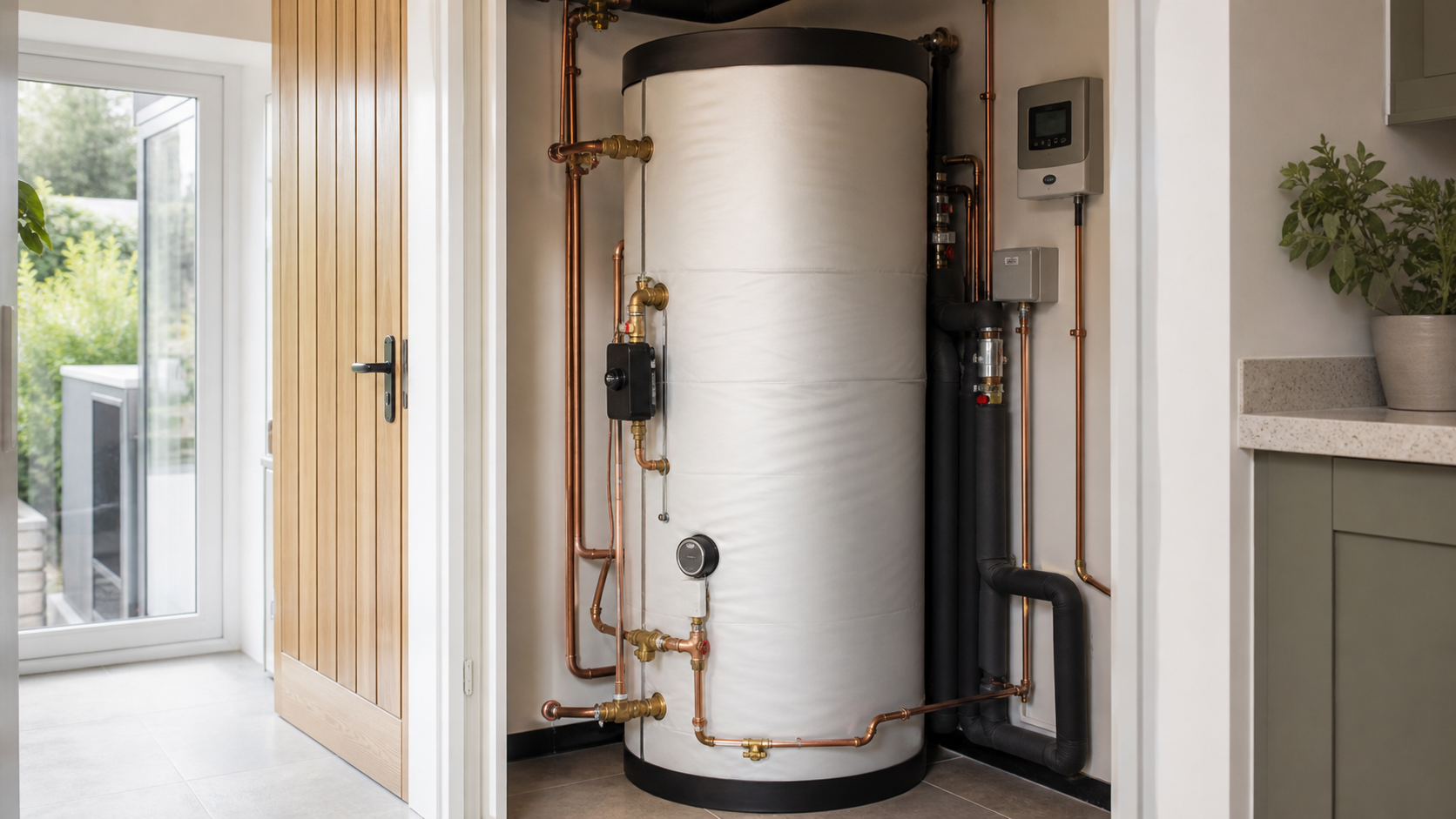
A heat pump compatible cylinder is designed to transfer heat from the heat pump into stored water effectively.
MCS says the specification of the domestic hot water cylinder heat exchanger should follow the heat pump manufacturer or cylinder manufacturer recommendations. MCS also notes that heat pump cylinders tend to require a greater heat exchanger surface area compared with traditional boiler heated cylinders because the water from a heat pump is typically at a lower temperature.
That is the key technical difference. An older cylinder might physically hold water, but it may not transfer heat quickly enough for the new system. If heat transfer is poor, the heat pump may take too long to reheat the cylinder, use backup heat more often or deliver a worse user experience.
The product detail matters. Ask whether the proposed cylinder is designed for heat pump use, what size has been selected, what manufacturer guidance has been followed and how reheating will work.
The 55 degrees C design point
MCS says that when installing a domestic hot water cylinder to work with a heat pump, the heat pump must be capable of a flow temperature of at least 55 degrees C at design conditions.
That does not mean the whole heating system should always run at that temperature. Space heating often works best at lower flow temperatures. Energy Saving Trust says heat pumps typically send hot water to radiators at a lower temperature than an equivalent fossil fuel system, often between 35 and 45 degrees C.
The point is that hot water needs a separate check. A system can be efficient for space heating and still need a proper strategy for cylinder heating, pasteurisation, immersion use, controls and household demand.
This is also why the design needs to be explained in plain English. The homeowner should know whether the heat pump heats the cylinder directly, whether an immersion heater is used at times, and how the hot water schedule is set.
Legionella and safe hot water
Hot water safety is not just about comfort. Energy Saving Trust says heat pumps are not usually designed to supply very hot water all the time, so a cylinder may run at a higher temperature from time to time to reduce the risk of legionella bacteria.
MCS says domestic hot water systems must include a means to prevent bacterial growth, including legionella bacteria. MCS also notes that where prevention is through periodic pasteurisation, a bacterial risk assessment can help determine how often pasteurisation should happen.
Approved Document G is the building regulation guidance for sanitation, hot water safety and water efficiency. GOV.UK says the current edition covers cold water supply, water efficiency, hot water supply and systems, sanitary conveniences, washing facilities, bathrooms, kitchens and food preparation areas.
For a homeowner, the action point is straightforward. Ask the installer how the anti legionella routine is set, how often it runs, whether it uses the heat pump or immersion heater, and whether you need to change anything on the controller.
Do not oversize the cylinder
There is a common assumption that a larger cylinder is always safer. That is not a good design rule.
Approved Document L 2026 says domestic hot water systems should be sized for the anticipated demand for domestic hot water in the dwelling, based on BS EN 12831 part 3. It also says systems should not be significantly oversized.
An oversized cylinder can take more space, increase standing heat losses and cost more than needed. An undersized cylinder can lead to poor comfort, especially where several showers are used close together.
The right cylinder depends on the number of occupants, bathrooms, shower behaviour, bath use, reheating rate, heat pump output and available space. The design should reflect the household, not just the property type.
Existing cylinders need careful checks
Some homes already have a hot water cylinder. That does not automatically mean it can stay.
MCS says that where an existing domestic hot water cylinder is used, the thermal insulation of the cylinder and all connected pipes should be upgraded to at least the level applicable to new installations under relevant legislation and guidance. It also says proper duty of care should be used to check that the cylinder is fit for purpose, including scale, corrosion, damage, deterioration and any extra stress from connecting a heat pump.
That means keeping an existing cylinder should be a conscious decision. It should be checked for insulation, condition, heat exchanger suitability, volume, location, controls and manufacturer requirements.
If the installer says the cylinder can stay, ask why. If they say it must be replaced, ask what the new cylinder changes and whether the old location will still work.
Insulation still saves money
Cylinder and pipe insulation are not exciting, but they matter.
Energy Saving Trust says lagging water tanks reduces heat loss through the tank, so less money is spent heating water and hot water stays hotter for longer. It also says a hot water cylinder jacket costs about £18 in Great Britain and £30 in Northern Ireland.
Energy Saving Trust separately says that upgrading hot water cylinder insulation to 80 mm could save around £40 a year in Great Britain and £35 in Northern Ireland. If you are replacing your cylinder, it says you can save more energy by making sure the cylinder is only as big as you need it.
For a heat pump home, this is not just a small saving. Lower standing losses mean the system needs fewer reheats. Pipe insulation also helps reduce wasted heat between the cylinder, primary pipework and hot water outlets.
What grants can and cannot cover
The Boiler Upgrade Scheme is the main grant route for many heat pump installations. GOV.UK says current grants are £7,500 towards an air source heat pump, £7,500 towards a ground source heat pump, £5,000 towards a biomass boiler and £2,500 towards an air to air heat pump. GOV.UK also says there is one grant per property and that hybrid heat pump systems are not eligible.
The cylinder is not a separate household grant in that route. It is part of the installed system design and quote where required.
Warm Homes Local Grant is different. GOV.UK says it is available in England and can fund energy saving improvements for eligible low income households, or households receiving certain benefits, or households in certain postcode areas. GOV.UK says eligible homes must be privately owned and have an EPC of D, E, F or G. Household income must usually be £36,000 a year or less, although postcode and benefit routes can apply.
GOV.UK says councils may suggest improvements such as wall, loft and underfloor insulation, air source heat pumps, smart controls and solar panels after a home survey. If a heat pump is fitted through a funded package, the hot water design still needs to be right.
What Ofgem prices mean for hot water
Ofgem says the energy price cap from 1 July to 30 September 2026 is £1,862 a year for a typical direct debit dual fuel household. Ofgem also published average direct debit unit rates for that period, including 26.11 pence per kWh for electricity and 7.33 pence per kWh for gas.
Those figures are not a quote for any individual home. They are useful because they show why hot water design matters. If a cylinder is poorly sized, poorly insulated or controlled badly, extra electricity use can show up in bills.
Good design should reduce waste. That means matching the cylinder to demand, insulating pipework, programming sensible hot water times and explaining how the homeowner should use the controls.
Space questions to ask during survey
Space is often the first practical barrier.
Ask where the cylinder will go. Ask how large it is. Ask whether access is needed for future servicing. Ask whether the cupboard needs ventilation, floor support, pipe routes or electrical work. Ask whether an existing airing cupboard can be reused.
Energy Saving Trust says that if there is no room for a hot water cylinder, an installer can suggest other options, including a heat battery or one or more instant hot water heaters.
Those alternatives need just as much scrutiny. They may suit some homes, but the running cost, grant fit, controls and comfort should be clear before anyone signs.
Controls and schedules
The cylinder should not be treated as a passive tank. It is part of the control strategy.
Approved Document L 2026 says controls should be wired so that when there is no demand for space heating or hot water, the heating appliance and pump are switched off or set back to a reduced output temperature.
That matters because hot water timing affects comfort and cost. Some households need morning showers. Some need evening baths. Some can heat water during lower cost tariff windows if they have the right tariff and controls.
Ask the installer to show the hot water schedule, target temperature, boost function, anti legionella setting and what happens if the cylinder runs low.
Solar panels and batteries
A hot water cylinder can also interact with solar panels, solar battery storage and smart tariffs.
Solar panels can help supply household electricity during the day. A battery can shift some solar generation into later use. Smart tariffs can reward households that move flexible electricity demand away from peak periods.
That does not mean every home should heat its cylinder at the same time. The best setting depends on the heat pump, tariff, controls, solar generation, battery size and hot water pattern.
The important point is to avoid isolated decisions. If a home is considering solar panels, solar battery storage and a heat pump, the hot water cylinder should be part of the same conversation.
Questions to ask before accepting a quote
- Do I need a new hot water cylinder
- If I already have a cylinder, why can it stay or why must it be replaced
- Is the proposed cylinder designed for heat pump use
- What manufacturer guidance has been used for the heat exchanger
- What volume has been selected and why
- How long should reheating normally take
- How is legionella risk managed
- Will an immersion heater be used, and when
- Are the cylinder and all connected pipes insulated
- Where will the cylinder be installed
- What controls will I use day to day
- What documents and warranties will I receive
These questions make the quote easier to compare and reduce the chance of surprises after installation.
Bottom line
A hot water cylinder is central to many heat pump installations in 2026. It affects comfort, space, controls, running costs and grant funded design.
The best cylinder is not always the largest one. The best choice is the one that matches the household demand, works with the selected heat pump, complies with MCS design expectations, is safely installed, is well insulated and is clearly explained at handover.
If you are replacing a combi boiler, bring the cylinder question into the first survey. If you already have a cylinder, ask for a proper suitability check. If a grant is involved, remember that funded work still needs the same level of technical care.