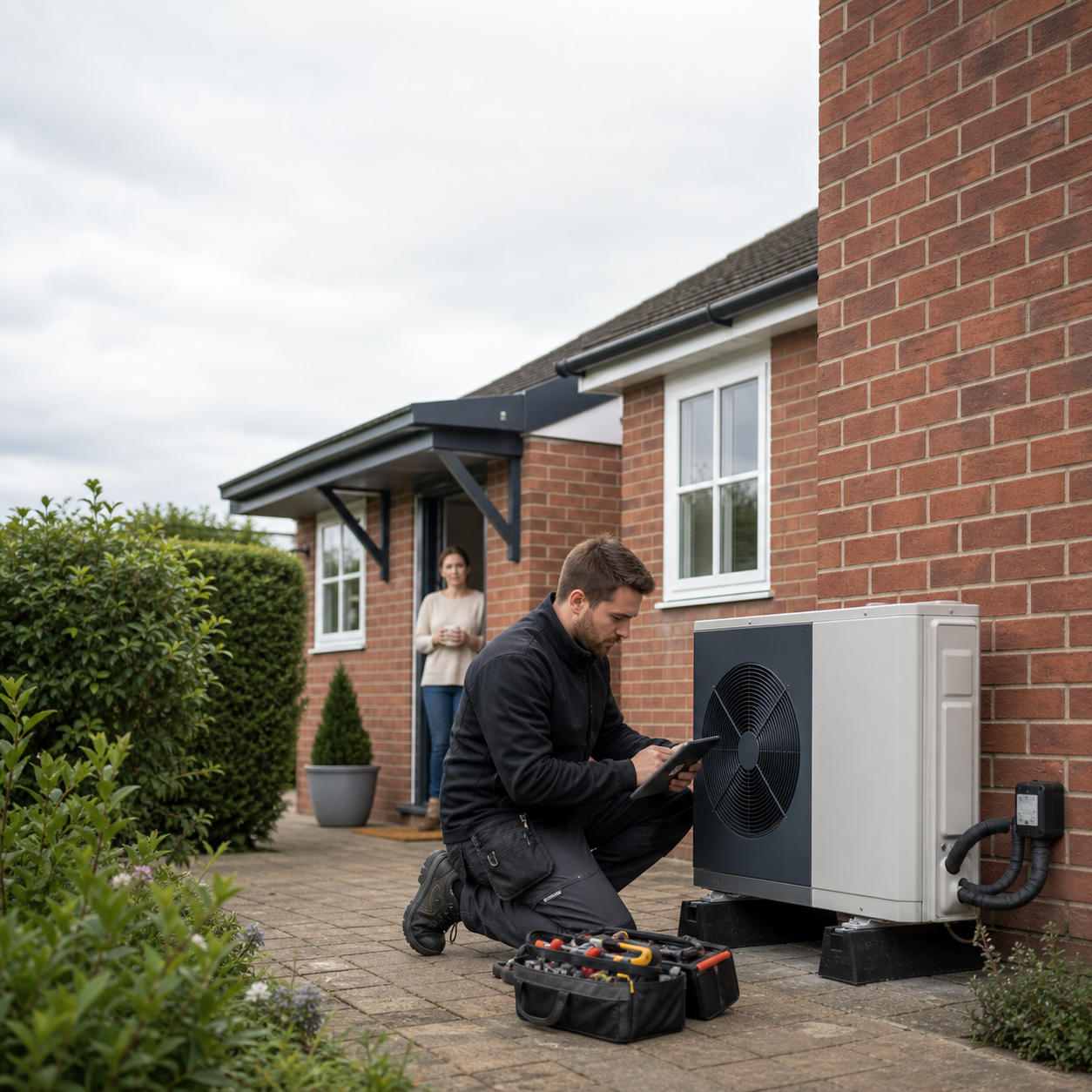
A practical guide to heat pump grant routes in 2026, covering the Boiler Upgrade Scheme, Warm Homes Local Grant and Warm Homes Plan. It explains who each route is for, what to check before accepting a quote, and why design quality matters as much as the grant value.
More UK homeowners are searching for heat pump grants in 2026 because the decision is no longer just about climate policy. It is about replacing an ageing boiler, controlling future bills, improving comfort, and understanding which grant route is actually available before work starts.
The short answer is that support is still available, but the right route depends on the property, the current heating system, the household circumstances and the installer. The Boiler Upgrade Scheme can give eligible homeowners in England and Wales up to £7,500 towards an air source heat pump or ground source heat pump. The Warm Homes Local Grant can fund wider improvements for eligible homes in England, including insulation, smart controls, air source heat pumps and solar panels where the local authority agrees the measures. The Warm Homes Plan is the wider government programme behind much of this direction.
This guide explains how the main schemes work in 2026, what to check before accepting a quote, and how to avoid choosing a heat pump on grant value alone.
Why heat pump grant searches are rising in 2026
Heat pumps have moved from a niche renewable heating option to a mainstream replacement route for many homes. The reason is simple. A modern heat pump can move several units of heat into a home for every unit of electricity it uses, while a gas or oil boiler can only convert the fuel it burns.
That does not mean every property should be rushed into a heat pump. A good installation is a design project, not a box swap. The home needs a proper survey. The installer needs to calculate room by room heat loss, check radiator output, review pipework, consider hot water demand, choose a suitable outdoor location and explain the controls.
Grants help with the upfront cost, but they do not remove the need for good design. A poorly specified system can be expensive to run, uncomfortable in cold weather and frustrating for the homeowner. A well designed system can feel steady, quiet and predictable.
The funding picture has also become more layered. Some households will look first at the Boiler Upgrade Scheme. Others may be better suited to the Warm Homes Local Grant because their home needs insulation or wider energy work before a heating upgrade makes sense. Homeowners need to understand the difference before they commit.
The Boiler Upgrade Scheme in 2026
The Boiler Upgrade Scheme, often shortened to BUS, is the main national grant route for many private homeowners in England and Wales who are replacing fossil fuel heating with eligible low carbon heating.
GOV.UK currently lists four grant values.
- £7,500 towards an air source heat pump.
- £7,500 towards a ground source heat pump.
- £5,000 towards a biomass boiler.
- £2,500 towards an air to air heat pump.
For most homes considering wet central heating with radiators or underfloor heating, the air source heat pump grant is the one people ask about most often. The grant is normally handled by the installer. The homeowner does not usually receive the grant as cash. Instead, an eligible installer applies for the voucher and the grant value is taken off the quoted price.
This matters because the quote should show the full project clearly. Homeowners should be able to see the total cost, the grant value, the customer contribution, what equipment is included, what radiator or cylinder changes are included, what electrical work is included and what happens if the voucher is not approved.
The scheme is not a blank cheque. GOV.UK says you cannot get a grant for a hybrid heat pump system, such as a gas boiler working with an air source heat pump. The system must also meet relevant standards, and the maximum capacity rules matter on larger or shared systems.
Who should look at BUS first
BUS is usually most relevant when a homeowner is ready to replace an eligible fossil fuel system and the property can support the chosen technology.
It may be a good route if the boiler is ageing, the home has reasonable insulation, there is space for an outdoor unit, the household is comfortable with a hot water cylinder where needed, and the installer can produce a clear design.
It is less useful if the home needs major fabric upgrades first. A heat pump can work in many older homes, but if the property loses heat quickly, the design may need larger radiators, better controls, draught work, loft insulation, cavity wall insulation, internal wall insulation or floor insulation. In those cases, wider grant support may be more useful than a heating grant by itself.
Homeowners should also remember that BUS only helps with the approved low carbon heating installation. It does not automatically pay for every possible improvement around the home. If the quote depends on other works, those works need to be listed clearly.
The Warm Homes Local Grant in 2026
The Warm Homes Local Grant is different. It is England only and is delivered through local authorities. GOV.UK says eligible households could get free energy saving improvements if they are on a low income, receive certain benefits or live in a qualifying postcode area.
The home must be privately owned, either by the homeowner or a landlord, and have an EPC rating of D, E, F or G. Household income must usually be £36,000 a year or less, although GOV.UK says some households earning more may still qualify through a postcode route or benefit route.
If the council has funding available and the home qualifies, the council arranges a survey. Measures can include wall, loft and underfloor insulation, air source heat pumps, smart controls and solar panels. GOV.UK says the council will usually contact applicants within 10 working days to get more information and arrange a home survey.
This makes the Local Grant especially important for homes that need more than a new heating appliance. A low carbon heating system works best when the building can hold heat well. Funding insulation and controls alongside heating can be a stronger route than fitting a heat pump into a poorly prepared home.
How the Warm Homes Plan fits in
The Warm Homes Plan is the wider policy framework. GOV.UK describes a £15 billion public investment across consumer support, including £5 billion for low income schemes, £2 billion for consumer loans and £2.7 billion for the Boiler Upgrade Scheme.
For homeowners, the practical point is that the direction is not only about one grant. It is about moving homes towards better insulation, cleaner heating, improved comfort and lower energy waste. The plan also confirms continuing support for heat pumps, solar panels, batteries and other home upgrades.
The Warm Homes Plan does not mean every household can claim every measure. Each scheme still has its own rules. It does mean homeowners should stop treating heating, insulation, ventilation, solar panels and controls as separate decisions. They work together.
That whole home view is especially useful before replacing a boiler. If the roof has poor insulation, the cavity walls are empty, the floor is draughty or the radiators are undersized, the heating design will be affected. Spending time on the fabric first can reduce the heat pump size required and improve comfort.
What an air source heat pump usually costs
Energy Saving Trust says the typical cost of installing an air source heat pump is around £11,000. The final price varies with the size of the heat pump, the size of the property, whether it is a new build or existing home, and whether radiator upgrades are needed.
This is why the £7,500 BUS grant can be significant, but not the whole story. A simple home may need fewer changes. A more complex home may need radiator replacements, pipework changes, a cylinder upgrade, electrical work, a base for the outdoor unit and careful commissioning.
The cheapest quote is not always the best value. A low price that excludes essential design work can become expensive later. A strong quote should explain what will happen in each room, how the hot water will be provided, how the controls will work and what performance assumptions are being made.
Running costs in 2026
Running costs depend on electricity price, gas or oil price, heat pump efficiency, controls, tariff and the heat demand of the home. Ofgem lists April to June 2026 typical direct debit unit rates of 24.7p per kWh for electricity and 5.7p per kWh for gas, with standing charges of 54.7p a day for electricity and 29.1p a day for gas.
Energy Saving Trust explains the key trade off clearly. Electricity costs around four times as much as gas, but heat pumps are much more efficient. A typical new gas boiler may run around 85 percent efficient, while heat pumps tend to run with a seasonal performance factor around 3.1, and better systems can exceed 4 when designed and controlled well.
This means a heat pump on a standard tariff may have similar running costs to gas in some homes and lower costs in others. Replacing electric heating, oil or LPG can produce stronger savings. Specialist heat pump tariffs can also change the calculation if the household can use cheaper periods well.
The honest answer is that running cost claims must be property specific. A quote should not promise savings without knowing the heat demand, flow temperature, tariff and current heating system.
Maintenance costs and servicing
Maintenance is often overlooked when people compare grants. Energy Saving Trust says a heat pump should usually be serviced according to manufacturer advice, normally once a year, similar to a gas or oil boiler. It says an air source heat pump service typically costs around £150.
A service can include an electrical safety check, thermostat checks, a visual inspection, leak and pressure checks, cleaning filters and coils, checking the compressor, fan and pump, lubricating moving parts and replacing small parts where manufacturer guidance requires it.
For ground source systems, the service should also include checks on the ground loop circuit, such as antifreeze concentration, flow and return temperatures and pressure.
Homeowners can also help day to day. The outdoor unit should be kept clear of obstructions such as bins, bikes and leaves so air can move freely. Good airflow helps efficiency and reduces unnecessary strain on the system.
Why MCS design matters
MCS standards matter because heat pump performance depends on design quality. MCS material says heat load calculations should be done in line with recognised standards and that room by room heat loss helps size heating systems and heat emitters correctly.
The MCS Heat Load Calculator documentation explains that low carbon heating systems need to meet the specific needs of the application with a slim margin of error. It also says a comprehensive property survey is strongly advised before finalising system design, suitability or a contract.
For homeowners, this translates into one simple rule. Do not accept a heat pump quote that has not properly assessed the property.
The installer should be able to explain:
- The calculated heat loss for the home.
- Which rooms need radiator changes.
- The proposed flow temperature.
- The expected seasonal performance.
- The outdoor unit location.
- The hot water cylinder plan.
- The controls and handover process.
- The warranty and aftercare route.
If those points are vague, the quote is not ready.
EPC ratings and grant eligibility
An EPC is not the same as a heat pump design survey, but it is still useful. It shows the property energy rating and gives recommendations that can point towards obvious improvements.
For the Warm Homes Local Grant, GOV.UK says the home must have an EPC rating of D, E, F or G. If the homeowner does not know the EPC, GOV.UK says it can be found out during the application.
For heat pump design, an EPC is only a starting point. A home might have an average EPC rating but still have room specific heat loss problems. Another home may have a poor EPC because of electric heating, but have decent insulation and be a good candidate for a heat pump design.
The safest route is to use the EPC to start the conversation, then ask for a proper home survey before any installation decision is made.
Questions to ask before applying for a heat pump grant
Before moving forward, homeowners should ask direct questions.
- Which grant route are you using?
- Am I eligible for the scheme or are you assuming eligibility?
- Is the grant shown clearly in the quote?
- What happens if the grant voucher is not approved?
- Are you MCS certified for this technology?
- Have you completed a room by room heat loss calculation?
- What radiator changes are included?
- What cylinder changes are included?
- What electrical work is included?
- What is the expected seasonal performance?
- What tariff assumptions are being used?
- What servicing is required each year?
These questions protect the homeowner from rushed decisions. They also help separate a proper design quote from a headline price.
Common mistakes to avoid
The first mistake is assuming the biggest grant is automatically the best route. BUS can be excellent for the right home, but a household that qualifies for the Warm Homes Local Grant may need a wider package of measures.
The second mistake is treating insulation as optional. Heat pumps can work in many homes, but reducing heat loss makes any heating system easier to run.
The third mistake is ignoring hot water. Many homes moving from a combi boiler will need a cylinder or another hot water solution. Space, sizing and usage patterns need to be checked early.
The fourth mistake is comparing running costs using only the unit price of electricity. Heat pump efficiency, flow temperature and tariff matter just as much.
The fifth mistake is waiting until a boiler fails. Emergency heating decisions rarely produce the best retrofit plan. If the boiler is old, it is better to review grant options before winter pressure arrives.
Final thoughts
Heat pump grants in 2026 can make a major upgrade more affordable, but they work best when homeowners treat the grant as one part of a whole home decision.
The Boiler Upgrade Scheme can provide up to £7,500 towards an eligible air source or ground source heat pump. The Warm Homes Local Grant can support eligible English homes with wider energy saving improvements. The Warm Homes Plan shows that government policy is still pushing towards warmer, cleaner and more efficient homes.
The best next step is not to chase the largest number first. It is to understand the property, check the grant route, review the EPC, ask for a proper heat loss calculation and choose an installer who can explain the design clearly.
Done well, a heat pump can be a practical long term upgrade. Done badly, the grant will not fix a weak design. The difference is careful assessment before the contract is signed.