A practical 2026 guide to flat roof insulation, covering Warm Homes Local Grant eligibility, building regulation checks, ventilation risks, survey questions and when professional advice is essential.
Why flat roof insulation matters in 2026
Flat roof insulation is one of the less glamorous home upgrades, but it can make a real difference to comfort, heat loss and future retrofit plans. Many UK homes have flat roof extensions, porches, dormers, garages converted into living space, or older single storey additions that lose heat faster than the main house.
Energy Saving Trust says homes can lose around 25% of their heat through an uninsulated roof. That figure covers roof heat loss generally, but it explains why a cold flat roof can make a room feel uncomfortable even when the heating is on.
Flat roofs need more care than a simple loft top up. Energy Saving Trust specifically says people should speak to a professional installer if they have a flat roof. The reason is simple. Insulation changes how heat, air and moisture move through the roof build up. If the design is wrong, the result can be condensation, damp, mould or damage hidden inside the roof.
The right approach is a proper survey first, then a roof build up that deals with insulation, waterproofing, ventilation, roof lights, drainage, upstands and any structural limits together.
The short answer
Flat roof insulation can be worth considering where a flat roof covers a heated room and the space feels cold, expensive to heat, or difficult to keep comfortable. It may also be relevant when a flat roof is being repaired, replaced or upgraded as part of wider retrofit work.
In 2026, flat roof insulation appears in DESNZ Warm Homes Local Grant policy guidance as an energy performance measure. That does not mean every flat roof will automatically be funded. The home and household still need to meet the scheme rules, local funding must be available, and the council survey must agree the right package of measures.
For privately arranged work, the key questions are technical. Is the roof dry and sound. Is the insulation layer continuous. Has condensation risk been considered. Does the roof still drain properly. Are roof lights, parapets and edges dealt with properly. Does the proposed work meet the right building regulation standard.
Why flat roofs are different from lofts
A standard cold loft often has insulation laid across the loft floor. That can be straightforward where the loft is accessible, dry, well ventilated and not used as a living space.
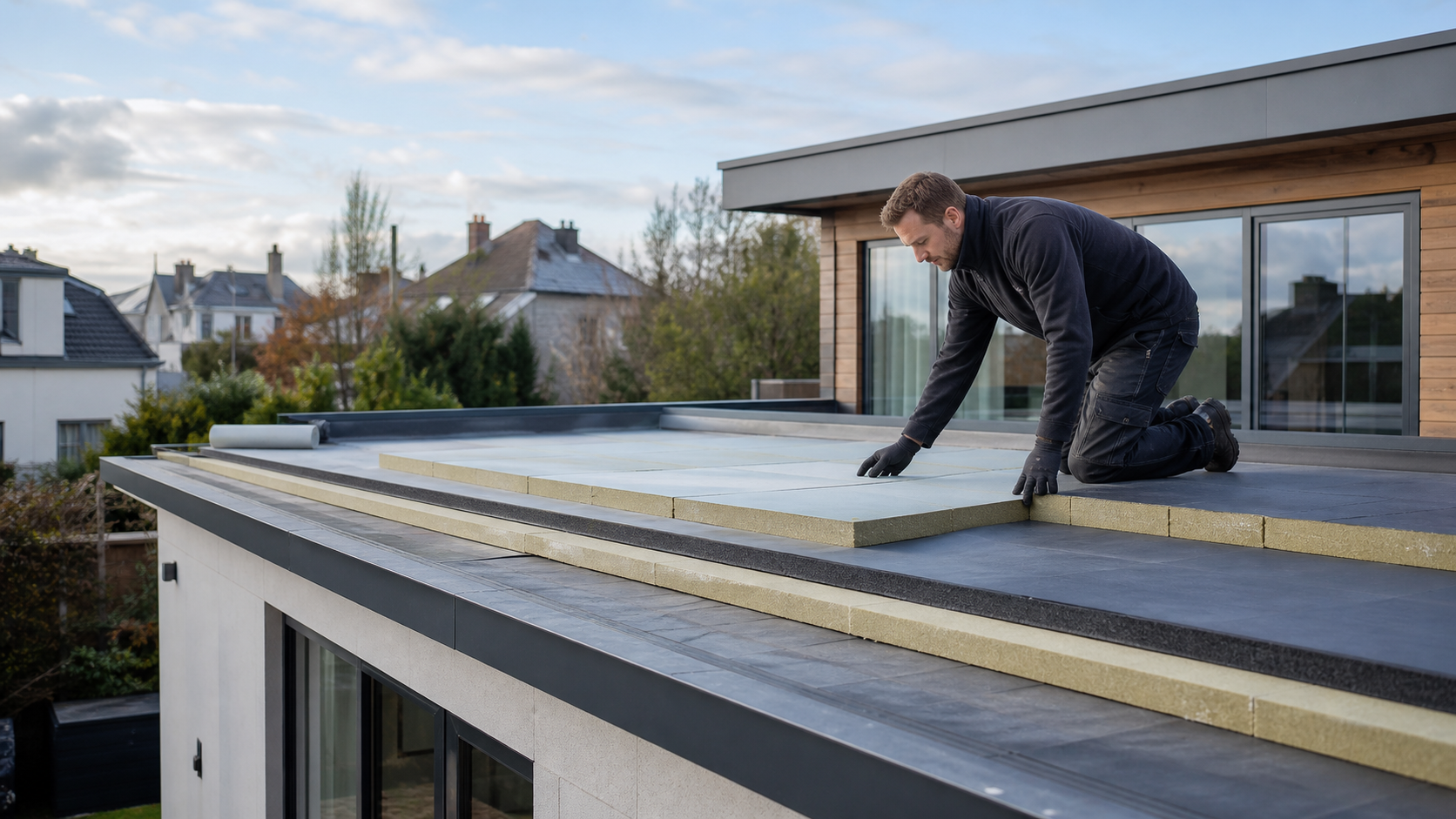
A flat roof is different because there may be no easy loft void above the room. The roof covering, deck, insulation, vapour control, structure and ceiling all work together. The insulation may be fitted above the deck, below the deck, or as part of a more complete roof replacement. The correct method depends on the existing construction and condition.
Energy Saving Trust says flat roofs usually need professional advice. It also warns that insulation can make loft spaces cooler and condensation more likely if moisture is not managed. The same principle matters for flat roofs. You cannot just add insulation and hope the roof will behave as before.
This is why a flat roof survey should look for leaks, trapped moisture, sagging, ponding water, blocked outlets, poor ventilation, unsafe electrical penetrations, old roof lights and signs of previous patch repairs.
Warm deck and cold deck in plain English
You may hear installers talk about a warm deck roof or a cold deck roof.
A warm deck roof usually places the main insulation above the structural roof deck and below the waterproof covering. In many retrofit situations this is preferred because it helps keep the deck warmer and reduces condensation risk when detailed correctly.
A cold deck roof usually has insulation below the roof deck, with ventilation needed above the insulation. It can be more difficult to get right on some existing flat roofs because airflow can be hard to prove and gaps can create cold spots.
The homeowner does not need to become a roofing designer. The useful question is whether the installer has explained the proposed build up and why it suits the existing roof. A vague answer is a warning sign.
What building rules say
Approved Document L 2026 gives limiting standards for energy performance in dwellings. For new fabric elements in existing dwellings, the limiting roof U value is 0.15 W per square metre K. For existing roof elements being renovated, the threshold roof U value is 0.35 W per square metre K and the improved roof U value is 0.16 W per square metre K.
Those numbers do not mean every old flat roof can always reach the same result in the same way. Approved Document L also recognises that for a flat roof or roof with integral insulation, a higher U value may be appropriate where there are problems with load bearing capacity of the frame or height of the upstand.
That caveat matters in real homes. Adding insulation above a flat roof can raise finished roof height. That can affect door thresholds, roof light kerbs, parapet heights, drainage outlets, wall abutments and the height where the roof meets the main house.
The practical point is that compliance is a design question. Ask what U value is being targeted, what constraints were found, and whether building control or competent person sign off is needed.
Condensation and damp risk
Flat roof insulation is not just about thickness. Moisture control is just as important.
Energy Saving Trust says insulation changes how air and moisture move through a space. Without enough airflow, warm air can become trapped and lead to condensation, damp, mould or rot in roof timber.
Energy Saving Trust also warns that the roof should be dry and in good condition before adding insulation. It does not recommend spraying foam insulation onto the underside of a roof to fix a damaged or leaking roof without fixing the problem first.
For a flat roof, that means the survey should establish whether the roof covering is watertight before insulation is added. If the roof has been leaking, the deck and joists may need inspection. Covering a damp problem can make the future repair more expensive.
When flat roof insulation can be a good project
Flat roof insulation is most likely to make sense when the flat roof sits above a heated room. Typical examples include a kitchen extension, rear extension, bedroom over a garage, dormer, converted garage, utility room, home office or older single storey addition.
It is also a good moment to consider insulation when the roof covering is already being replaced. If scaffolding, waterproofing and edge detailing are already part of the job, it may be more practical to add insulation at the same time than to reopen the roof later.
The upgrade can also support future heating changes. A better insulated room needs less heat. That can make smart controls easier to manage and can help when planning an air source heat pump, because heat pump design depends on the heat loss of each room.
Where the flat roof is over an unheated garage or store, the case may be different. The survey should confirm what is heated, what is outside the thermal boundary, and where insulation will actually help.
When to be cautious
Be cautious if the roof is actively leaking, has standing water, has poor falls, has rotten decking, has a weak structure, has awkward roof lights, has low upstands, has damp patches on the ceiling, or has previous spray foam added without clear records.
Approved Document L notes that a higher U value may be appropriate for a flat roof where load bearing capacity or upstand height creates problems. That does not mean the job should be ignored. It means the constraints must be identified and recorded.
You should also be cautious where a quote promises a quick insulation fix without mentioning condensation, waterproofing, roof condition or ventilation. Flat roof insulation is not just a product. It is a roof design.
If the room below already has mould or damp, get the cause diagnosed before signing off insulation. The problem could be roof leakage, surface condensation, poor ventilation, thermal bridging, plumbing, or more than one issue at once.
Warm Homes Local Grant in 2026
Warm Homes Local Grant is one of the main funding routes to understand in 2026. GOV.UK says the grant is only available in England. It is aimed at households on a low income, households receiving certain benefits, or households in certain postcode areas.
GOV.UK says the home must be privately owned and have an EPC of D, E, F or G. Household income must usually be £36,000 a year or less, although postcode and benefit routes may still apply.
GOV.UK says that if a household is eligible and the local council has funding available, the council will arrange a home survey and may suggest improvements such as wall, loft and underfloor insulation, air source heat pumps, smart controls and solar panels.
The DESNZ policy guidance goes further for delivery teams and lists flat roof insulation as an energy performance measure under the Warm Homes Local Grant. That is the important point for homeowners with flat roof rooms. It can be in scope, but it still depends on survey, property eligibility and local delivery.
What the grant will not do
Warm Homes Local Grant is not a shopping list where the homeowner simply chooses one measure. The council or its delivery partner will survey the property and agree what work is suitable.
The grant will also not pay twice for the same individual measure. DESNZ guidance says the same individual measure cannot be funded twice.
If there is a landlord, GOV.UK says the landlord may need to pay for some improvements. That is especially relevant for private rented homes, where consent, contribution and access need to be sorted before work starts.
The best way to treat the grant route is to apply or check eligibility, then let the survey decide whether flat roof insulation is suitable and fundable in that home.
Energy prices and why heat loss still matters
Ofgem says the energy price cap from 1 July to 30 September 2026 is £1,862 a year for a typical dual fuel household paying by Direct Debit. Ofgem also says average Direct Debit rates for that period are 26.11 pence per kWh for electricity and 7.33 pence per kWh for gas, with standing charges of 57.19 pence per day for electricity and 29.04 pence per day for gas.
Those figures are not a personal bill forecast. Actual bills depend on use, region, tariff and payment method. They do show why reducing heat loss remains relevant.
If a flat roof room loses heat quickly, the heating system has to work harder to keep it comfortable. That can mean higher use, colder corners, longer heat up times, or one room that drives the thermostat setting for the whole home.
The value of insulation is not only the bill saving. It is also comfort, reduced draughty feeling, better use of the room and a more sensible base for future heating upgrades.
How flat roof insulation links with heat pumps
Flat roof insulation is not a heat pump grant by itself, but it can affect heat pump readiness.
Heat pump design starts with heat loss. A poorly insulated extension may need a larger radiator, higher flow temperature or more careful control. Improving the roof can reduce the heat demand for that room.
The Boiler Upgrade Scheme is a separate route. GOV.UK says current grants are £7,500 towards an air source heat pump, £7,500 towards a ground source heat pump, £5,000 towards a biomass boiler and £2,500 towards an air to air heat pump. GOV.UK also says there is one grant per property and that hybrid heat pump systems are not eligible.
If a home is planning both insulation and a heat pump, the sequence matters. Insulation should be factored into the heat loss calculation, radiator sizing and control plan.
Survey questions before you accept a quote
- Is the flat roof over a heated room
- Is the existing roof dry and structurally sound
- Are there signs of leaks, rot, ponding water or poor drainage
- What roof build up is being proposed
- Is this a warm deck or cold deck design
- How will condensation risk be controlled
- What U value is being targeted
- Are roof lights, outlets, edges and upstands included
- Will the finished roof height change
- Is building control or competent person sign off required
- What warranty covers the roof covering and insulation work
- Will any internal ceilings, electrics or ventilation need work
These questions help separate a proper retrofit specification from a thin quote.
Documents to ask for
Ask for the specification before work starts. It should describe the roof build up, insulation type, thickness, waterproof covering, vapour control approach, U value target, drainage details and affected roof lights or abutments.
Ask for product details and warranty information. If the job is grant funded, ask what documents will be lodged and what quality standard applies.
Ask for photos during the work if layers will be covered before you can inspect them. This is useful later if you sell the property, apply for further retrofit funding, or need to prove what was installed.
After completion, keep the quote, invoice, product sheets, warranties, building control documents, guarantee documents and any grant paperwork in one place.
Common mistakes
The first mistake is treating flat roof insulation like a simple loft roll job. It is not. Flat roof work needs professional judgement.
The second mistake is insulating before fixing moisture. If the roof leaks, insulation will not solve the underlying problem.
The third mistake is ignoring roof height. Adding insulation above the roof deck can affect doors, thresholds, roof lights, parapets and drainage.
The fourth mistake is not asking how the room will be ventilated. Insulation can improve warmth, but indoor air quality still needs attention.
The fifth mistake is planning heating before fabric work. If the flat roof room is part of a future heat pump design, the insulation decision should be included in the heat loss survey.
How to prioritise flat roof insulation
Start with the room that causes the problem. Is it cold in winter, hot in summer, expensive to heat, damp, or uncomfortable compared with the rest of the home.
Then check whether the roof covering is due for repair. If the roof is near the end of its life, combining insulation with replacement may be more sensible than paying twice for access and disruption.
Next, check funding. Warm Homes Local Grant may be relevant for eligible homes in England, especially if the property has EPC D to G and the household meets the income, postcode or benefit route.
Finally, think about sequencing. A flat roof upgrade can sit alongside draught proofing, ventilation, wall insulation, smart controls or heat pump planning. The best package depends on the whole home.
Bottom line
Flat roof insulation can be a strong upgrade in 2026, especially for cold extensions, dormers and rooms under older flat roofs. It can reduce heat loss, improve comfort and support wider retrofit plans.
It is also a job where detail matters. The roof must be dry, structurally suitable, properly detailed and designed with moisture control in mind. Energy Saving Trust is clear that flat roofs usually need professional advice.
If you are eligible for Warm Homes Local Grant, flat roof insulation can be considered as part of a funded package because DESNZ guidance lists it as an energy performance measure. If you are paying privately, use the same discipline. Get the survey, ask the technical questions, and make sure the roof is improved as a whole system rather than patched in pieces.