A practical 2026 guide to underfloor insulation costs, savings, building rules, ventilation risks and funding routes. It explains when suspended timber floor insulation is worth doing, how it supports heat pump design, and how the Warm Homes Local Grant, Warm Homes Plan and Boiler Upgrade Scheme fit together.
Floor insulation under suspended timber floors is one of the least glamorous home energy upgrades, but in the right property it can make a cold room feel completely different. If you live in a Victorian terrace, an Edwardian semi, a draughty cottage, or any home with suspended timber floors, the floor can be a steady route for heat loss and cold air movement.
The Energy Saving Trust says floor insulation can save about £70 a year in a typical home in Great Britain, and up to £120 a year in a detached house. Those savings are smaller than many wall or roof insulation figures, but the comfort gain can be much more noticeable than the number suggests. Cold floors make people turn the thermostat up, close rooms off, or run electric heaters. A warmer floor can help the whole heating system feel calmer.
In 2026, floor insulation is also worth looking at because the Warm Homes Plan and Warm Homes Local Grant are putting more attention on fabric upgrades before expensive heating changes. Heat pumps, solar panels and smart controls get the headlines, but floor insulation can be the measure that makes a home feel ready for low temperature heating.
This guide explains what floor insulation costs in 2026, which homes benefit most, how it affects heat pump design, and when government funding may help.
What floor insulation actually means
Floor insulation means adding insulation to the construction of the ground floor so less heat escapes downwards and fewer draughts come up through gaps. The right method depends on the floor type.
Most homes only need the ground floor assessed. Upper floors usually sit above heated rooms, so they do not normally need thermal floor insulation. The exception is a floor above a garage, cellar, basement, passageway or other unheated space.
There are three common floor types.
- Suspended timber floors, found in many homes built between the 1850s and the 1950s.
- Solid concrete floors, common in many homes built from the 1950s onwards.
- Stone, tile or lime based floors, often found in older and heritage properties.
Suspended timber floors are the main focus for most retrofit projects. They usually have timber joists with a ventilated void underneath. You may spot air bricks on outside walls below floor level. Those air bricks are not a defect. They ventilate the void and help protect the timber from damp and rot.
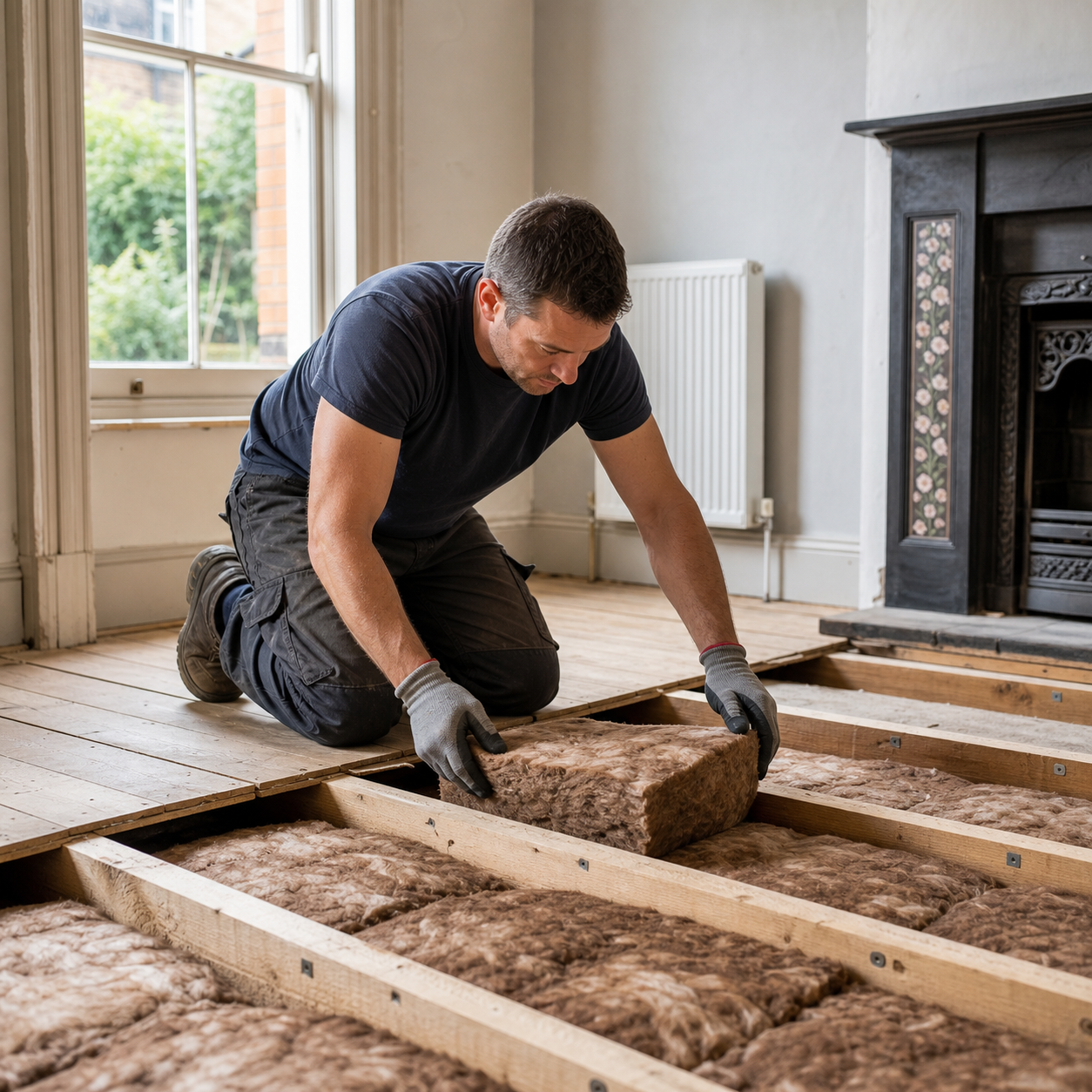
The basic principle is simple. Insulation is fitted between the joists, usually from below if there is safe access, or from above if floorboards must be lifted. Mineral wool, wood fibre, sheep wool and rigid foam boards can all be used, depending on the floor, moisture strategy, budget and installer design.
Why floor insulation matters in older homes
Older homes were often built to breathe. Suspended timber floors let air move below the floor structure. That ventilation is essential for moisture control, but it can also make rooms feel cold when gaps in floorboards, skirting edges and service penetrations allow draughts into the living space.
The Energy Saving Trust highlights four main benefits: lower heat loss, fewer draughts, lower carbon emissions and improved warmth. It also says suspended timber floors are typical in Victorian and Edwardian properties, which is why many period homeowners notice the issue.
Floor insulation is rarely the first measure in a full retrofit plan. Loft insulation and wall insulation usually save more. But floor insulation can become important when:
- The ground floor feels cold even when the heating is on.
- There are draughts around skirting boards or floorboards.
- The home has bare boards, old carpets or uninsulated suspended timber floors.
- The property is being renovated and floors are already being lifted.
- A heat pump is planned and the designer is trying to reduce heat loss.
- The home has tenants who complain about cold rooms at low level.
It is also one of those measures where timing matters. If you are already replacing flooring, rewiring, moving pipework or renovating a kitchen, the disruption cost can be much lower than doing the job as a standalone project later.
How much floor insulation costs in 2026
Energy Saving Trust gives a typical suspended floor installation cost of about £1,400 to £2,500, depending on house type. Solid floor insulation can cost considerably more because it may involve raising floor levels, replacing finishes, trimming doors and moving services.
Suspended timber floors
For suspended timber floors, the final quote depends on access.
If there is a safe cellar or crawl space, the installer may work from underneath. This can reduce disruption because floor coverings and boards may stay in place. If there is no access from below, floorboards need to be lifted, numbered, insulated beneath, then refitted. That takes more time and can add joinery, decoration and flooring costs.
Typical cost drivers include:
- Floor area.
- Access from below or above.
- Condition of timber joists.
- Presence of damp, rot or woodworm.
- Chosen insulation material.
- Need for draught sealing at edges.
- Need to protect ventilation below the floor.
- Whether finished flooring must be replaced.
- Whether electrical or plumbing work is needed.
For a simple suspended timber floor, £1,400 to £2,500 is a sensible starting point. A single room may be less. A large ground floor with delicate boards, fitted furniture or moisture problems may be more. A solid floor retrofit can rise further because the project becomes part insulation, part flooring and part building work.
Solid floors
Solid floors need a different cost conversation because insulation often changes floor height. That can mean doors, skirting, thresholds, sockets and finished surfaces all need attention as part of the same project.
How much you can save
The current Energy Saving Trust figure is about £70 a year for an average house in Great Britain, with a detached house saving up to £120 a year. It also gives a carbon saving of about 190kg a year in Great Britain for the average home.
That means floor insulation is not usually sold on bill saving alone. A homeowner spending £2,000 and saving £70 a year is looking at a long simple payback. The reason many people still do it is comfort.
Cold floors change how a room feels. You can have an air temperature that looks fine on a thermostat while your feet, ankles and lower legs still feel cold. The result is that people raise the thermostat, use extra heaters or avoid the room. Insulation and draught sealing can reduce that low level chill.
The financial case becomes stronger when the work is funded, when it is part of another renovation, or when it helps a heat pump run at lower flow temperatures. It can also support an EPC improvement, although the exact EPC impact depends on the whole property, floor area, existing assumptions and assessor evidence.
The building regulation requirement
Energy Saving Trust says that if you replace a significant portion of a floor, you are legally required to insulate it to meet current building regulations. It also gives a target U value of 0.25 W/m2K or lower for floors in England, Wales and Northern Ireland, with a stricter 0.18 W/m2K requirement in Scotland.
It says that if you are replacing 50% or more of a floor, you must insulate to these standards. Typical routes include about 70mm of high performance rigid foam insulation or around 150mm of mineral wool, depending on the floor type, shape and construction.
This is why floor insulation should not be treated as a quick cosmetic job. If you are lifting large areas of floor, speak to Building Control or use an installer who understands Part L requirements, moisture management and ventilation.
Moisture and ventilation are the risk points
The biggest mistake with suspended timber floors is blocking the airflow that keeps the timber dry. Air bricks should not be filled, blocked by insulation, covered by external ground levels, or hidden behind new finishes without a ventilation plan.
Energy Saving Trust warns that adding insulation changes how air and moisture move beneath the floor. It says good ventilation below the floor must be maintained, and that damp or rotten joists should be dealt with before insulation is installed.
This matters because a warmer floor above can mean colder timber zones below if the design is wrong. Moisture can then build up in places that used to dry more easily.
A good survey should check:
- Air bricks and cross ventilation.
- Joist condition.
- Sub floor moisture.
- Gaps around pipes and services.
- Existing damp issues.
- External ground levels.
- Whether a breathable membrane is needed.
- Whether the insulation can be fitted without gaps or compression.
Heritage properties need extra caution. Stone floors, lime based floors and old timber structures may need breathable materials and specialist advice. The aim is not to seal an old home like a new build. The aim is to reduce heat loss while keeping the building healthy.
Can you install floor insulation yourself
Some capable homeowners insulate suspended timber floors themselves, especially where there is good access from below. Energy Saving Trust says DIY may be possible for a typical suspended timber floor, but only if you are confident and understand the risks.
The job is more than pushing insulation into a gap. The insulation must be supported properly, fitted tightly, kept dry, and installed without blocking sub floor ventilation. Gaps can dramatically reduce performance. Poor moisture detailing can create a future repair bill.
DIY may be realistic if:
- There is safe access from a cellar or crawl space.
- Joists are dry and sound.
- The floor area is simple.
- You can maintain ventilation.
- You understand vapour control and breathable membranes.
- You can document the work with photos for future EPC evidence.
Use a professional if the floorboards need lifting, the home is old or listed, there is any sign of damp, the void is shallow, services are in the way, or the project is funded. Grant funded work usually needs approved installers and a proper compliance route.
Floor insulation and heat pumps
Floor insulation can be helpful before an air source heat pump because heat pumps work best when the building loses heat slowly. A heat pump designer calculates the heat loss room by room, then sizes the heat pump and heat emitters around that result.
MCS heat pump design guidance requires a heat load calculation and sets out how suspended floors should be treated in that calculation. For suspended floors, the temperature difference is based on the internal design room temperature minus the design external air temperature. In plain English, an uninsulated suspended floor can count as a real heat loss route on a cold design day.
Insulating the floor can reduce the heat demand of ground floor rooms. That may help radiators, underfloor heating or other emitters work at lower flow temperatures. Lower flow temperatures can improve heat pump efficiency, although the result depends on the whole system.
This does not mean you must insulate every floor before a heat pump. It means the floor should be assessed honestly. If a room is already hard to heat, has draughty boards and has a suspended floor, ignoring it can make the heat pump design harder.
The Boiler Upgrade Scheme does not pay for floor insulation as a standalone measure. It supports eligible low carbon heating systems, including £7,500 towards air source heat pumps and ground source heat pumps, £2,500 towards air to air heat pumps and £5,000 towards biomass boilers. Fabric improvements may still be recommended before or alongside a heat pump, but they are not the BUS grant itself.
Funding in 2026
The main funding route to check for floor insulation is the Warm Homes Local Grant. The public gov.uk page says eligible homes must have an EPC of D, E, F or G, and the scheme is aimed at low income households, certain benefits or eligible postcode areas. The DESNZ transparency record says baseline conditions include England, privately owned homes, low income households and EPC D to G.
Warm Homes Local Grant
The Warm Homes Local Grant can support energy performance and low carbon heating upgrades. The exact package is delivered through local authorities, so the measure mix can vary by area and by property. Floor insulation may be considered where the assessment shows it is suitable and helps the home towards the target outcome.
Boiler Upgrade Scheme
The Boiler Upgrade Scheme is mainly relevant if floor insulation is being considered before a heat pump. It does not fund floor insulation directly, but it can fund eligible heat pump systems where the property and installation meet the rules.
Warm Homes Plan
The wider Warm Homes Plan is the national policy backdrop. Gov.uk says the plan includes major investment in home upgrades, with support for low income households and routes including grants, loans and the expanded Boiler Upgrade Scheme.
For homeowners and landlords, the practical route is simple:
- Check the EPC rating.
- Check local authority Warm Homes Local Grant availability.
- Keep income and benefit evidence ready if applying.
- Ask whether floor insulation is included after survey.
- For rented homes, get landlord and tenant permissions in writing.
- Make sure the installer route is compliant and documented.
If the property is not eligible for grant funding, floor insulation may still be worth doing during renovation, before a heat pump design, or where cold floors are a major comfort issue.
Landlords and rented homes
Landlords should treat floor insulation as part of a wider EPC and comfort plan, not just a bill saving measure. The Warm Homes Local Grant can include privately rented homes where the household and property qualify, but landlord permissions and scheme rules apply.
For rented homes, the most important question is whether the measure helps move a cold home towards a better EPC and a more stable heating demand. Cold floors can be a common tenant complaint in older homes. They can also make a property feel underheated even when the boiler or heat pump is working.
Before agreeing work, landlords should ask for:
- A clear survey report.
- Photos of the floor void and joists.
- Confirmation of ventilation strategy.
- Confirmation of insulation type and depth.
- Evidence that air bricks remain open.
- Completion photos before floors are closed.
- Any guarantee or warranty paperwork.
- EPC evidence for the assessor.
The best installations are invisible afterwards, which is exactly why evidence matters. Once carpets and boards are back down, a future assessor or buyer may need proof that the work was done correctly.
When floor insulation is not the first priority
Floor insulation is useful, but it is not always the best first spend. If the loft has little insulation, if cavity walls are empty, if solid walls are the main heat loss route, or if the heating controls are poor, other measures may deliver bigger savings.
It may also be better to delay floor insulation if:
- There is unresolved damp.
- Joists show rot or structural damage.
- Air bricks are missing or blocked.
- Flooring will be replaced soon anyway.
- A full retrofit assessment is already planned.
- The home needs wall or roof work first.
PAS 2035 matters here because it promotes a whole house approach. BSI describes PAS 2035 as best practice for end to end energy retrofit, and it is mandatory for some government funded projects. That approach helps avoid isolated measures that create moisture, ventilation or sequencing problems.
A sensible 2026 decision process
If you are deciding whether to insulate your floor this year, use this order.
- Identify the floor type.
- Check whether it is ground floor or above an unheated space.
- Look for air bricks, draughts and cold spots.
- Check for damp, rot and blocked ventilation.
- Compare the measure against loft and wall insulation.
- Check Warm Homes Local Grant eligibility if income, benefits or postcode may qualify.
- If planning a heat pump, ask the designer how floor heat loss affects the calculation.
- Get a quote that explains material, depth, ventilation and access method.
- Keep photos and certificates after completion.
For many older homes, the answer is not whether floor insulation is good or bad. It is whether the timing, access and building condition make it sensible now.
Bottom line
Floor insulation in 2026 is a comfort led upgrade with a real but modest bill saving. Energy Saving Trust puts the typical saving at about £70 a year for an average home in Great Britain, with up to £120 a year for a detached house. Typical suspended floor installation costs sit around £1,400 to £2,500, although complex floors can cost more.
It is most worth considering in older homes with suspended timber floors, draughty boards, cold ground floor rooms, or planned heat pump upgrades. It is also worth checking under the Warm Homes Local Grant where the home has an EPC of D to G and the household meets the income, benefit or postcode route.
The golden rule is simple. Do not block ventilation, do not hide damp, and do not treat the floor in isolation. Done properly, floor insulation can make an older home feel warmer, support a better retrofit plan, and reduce the heating demand that every grant funded or privately funded upgrade has to work around.