A complete guide to solar panels in 2026, covering installation costs, realistic savings figures, the Smart Export Guarantee, pairing with heat pumps and batteries, and funded routes through the Warm Homes Plan.
Solar panels have become mainstream in the UK. Over a million homes now have them installed, and the economics have never been more compelling. Installation costs have fallen by more than 70 per cent over the past decade, the Smart Export Guarantee ensures you are paid for surplus electricity you send to the grid, and pairing solar with a battery or a heat pump can dramatically increase how much of your own generation you actually use.
In 2026, solar panels make financial sense for a growing proportion of UK homes. This guide gives you an honest, complete picture: what it costs, what you will actually save, how the grid export scheme works, what funding is available, and how to approach the decision sensibly.
How Solar Panels Work in the UK
Solar photovoltaic (PV) panels convert sunlight into direct current (DC) electricity. An inverter fitted in your home converts this into alternating current (AC) electricity that your appliances can use. Any electricity generated that you do not use immediately either flows back to the grid, or if you have a battery, is stored for later use.
The amount of electricity a solar panel system generates depends on several factors: the size of the system, the orientation and pitch of your roof, whether any parts of the roof are shaded, and the amount of sunlight your location receives. The UK is not the sunniest country in the world, but solar panels work on diffuse daylight, not just direct sun. Even on overcast days, panels generate electricity.
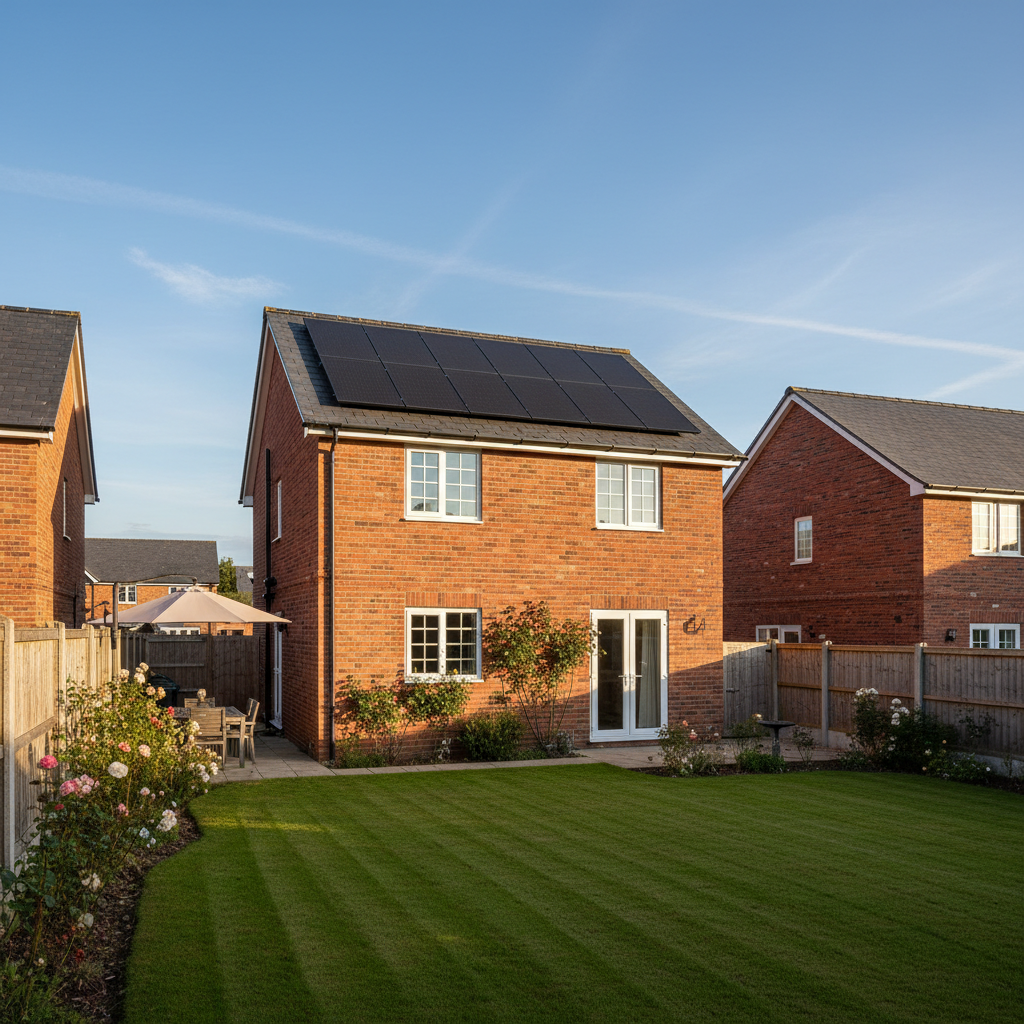
A south-facing roof at around 30 to 40 degrees pitch is ideal. East or west-facing roofs generate around 15 to 20 per cent less electricity than south-facing. North-facing roofs are not suitable for solar panels in the UK.
The typical system size for a three to four bedroom home is 4 kilowatts peak (kWp), consisting of 10 to 12 panels. This would generate approximately 3,400 to 3,800 kWh of electricity per year in most parts of the UK, which represents a significant proportion of the average household's annual electricity consumption of around 3,500 kWh.
Cost Breakdown: What to Expect in 2026
Solar panel costs have fallen substantially over the past decade and have largely stabilised in recent years. In 2026, a standard 4kWp system costs approximately £6,000 to £8,000 fully installed, including panels, inverter, mounting hardware, and installation labour.
Adding a home battery changes the economics significantly. A battery allows you to store electricity generated during the day and use it in the evening, which is when most households actually need power. A 5 to 10 kWh battery storage system typically adds £3,000 to £4,500 to the installation cost.
A complete solar and battery system for a typical family home therefore costs between £9,000 and £12,500. This is before any grants or funding are applied.
Larger systems, for bigger homes or homes with higher electricity consumption (particularly if you have a heat pump or an electric vehicle), may cost proportionally more. A 6kWp system might cost £8,000 to £10,000, and a 10kWp system could cost £12,000 to £16,000.
Solar panels are zero-rated for VAT in the UK. There are no hidden charges on the purchase itself, though you should budget for scaffolding hire if your installer does not include this, and for any necessary electrical upgrades such as a new consumer unit.
How Much Will You Save?
Savings from solar panels come from two sources: reduced electricity bills because you are using your own generation rather than buying from the grid, and income from the Smart Export Guarantee for surplus electricity you export.
For a 4kWp system with no battery, a typical household might self-consume around 40 to 50 per cent of the electricity generated (depending on how much time people are at home during the day). The remaining 50 to 60 per cent is exported to the grid.
At an electricity price of 24p per kWh, self-consuming 1,500 to 1,900 kWh per year saves approximately £360 to £456 per year on electricity bills.
Including Smart Export Guarantee income (see below), total annual financial benefit is typically in the range of £500 to £700 per year for a standard 4kWp system without battery storage.
With battery storage, self-consumption typically rises to 70 to 80 per cent of generation, significantly increasing the saving on electricity bills. Total annual benefit rises to approximately £700 to £950 for a system with a 5 to 10 kWh battery.
The Smart Export Guarantee Explained
The Smart Export Guarantee (SEG) was introduced in 2020 to replace the old Feed-In Tariff. It requires licensed energy suppliers with more than 150,000 customers to offer a tariff that pays you for every unit of surplus electricity you export to the grid.
Unlike the old Feed-In Tariff, the SEG rate is set by the supplier, not the government. Rates vary between suppliers and change over time. In early 2026, competitive SEG rates range from around 3p to 15p per kWh. Some suppliers, including Octopus Energy, offer dynamic SEG tariffs that pay you the market rate for electricity in real time, which can be significantly higher at peak demand periods.
To benefit from the SEG, you need an export meter (usually a smart meter) and to register with an eligible supplier. Your installer will typically help you with this process.
To qualify for the SEG, your installation must be certified under the Microgeneration Certification Scheme (MCS). Always use an MCS-registered installer. Without MCS certification, you cannot access the SEG and your installation will not be eligible for funding schemes either.
The Impact on Your EPC Rating
Installing solar panels typically improves your EPC rating by one to two bands. The current SAP methodology rewards solar generation by reducing the estimated energy cost per square metre of your property. A home that is EPC band D with no solar panels may well achieve EPC band C or even B after a solar installation.
This matters for access to green mortgage products, for rental property compliance with future minimum energy efficiency standards, and for property value. Some research suggests that solar panels add between 4 and 14 per cent to property values, though this varies by location and property type.
The government is transitioning to the new Home Energy Model (HEM) in the second half of 2027. HEM will replace SAP as the basis for EPC calculations. Solar generation is expected to remain a high-value measure under HEM, and the new model may better reflect the interaction between solar panels, battery storage, and low carbon heating systems.
Solar Panels and Heat Pumps: A Powerful Combination
Pairing solar panels with a heat pump is one of the most effective ways to reduce home energy costs. Heat pumps run on electricity, and they tend to run for extended periods during the day in colder months. By generating your own electricity, you are directly offsetting some of the electricity your heat pump consumes.
The Boiler Upgrade Scheme (BUS) currently offers a £7,500 grant for the installation of an air source heat pump. If you install solar panels at the same time as a heat pump, you may be able to fund both measures together, with the solar panels helping to offset the heat pump's running costs from day one.
The combination of solar panels, battery storage, and a heat pump can achieve very low (sometimes close to zero) energy bills in the summer months, and meaningfully reduced bills throughout the year.
The Octopus Zero Bills Tariff
Octopus Energy offers a tariff called Zero Bills, which is available to homes that generate enough of their own renewable electricity to offset their consumption. The tariff is primarily available to new build homes built to a high standard of energy efficiency and equipped with solar panels and battery storage. It is also being rolled out to retrofit homes that meet certain generation and efficiency criteria.
Under Zero Bills, Octopus guarantees that your electricity bill will be zero for the term of the agreement. It is a compelling proposition for the right home, and it illustrates the direction of travel for households that invest in both generation and storage.
Even without Zero Bills, homes with solar and battery can achieve very low electricity bills, particularly if they are also on time-of-use tariffs like Octopus Agile or Cosy Octopus.
Warm Homes Plan Funding for Solar Panels
The Warm Homes Plan offers grants of up to £30,000 per household for energy efficiency and low carbon technology measures in eligible homes. Solar panels are included as an eligible measure in many local authority delivery areas.
Eligibility follows the same criteria as for other Warm Homes Plan measures: household income below £36,000 per year and an EPC rating of D, E, F, or G, or living in deprivation deciles 1 or 2 on the Index of Multiple Deprivation.
Where solar panels are funded as part of a broader package (for example, alongside insulation and a heat pump), the full cost may be covered. The £30,000 cap is across all measures combined, so it is worth understanding how to prioritise within that budget.
The Warm Homes Local Grant
The Warm Homes Local Grant is a separate pot of funding allocated to local authorities in England, running until March 2028. It targets owner-occupiers and private renters in lower-income households and includes solar panels and battery storage as eligible measures in many areas.
Eligibility and the specific measures available vary by local authority. Cucumber Eco can check what is available in your area and guide you through the application process.
Step by Step: What Installation Involves
Installing solar panels is a well-established process with minimal long-term disruption, but it does require careful preparation.
Step 1: Roof survey and assessment. Your installer will assess the condition, orientation, and pitch of your roof, check for any shading, confirm that the structure can support the panels, and identify the optimum layout. A structural survey may be required for older properties.
Step 2: Design and specification. The installer designs the system, specifying panel model, inverter type, and mounting system. If you are adding a battery, this is specified at the same time.
Step 3: MCS documentation and scaffolding. Scaffolding is erected (usually one day's work). The installation is registered under MCS before work begins.
Step 4: Panel installation. The mounting rails are fixed to the roof using specialist brackets. Panels are then fitted to the rails. Roof penetrations are sealed to prevent water ingress.
Step 5: Electrical installation. Cabling is run from the roof to the inverter location (usually in a garage, utility room, or loft space). The inverter is fitted and connected to your consumer unit. If a battery is included, this is wired in at the same time.
Step 6: Commissioning and handover. The system is tested and commissioned. Your installer registers the installation with MCS and helps you register for the Smart Export Guarantee.
A typical installation takes one to two days for a standard residential system. Battery additions can usually be completed on the same day.
Flat Roofs and Planning Permission
Solar panels on flat roofs are increasingly common, particularly on extensions and garage roofs. Flat roof installations use angled mounting frames to present the panels at the optimum angle, and the panels are ballasted or mechanically fixed to the roof structure.
For most residential solar installations in the UK, permitted development rights mean that planning permission is not required. However, there are exceptions:
Properties in designated areas (conservation areas, areas of outstanding natural beauty, national parks, or world heritage sites) may need planning permission.
Listed buildings almost always require listed building consent.
If your panels would protrude more than 200mm from the roof surface, you may need to check with your local planning authority.
For the vast majority of UK homes, permitted development applies and planning permission is not required. Your installer will confirm this as part of the pre-installation assessment.
How Cucumber Eco Can Help
Cucumber Eco is an MCS-accredited installer with experience in residential and commercial solar installations across the UK. We carry out full roof and property assessments before specifying any system, and we are transparent about realistic generation and savings figures.
We do not oversell. If solar panels are not right for your home (for example, due to significant shading or a north-facing roof), we will tell you. If they are a good fit, we will design the right sized system, advise on whether battery storage makes sense for your usage patterns, and help you access any funding you are entitled to.
We also help with tariff switching, making sure you are on the best available Smart Export Guarantee rate and, where relevant, a time-of-use tariff to maximise the financial return from your system.
Get in touch for a free assessment. We will give you an honest picture of what solar panels would mean for your specific home and your energy bills.
Frequently Asked Questions
Do solar panels work in winter in the UK? Yes. Solar panels generate electricity whenever there is daylight, including on overcast winter days. Generation is lower in winter due to fewer daylight hours and lower sun angles, but a well-specified system will still generate meaningful electricity year round. A 4kWp system in the UK typically generates around 10 to 15 per cent of its annual output in December and January combined, compared to around 25 to 30 per cent in June and July.
How long do solar panels last? Most solar panels carry performance warranties of 25 years, guaranteeing at least 80 per cent of original output by the end of the warranty period. Real-world data suggests that panels degrade at around 0.5 per cent per year, meaning a well-made panel installed in 2026 should still be performing at around 90 per cent of original capacity in 2044. Inverters typically need replacing after 10 to 15 years, at a cost of approximately £500 to £1,500.
Will solar panels damage my roof? When installed correctly by an MCS-accredited installer, solar panels should not damage your roof. The mounting systems are specifically designed to be watertight. In fact, the panels provide a degree of protection to the roof surface beneath them from UV degradation and physical weathering.
Do I need planning permission? For most UK homes, no. Standard residential solar installations fall under permitted development. There are exceptions for listed buildings and homes in designated areas. Your installer will confirm what applies to your property.
What happens if I sell my house? Solar panels generally add value to a property. You should inform your conveyancer and update your home insurance policy. The new owner inherits the panels and any existing Smart Export Guarantee agreement. If the property is on a funded scheme, there may be conditions attached to the funding that require the measures to remain in place for a minimum period.
How do I know if solar panels are worth it for my specific home? The key variables are roof orientation, shading, your current electricity usage, and whether you are at home during the day. Cucumber Eco carries out free assessments that give you a specific generation estimate for your roof, a realistic savings projection based on your usage, and a clear payback calculation. Get in touch at cucumbereco.co.uk to book yours.