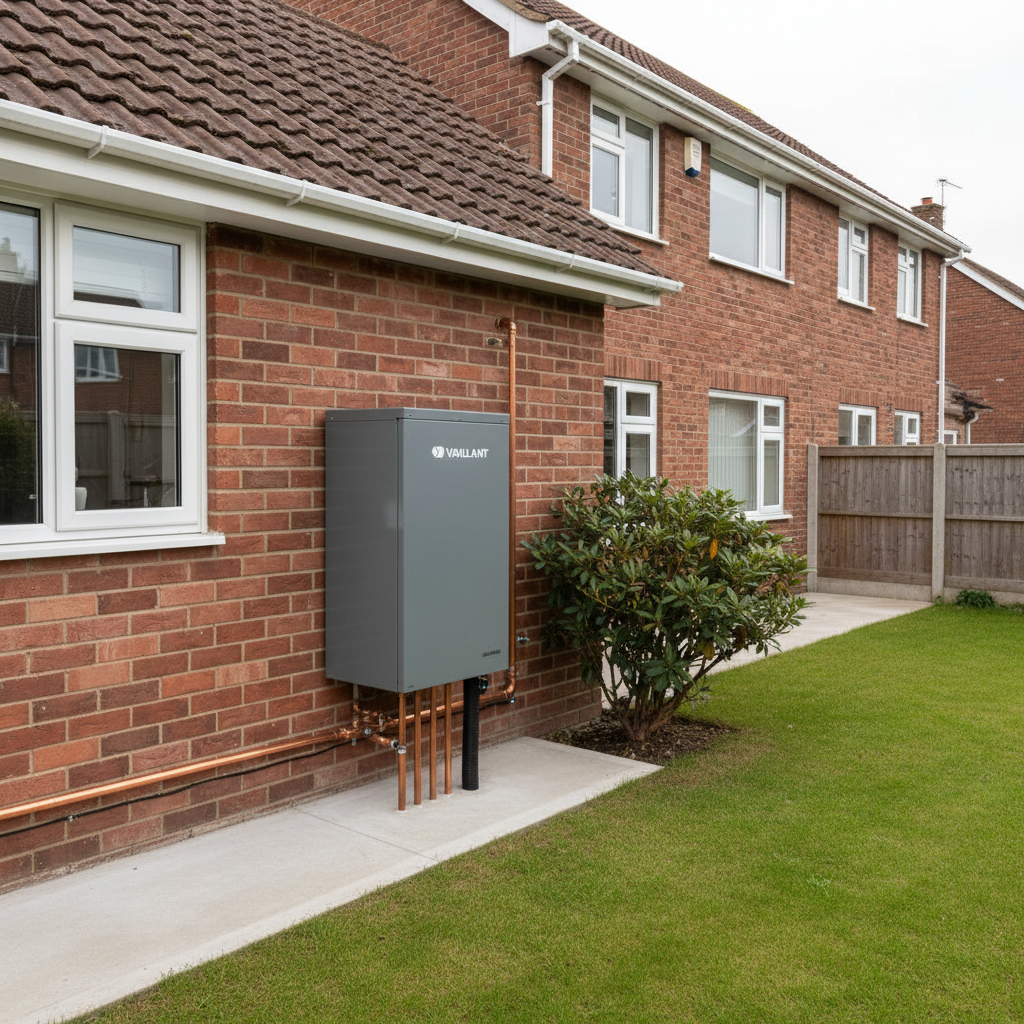
Get heat pump sizing wrong and you pay for it every winter. This 2026 guide explains how MCS heat loss calculations work, what capacity your home really needs, why oversizing kills efficiency, and how the April 2026 Boiler Upgrade Scheme amendments change the funding picture.
Sizing is the single biggest decision in any heat pump install. Get it right and your home runs warm at low flow temperatures, cycles smoothly, and lands close to the SCOP figures the manufacturer printed on the box. Get it wrong and you either freeze on the coldest week of the year or pay an oversized unit to cycle on and off all winter, dragging efficiency down and pushing your bills up.
This guide explains how UK installers should size a heat pump in 2026, what capacity your home really needs, the warning signs of an oversold quote, and how the April 2026 changes to the Boiler Upgrade Scheme alter the funding side of the conversation.
Why sizing matters more than the brand on the box
A heat pump is not a gas boiler. A modern combi will modulate from around 4 kW up to 30 kW, so installers got into the habit of fitting whatever was on the van and letting the boiler turn down to suit the property. Heat pumps cannot do that. Most monobloc air source heat pumps modulate down to around 25 to 30 percent of their rated output, which means a 12 kW unit cannot run below roughly 3 to 4 kW. If your home only loses 4 kW of heat at minus 3 degrees outside, that 12 kW unit will short cycle every mild day from October through April.
The Department for Energy Security and Net Zero monitoring data and several long running fleet datasets show the same pattern. Oversized installs lose 10 to 20 percent of their seasonal efficiency to cycling losses. Undersized installs trip the back up immersion heater on the cold spells when running cost matters most. Sizing sits at the centre of every running cost calculation, every grant business case, and every warranty claim.
The MCS heat loss method in plain English
Every MCS certified heat pump install in the UK has to follow the design standard MIS 3005D, which references the British Standard BS EN 12831 part 1 (2017 edition) and the CIBSE Domestic Heating Design Guide for the heat loss calculation itself. The 2025 edition of MIS 3005D and the 2026 update to the CIBSE guide tightened the methodology and the MCS Heat Load Calculator tool now bakes both into one online workflow that every certified installer must use.
A compliant heat loss survey works through the property in this order:
- Establish the design external temperature for the property postcode using MCS Table 2. Most of England sits at minus 3 degrees, with colder pockets at minus 4 or minus 5.
- Set design internal temperatures by room. Newer well insulated buildings default to 21 degrees throughout, with bathrooms at 22 degrees, taken from the CIBSE 2026 guide Table 2.2.
- Measure every external wall, window, door, floor, and roof. Apply the correct U value for the construction type and age band.
- Calculate fabric heat loss room by room.
- Add ventilation losses using the BS 12831 part 1 (2017) Table B7 air change rates, which now replace the older CIBSE values.
- Sum the rooms to give the total design heat loss in kilowatts.
- Add a cold weather uplift only if Table 2 column A external temperatures were used.
The output is a single number in kilowatts. That number is the smallest heat pump capacity that will keep your home at design temperature on the coldest day of a typical winter. It is not a rule of thumb based on bedrooms, square metres, or boiler size. It is a measured, room by room calculation, and any reputable installer will share the full report with you.
What capacity does an average UK home actually need?
Real heat loss figures from MCS surveys across the UK housing stock cluster around the following ranges. These are starting points only. Your actual figure depends on insulation, glazing, exposure, and infiltration.
Mid terrace, 2 bed Victorian
Typical heat loss after loft and cavity insulation: 3.5 to 5 kW. A 5 kW or 6 kW heat pump usually fits well. If solid walls remain uninsulated the figure can rise to 6 or 7 kW.
Three bed semi detached, 1980s build
The most common UK property type. Heat loss after standard upgrades typically lands at 5 to 7 kW. A 5 kW or 7 kW unit covers most installs. Older 1930s pebble dash semis without internal wall insulation often need 7 to 9 kW.
Three or four bed detached, 1990s onwards
Higher fabric standards but more external wall area. Heat loss usually 6 to 9 kW. A 7 kW or 10 kW unit is the common pairing.
Four or five bed detached, older or larger floor plan
Heat loss can reach 10 to 14 kW depending on insulation, with the 10 kW and 12 kW Vaillant aroTHERM Plus, the 11.2 kW Daikin Altherma 3 H HT, and the 11 to 14 kW Mitsubishi Ecodan all fitting this bracket.
Period stone or solid wall property
Heat loss is highly variable. A 1900s Cotswold stone cottage with single glazing and no internal wall insulation can lose 12 to 18 kW. Insulation should always be modelled before sizing. PAS 2035 retrofit assessments are strongly recommended for older homes.
The Vaillant, Daikin, Mitsubishi, and Octopus Cosy capacity ladder
Each of the major UK heat pump manufacturers offers a tight capacity ladder. Knowing the next size up and the next size down on each model range helps you spot a quote that has gone in the wrong direction.
Vaillant aroTHERM Plus, R290 refrigerant, GWP of 3. Available in 3.5 kW, 5 kW, 7 kW, 10 kW, and 12 kW.
Daikin Altherma 3 H HT, high temperature R32 monobloc. Available in 9 kW, 11 kW, 14 kW, 16 kW, and 18 kW.
Mitsubishi Ecodan R290. Available in 6 kW, 8.5 kW, 11.2 kW, and 14 kW outputs.
Octopus Cosy 6 (suitable for heat loss up to 5.6 kW) and Cosy 9 (suitable for heat loss up to 8.7 kW).
If your heat loss survey says 5.5 kW and the installer is quoting a 10 kW unit, ask them to justify it in writing. If they cannot point to a specific reason in the survey itself, the quote is oversized.
Oversizing: the hidden running cost penalty
Oversizing is the most common sizing mistake in UK retrofit installs. It happens when an installer pads the heat loss figure for safety, or chooses the next size up because the smaller unit was out of stock, or simply applies an old gas boiler rule of thumb such as 1 kW per 10 square metres.
The damage shows up in three places.
Short cycling
A heat pump that cannot modulate below the home heat demand will cycle on and off rather than run steadily. Each start up draws extra current, the compressor spends time at low efficiency before settling, and the system warms then overshoots before turning off again. Cycling losses of 10 to 20 percent of seasonal efficiency are well documented in DESNZ and university field trials.
Higher flow temperatures
Oversized units often get paired with smaller radiators because the installer assumed extra capacity would compensate. The result is a system that has to run at 50 to 55 degrees flow rather than 45 degrees. Every 5 degree lift in flow temperature drops SCOP by 5 to 10 percent. A heat pump running at 35 degrees flow can hit a SCOP of around 4. The same unit running at 55 degrees might achieve only 2.5 to 3.
Higher capital cost
A 10 kW Vaillant aroTHERM Plus costs around £700 to £1,000 more on the parts list than a 7 kW. With BUS at £7,500 the headline cost can look identical, but you have spent grant money on capacity you do not need.
Undersizing: the comfort and back up cost penalty
Undersizing is rarer in MCS installs because the design standard requires the unit to meet design heat load at the design external temperature. It still happens though, usually because the installer used a quick rule of thumb, ignored ventilation losses, or relied on a cheap online sizing tool.
The symptoms are predictable.
- The home reaches design temperature in autumn but not on the coldest week of the year.
- The back up immersion heater runs more than expected, dragging running cost up sharply on cold days.
- Heat pump capacity drops as outside temperature drops. A 5 kW unit rated at 7 degrees can deliver only 3.5 to 4 kW at minus 5 degrees, exactly when you need full output.
- SCOP often holds up reasonably well because the unit runs flat out for long steady periods, but comfort and bills suffer in the depths of winter.
A correctly sized system has 10 to 15 percent headroom above the design heat loss to absorb a colder than typical winter without leaning on the back up element.
Flow temperature is the other half of the sizing decision
Sizing and emitter design are inseparable. A 7 kW heat pump connected to small panel radiators left over from a 70 degree gas system will not deliver 7 kW at 45 degrees flow. The radiators simply do not have the surface area.
The standard retrofit rule of thumb is straightforward.
For a target flow temperature of 45 degrees, radiator surface area typically needs to be 2.6 times the gas boiler equivalent.
For 50 degrees flow, the multiplier is roughly 2.2.
For 55 degrees flow, it falls to 1.9.
For 35 degree flow temperature in an underfloor heating system, the multiplier is much lower because the floor area itself is the emitter.
A good MCS installer surveys every radiator in the home, models output at the proposed design flow temperature, and lists the exact upgrades needed in the quote. If the radiator schedule is missing from your quote, the system is not properly designed.
How the April 2026 BUS amendments change the sizing conversation
The Boiler Upgrade Scheme moved on materially from 28 April 2026 under the Boiler Upgrade Scheme (England and Wales) (Amendment) Regulations 2026. Three changes matter for sizing.
EPC requirement removed
Until April 2026 you needed a valid EPC with no outstanding insulation recommendations. From 28 April that requirement is gone. Installers can submit alternative evidence such as utility bills and photographs. This removes the previous incentive to oversize the heat pump in order to avoid retrofitting insulation first. The MCS heat loss calculation must still reflect the actual fabric of the building.
Air to air heat pumps now eligible at £2,500
The BUS now covers air to air heat pumps at a £2,500 grant. Sizing for an air to air system uses different methodology, working in cooling kilowatts and zone by zone capacity rather than a single whole house figure. If you are weighing wet versus air based systems, sizing differences should be modelled side by side rather than guessed.
Off gas grid uplift to £9,000
Homes off the gas grid that currently rely on heating oil or LPG can claim a temporary uplift from £7,500 to £9,000 on an air to water or ground source heat pump install. The £1,500 extra makes the case for a properly sized unit even stronger because the grant now covers more of the cost of getting it right rather than encouraging a cheap, oversized fitting.
Funding routes that pair with a properly sized install
Three live funded routes can support a heat pump install in 2026. Sizing rules apply equally to all three because every install must follow MIS 3005D.
Boiler Upgrade Scheme
£7,500 air to water or ground source heat pump (£9,000 temporary uplift for oil and LPG homes), £5,000 biomass boiler (rural off gas only), £2,500 air to air. No income test, no EPC requirement from 28 April 2026. The most accessible funded route for owner occupiers and private landlords.
Warm Homes: Local Grant
Up to £30,000 in fully funded measures, including a heat pump where appropriate, for low income households. Eligibility runs through three pathways: postcode in IMD Income Decile 1 or 2, in receipt of a means tested benefit, or gross household income of £36,000 or less. The scheme runs to 31 March 2028 and is delivered by participating local authorities.
Warm Homes Plan
The wider £13.2 billion programme launched on 21 January 2026, with the Warm Homes: Local Grant as one of its delivery channels alongside social housing and private landlord routes. Heat pump sizing on Warm Homes Plan installs follows the same MCS standard.
Six warning signs your quote is sized wrong
Use this checklist when you compare heat pump quotes. A quote that fails on more than one of these should trigger a follow up question to the installer.
- No room by room heat loss calculation attached to the quote.
- Heat pump capacity selected before the heat loss survey was complete.
- No radiator schedule. A proper quote shows the existing radiator size and the proposed replacement size for every emitter.
- Design flow temperature above 50 degrees on a property with average insulation. A retrofit running at 55 degrees should be a deliberate choice, not a default.
- Headline capacity more than 1.5 times the calculated heat loss. Slight oversizing is often sensible, but 2 times or more is almost always wrong.
- No mention of MIS 3005D, BS EN 12831, or the MCS Heat Load Calculator anywhere in the design documentation.
How Cucumber Eco approaches sizing
Every Cucumber Eco install starts with a free home survey carried out by an MCS certified surveyor, using the official MCS Heat Load Calculator. We size to the room by room heat loss figure, never to a rule of thumb or a stock list. We model the radiators at the proposed flow temperature, list the exact upgrades needed, and walk you through the survey before you sign anything.
If the property qualifies for the Warm Homes Plan, the Warm Homes: Local Grant, or the Boiler Upgrade Scheme, we apply the funded discount up front so you see the net cost on day one.
Five questions to ask before you accept a heat pump quote
- Can I see the full heat loss survey, room by room, with U values and ventilation rates?
- What design external temperature have you used and which MCS table column did that come from?
- What is the design flow temperature and what radiator changes are needed to hit it?
- What is the modulation range of the proposed unit, and how does that compare to my heat loss in milder weather?
- What SCOP figure are you forecasting at my actual design conditions, not just at 35 degrees test conditions?
Frequently asked questions
Can a heat pump that is too big still be efficient?
Not really. A unit oversized by more than 50 percent will short cycle in mild weather, lose 10 to 20 percent of its seasonal efficiency, and stress the compressor over time. Manufacturers do not warrant against the long term effects of cycling.
How much extra capacity should an installer add for safety?
A typical safety margin is 10 to 15 percent above the design heat loss. Anything more is oversizing.
What if I plan to extend or insulate later?
Size the heat pump to the property as it will be. If you are confident you will fit a loft conversion next year, model the new heat loss now and size accordingly. Sizing for a future state that may never happen is a common cause of oversizing.
Do I need a buffer tank?
Only if your system has low water volume relative to the modulation range of the heat pump, or if you have many TRVs that close down rooms and cause flow rate drops. Many modern installs run buffer free with a low loss header or volumiser. The decision should come out of the design, not be added as a default.
What SCOP should I expect from a properly sized system?
A properly sized R290 air source heat pump running at 45 degree flow with well sized radiators typically achieves a SCOP of 3.8 to 4.2 in UK conditions. The Octopus Cosy fleet currently averages around 3.6, with 80 percent of installs running cheaper than the gas boiler they replaced.
Get sizing right from day one
A heat pump that is sized correctly will run quietly, hit its forecast efficiency, and cost less to run than the gas boiler it replaces. A heat pump sized to a rule of thumb will haunt your bills for fifteen years.
If you are starting the process, book a free home consultancy with Cucumber Eco. We will run the MCS heat loss calculation at no cost, walk you through the survey, and tell you honestly whether a heat pump is the right call for your home, what capacity you need, what radiator changes are required, and which grant route gives you the best deal.