Loft insulation is still the single cheapest and fastest payback energy upgrade you can fit to a UK home in 2026. This guide covers what it costs, how much you save at the April 2026 price cap, the Building Regulations standard you need to hit, and exactly how to claim it free under the Warm Homes Plan, the Warm Homes Local Grant, or alongside a heat pump grant.
Why Loft Insulation Is Still the Best First Move in 2026
Around a quarter of the heat lost from an uninsulated home in the UK escapes through the roof. That makes loft insulation the single highest impact, lowest cost retrofit measure you can fit, and the one with the shortest payback. At the April 2026 Ofgem price cap of 5.74 pence per kilowatt hour for gas and £1,641 a year for a typical dual fuel household, every 1000 kilowatt hours of heat you stop losing keeps about £57 in your pocket every year. That is why every funded retrofit route in the UK, from the Warm Homes Plan and the Warm Homes Local Grant through to the Boiler Upgrade Scheme installer survey, starts with the roof.
This guide walks through exactly what loft insulation costs in 2026, how much you can expect to save, what depth you need to hit, the three current funded routes that can pay for the work in full, and the ventilation and condensation rules under PAS 2035:2023 that any reputable installer has to follow.
What Loft Insulation Actually Is
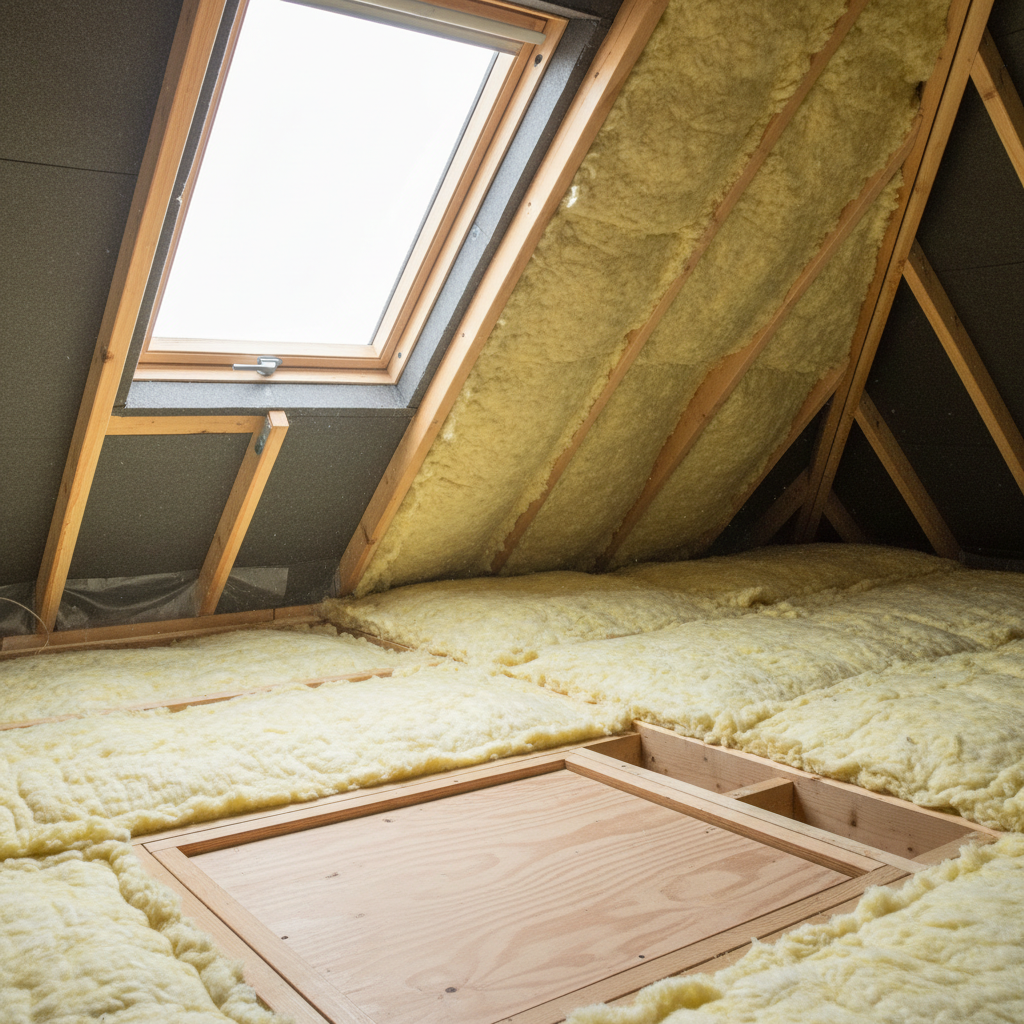
Loft insulation is a layer of low conductivity material laid across the floor of an unheated loft space (a cold loft) or fitted between and under the rafters when the roof itself is being insulated (a warm roof). For the vast majority of UK homes, what you want is a cold loft with insulation at ceiling level. It is cheaper, quicker, and easier to inspect or top up later.
The most common materials in the UK in 2026 are mineral wool quilt, glass wool quilt, blown cellulose, sheep wool, and rigid PIR boards where boarding over the joists is involved. Each material has a thermal conductivity, often called the lambda value, which dictates how thick the layer needs to be to hit the target U value.
The Depth You Need to Hit in 2026
The current standard recommended by the Energy Saving Trust and required under Approved Document L of the Building Regulations is a finished loft insulation depth of 270mm of mineral wool, giving a U value of 0.16 watts per square metre Kelvin or better. Approved Document L Volume 1 came into force on 15 June 2022 and is the live standard for any retrofit work in England in 2026.
To put that in plain English, where there is currently no insulation in the roof space, or where the existing insulation gives a U value worse than 0.35 watts per square metre Kelvin (roughly 125mm of mineral wool quilt and below), you need to bring the loft up to at least the 0.16 figure. The cheapest way to do that with mineral wool is two crossed layers: 100mm laid between the joists, then 170mm or 200mm laid across the joists at right angles to break the thermal bridge through the timber. Some installers fit a single 270mm to 300mm layer where joists are deeper. Going beyond 300mm gives diminishing returns; the jump from 0mm to 270mm is where almost all the saving sits.
If you are using a denser material like sheep wool (typical conductivity 0.035 to 0.040 watts per metre Kelvin) or a rigid PIR board (0.022 watts per metre Kelvin), you can hit the same U value with a thinner layer. PIR is normally reserved for warm roof builds or where head height is tight, because it is much more expensive per square metre.
How Much Loft Insulation Costs in 2026
Costs in 2026 sit in a wide band depending on property size, whether the loft is starting from bare joists or topping up an existing layer, and whether any boarding, hatch insulation, or rafter baffles are part of the job. Working from current Checkatrade, MyJobQuote, and HomeOwners Alliance 2026 rates, the typical professional install prices to take a loft to a finished 270mm depth are:
- Flat or small one bedroom apartment loft: around £200 to £500.
- Two bedroom terrace: around £300 to £700.
- Three bedroom semi detached: around £500 to £1,200.
- Four bedroom detached: around £900 to £1,800.
- Period property with restricted access or extensive rafter work: £1,200 to £2,500.
The average three bedroom semi detached install in 2026 comes in at around £930. Day rates for loft insulation installers typically sit at £150 to £250 in 2026, with London and major city work pulling toward the upper end. Materials themselves are inexpensive; mineral wool quilt runs at roughly £10 per square metre, blown loose fill cellulose at roughly £12 per square metre, and 100mm sheep wool at £18 to £25 per square metre depending on whether the product is 100 per cent wool or a polyester blend.
If you also want the loft boarded over for storage, expect to add around £55 per square metre for the boarding stage. A boarded loft must be raised above the insulation using purpose made loft legs to avoid compressing the wool, because compressed insulation loses thermal performance.
How Much You Save on Your Bills
The Energy Saving Trust's 2026 figures for moving a previously uninsulated loft up to the 270mm standard give the following annual gas bill savings at current prices:
- Detached house: about £355 a year.
- Semi detached house: about £225 a year.
- Mid terrace: about £135 a year.
- Flat (top floor with own roof): about £100 to £150 a year.
At those savings, a typical £900 three bedroom semi install pays for itself in four years. A larger detached home with a £1,500 install pays back in just over four years. From the day the roll goes down, every year after that is essentially free money. Mineral wool itself, properly installed and kept dry, lasts 40 to 50 years before performance drops far enough to warrant a replacement; glass wool sits at 20 to 30 years for full performance but retains around 95 per cent of its thermal resistance for around 40 years.
The savings are even bigger if your home is also heated by oil, LPG, or direct electric. Top floor flats with electric panel heaters or storage heaters can save twice the kilowatt hour total in cash terms because each unit of electricity at the April 2026 cap costs 24.7 pence rather than 5.74 pence for gas.
The Three Routes to Free or Funded Loft Insulation
The three live funded routes for loft insulation in 2026 are:
1. Warm Homes Plan (England, national rollout)
The Warm Homes Plan is the £13.2 billion Government programme launched to deliver energy upgrades to five million homes by 2030. It funds full retrofit packages, including loft insulation, for households on incomes of £36,000 or less, or living in postcodes within Indices of Multiple Deprivation deciles 1 to 2, or in receipt of a qualifying means tested benefit. The property must have an EPC rating of D, E, F, or G, and works are coordinated under PAS 2035:2023. Loft insulation is almost always the first measure on the recommended improvement plan.
2. Warm Homes Local Grant (England, council led)
The Warm Homes Local Grant runs through 74 individual projects covering 271 local authorities and more than 97 per cent of eligible English councils as of February 2026. It can fund up to £30,000 of energy upgrades per property, with the same EPC D to G rule and the same £36,000 income or IMD 1 to 2 or qualifying benefit eligibility. Funded measures always start with the fabric of the building, which means loft insulation comes first wherever the existing roof falls below the 0.16 U value standard. Applications go through your local council rather than a national portal, and the most current scheme guidance was last updated on 12 March 2026.
3. Boiler Upgrade Scheme (alongside a heat pump install)
The Boiler Upgrade Scheme does not directly fund loft insulation as a standalone measure. What it does, since the April 2026 amendments removed the EPC requirement, is fund up to £7,500 toward an air source or ground source heat pump, with an installer survey that almost always identifies loft insulation gaps. If the installer recommends bringing the loft up to standard before fitting the heat pump (which materially affects the heat loss calculation under the current MCS heat pump design standard), many homeowners pair this with the Warm Homes Local Grant or pay out of pocket because the install is so much cheaper than the heat pump itself.
If none of those three routes fits, paying for the install privately still gives a four to five year payback at current energy prices. There is genuinely no insulation measure that pays back faster.
What a Good Install Looks Like Under PAS 2035
PAS 2035:2023 has been the live standard for all funded retrofit work in the UK since 30 March 2025. It removed the older risk path A, B, and C structure and replaced it with a single mandatory whole house assessment process. For a loft insulation install, the practical implications are:
- The retrofit assessor produces a whole house assessment covering the building fabric, services, and ventilation. The loft is one element of that wider picture.
- The retrofit coordinator (who holds a Level 5 Diploma in Retrofit Coordination and Risk Management and works under a TrustMark approved scheme provider) signs off the medium term improvement plan and verifies the design meets BS 5250:2021 for moisture management.
- Where mould, condensation, or inadequate ventilation is already evident, ventilation upgrades such as additional eaves vents, tile vents, mechanical extract ventilation, or in some cases mechanical ventilation with heat recovery must be specified alongside the insulation.
- The installation contractor must work to PAS 2030:2023 and lodge the finished work on the TrustMark Data Warehouse, with a minimum two year financial protection guarantee, extending to 25 years on measures funded through ECO predecessors.
The single most important physical detail in a loft install is the eaves. Insulation must never be pushed tight to where the roof meets the wall plate, because the loft needs a clear air path to stay dry. The current BS 5250 guidance is a minimum 50mm clear ventilation gap between the top of the insulation and the underside of the roof felt at the eaves. Rafter trays, also called insulation baffles, are the standard way to hold the insulation back and keep that gap clear. Skip that detail and you trade a heat loss problem for a condensation problem.
Other details your installer should be handling:
- Loft hatch insulated to the same U value as the surrounding ceiling, with draught stripping around the frame.
- Service penetrations (cables, pipes, downlighter housings) air sealed before insulation goes down to stop warm moist air leaking into the cold loft.
- Recessed downlighters in the ceiling either replaced with sealed fire rated units or boxed over with a fire rated loft cap so the insulation can run continuously without a heat or fire risk.
- Water tanks and pipework in the loft insulated on all sides and lagged. Once the loft is properly insulated the space above the ceiling runs colder, which increases the freezing risk on any tanks left up there.
- Walkways for access to flues, water tanks, or aerials raised on loft legs above the insulation.
Common Mistakes That Wipe Out the Savings
Three issues come up again and again in retrofit field studies and post install surveys:
- Compressed insulation under boarding. A 270mm roll squashed under 100mm boarding gives the thermal performance of about 100mm of insulation. Always use loft legs to raise the boards.
- Insulation blocking the eaves. This causes condensation in the loft, which over time soaks the insulation. Wet insulation loses up to 40 per cent of its thermal resistance and creates a damp risk on the timber roof structure.
- Forgetting the hatch and pipes. An uninsulated loft hatch can lose as much heat as a small window. Pipes and tanks left exposed in a freshly insulated loft are the single most common cause of burst pipe claims in cold snaps.
A competent installer working under PAS 2035 handles all three by default. If you are pricing a private install, ask the contractor specifically how they detail the eaves, the hatch, and any tanks or downlights.
Will the Home Energy Model Change Any of This in 2027?
The Home Energy Model rolls out in the second half of 2027 to replace the current Standard Assessment Procedure underpinning EPCs. Rather than a single A to G letter, properties will be rated against four metrics: fabric performance, heating system performance, smart readiness, and energy cost. Loft insulation feeds directly into the fabric performance metric. Homes with thin or absent loft insulation will see their fabric score drop noticeably once the new methodology lands.
For landlords, the second factor is the Minimum Energy Efficiency Standard moving to EPC C by 2030 for all new tenancies and 2033 for all existing tenancies. Loft insulation is by some distance the cheapest measure that moves an EPC up by several SAP points. Most private rental properties currently sitting at D will need exactly this kind of fabric first work to clear the C threshold ahead of the deadline.
How to Get Started
- Check whether your household qualifies for the Warm Homes Plan or the Warm Homes Local Grant by contacting your local council or speaking to a retrofit advisor. Eligibility runs on income, postcode, or qualifying benefit, not tenure, so both owner occupiers and private rented sector tenants can apply.
- If you do not qualify for a funded route, get three quotes from PAS 2030:2023 registered installers and check they are working under a TrustMark approved scheme provider. Cucumber Eco can arrange this on your behalf.
- Insist on a written specification that names the material, the finished depth, the U value target, the eaves detail, and how the loft hatch, pipework, and any downlighters will be treated.
- After install, ask for the lodgement record from the TrustMark Data Warehouse if the work was funded, or the materials warranty if the work was private. Keep both with your home documents; mortgage lenders and green mortgage products increasingly look at insulation evidence as part of underwriting.
Loft insulation is not glamorous and it is not the headline retrofit measure in any government press release. It is the one measure that pays for itself fastest, lasts the longest, and unlocks every other upgrade you might fit afterwards, from a heat pump to a solar plus battery system. In 2026 there is no good reason to leave a loft uninsulated.