Old storage heaters can cost £1,500 to £2,500 a year to run, drag your EPC down, and leave the house cold by teatime. In 2026 there are three credible replacement routes (a full air source heat pump, a like for like high heat retention upgrade, or a hybrid air to air system) and three live grant schemes that can cover most or all of the cost.
If you live in a UK home that still relies on old storage heaters, the chances are you already know they are expensive to run, slow to respond, and leave you cold by the time you actually want the heat. What you may not know is that 2026 is the cheapest year in over a decade to replace them.
Warm Homes Local Grant is delivered by councils in England for qualifying households in privately owned D-to-G homes. A survey determines suitable measures and the council decides the funded package; a headline scheme budget is not a personal grant entitlement. Landlords may need to contribute. Check the official eligibility route and current alternatives.
This guide walks through what the upgrade really costs in 2026, how much you can expect to save, which technology suits which home, and which grant route gets you to the best outcome.
Why old storage heaters are the most expensive way to heat a UK home
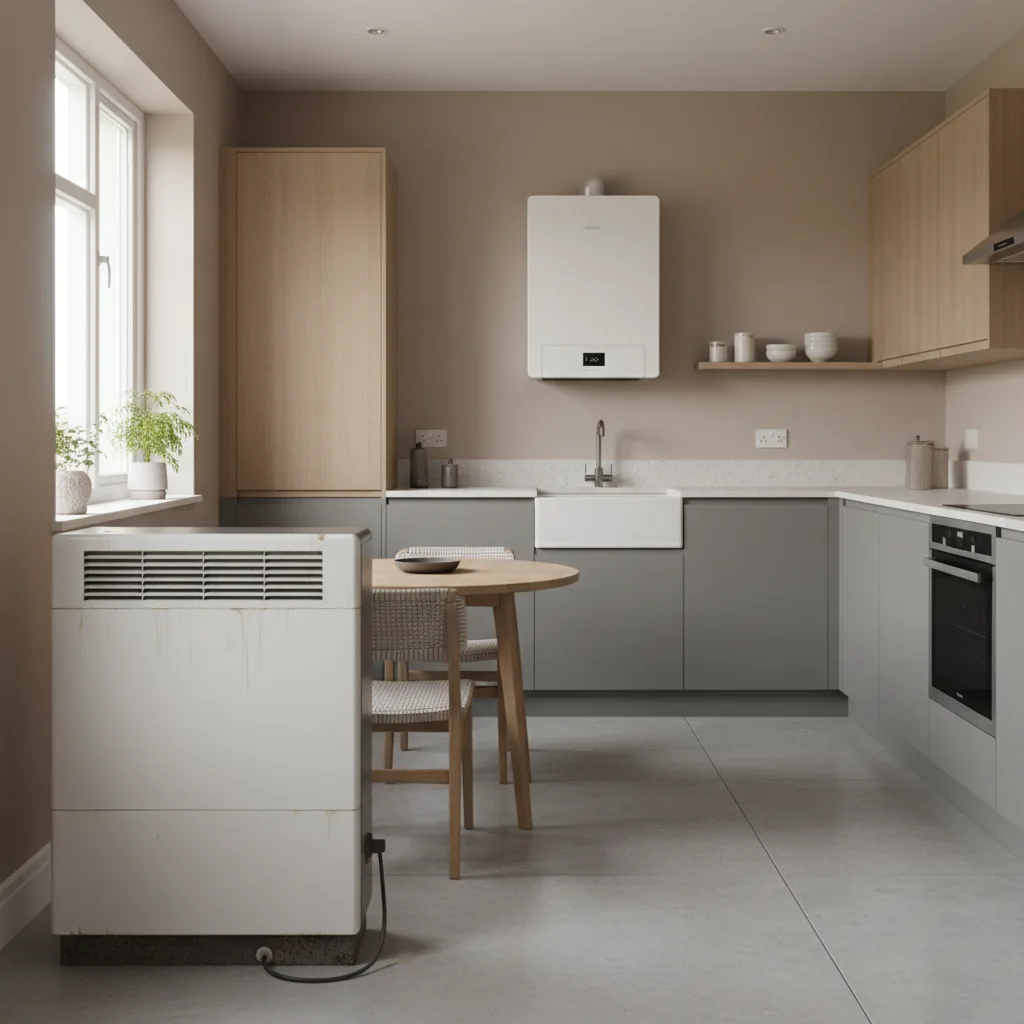
Old brick storage heaters work in a simple way. They draw electricity overnight on the Economy 7 off peak rate, store the heat in their internal bricks, and slowly release it through the day. On paper that sounds efficient. In practice, three things go wrong:
1. The heat releases when nobody wants it. Most of the warmth dissipates through the morning and is gone by the time the household gets home in the evening.
2. Households end up topping up with peak rate convection heaters, electric showers, and panel heaters at 24.7p per kWh.
3. The bricks themselves are 100 percent efficient at converting electricity to heat, but electricity is the most expensive heating fuel in the UK. Even at the off peak rate of 13.89p per kWh under the April 2026 Ofgem price cap, a single 3kW storage heater drawing for 8 hours uses 24 kWh per night, or roughly £3.33 just for one heater on one cold winter night.
Multiply that by four or five heaters across a typical three bedroom home and the maths gets ugly. Real world consumption for an old storage heater home is often 7,000 to 10,000 kWh a year on the heating element alone, before you include immersion heated hot water and any peak rate top up. At April 2026 rates, that is £1,500 to £2,500 a year on heating before any non heating use is counted.
The Energy Saving Trust estimates that the typical three bedroom home heated by electric storage heaters could save up to £1,200 a year by switching to an air source heat pump. That is one of the largest annual savings available from any single domestic energy upgrade.
What you can move to in 2026
There are three serious options, plus one that almost nobody should choose any more.
Option one: a full air source heat pump
A modern air source heat pump produces three to four units of heat for every one unit of electricity used. That coefficient of performance is the entire reason heat pumps are so much cheaper to run than storage heaters, which deliver one unit of heat per unit of electricity.
Practically, that means an air source heat pump pays roughly a quarter to a third of the running cost of an old storage heater system, even on the standard single rate electricity tariff. On a heat pump friendly tariff such as Cosy Octopus or Intelligent Octopus Flux, the running cost gap widens further because the heat pump can be scheduled to draw electricity during the cheapest off peak windows.
Typical 2026 install cost for a three bedroom semi: £8,000 to £14,000 before grant, £500 to £6,500 after the £7,500 Boiler Upgrade Scheme grant. The official UK government average figure is £12,500 installed, falling to £5,000 net for households eligible for BUS.
For storage heater homes specifically, a full air source heat pump installation usually requires a hot water cylinder (most storage heater properties only have an immersion or instant electric water heater), and may require some pipework retrofit because there is rarely an existing wet system. Total time on site is typically four to seven days for a competent MCS certified installer.
Option two: a like for like high heat retention storage heater upgrade
If your property is small, single occupancy, or genuinely cannot accommodate a wet system or external heat pump unit, modern High Heat Retention Storage Heaters (HHRSH) are a credible upgrade path.
HHRSH units use far better insulation, automatic charge control that responds to weather forecasts, and phased release fans that give the household control over when heat is delivered. The result is a unit that wastes much less of the off peak charge and can hold heat into the evening when the household actually wants it.
Compared to an old brick heater, a modern HHRSH typically reduces electricity consumption by around a third, depending on usage patterns and the controls fitted. They are not as cheap to run as a heat pump, because they still operate at one unit in one unit out, but they deliver a meaningful saving against ageing 1980s and 1990s storage heater stock.
Install cost in 2026 is typically £450 to £1,200 per unit fitted, and a typical three bedroom home needs four to five units. That puts the unfunded cost at around £2,500 to £5,000. Crucially, HHRSH replacement is a SAP recognised improvement measure, which means it is funded under the Warm Homes: Local Grant for households that meet the eligibility criteria. Many qualifying households pay nothing.
Option three: an air to air heat pump system
The April 2026 Boiler Upgrade Scheme reforms made air to air systems eligible for a £2,500 grant for the first time. This is a transformative change for storage heater households because:
1. Air to air systems do not require a wet central heating system. They deliver warm air directly through indoor units. This makes them straightforward to retrofit into properties that have never had radiators or pipework.
2. They cost meaningfully less than a wet air source heat pump install. A typical three bedroom multi split air to air installation is £4,000 to £6,500 before grant, falling to £1,500 to £4,000 net after the £2,500 BUS grant.
3. They can be installed alongside a small electric heat pump hot water cylinder, or paired with a Mixergy or Sunamp smart hot water unit, to deliver a full heating and hot water solution without the cost or complexity of a full wet system.
The trade off is that air to air systems are generally less efficient than wet air source heat pumps in cold weather (typically a SCOP of 2.6 to 3.5 against 3.0 to 4.2 for wet systems), so the lifetime running cost is slightly higher. They also require visible indoor units in each room you want to heat, which some households find cosmetically less appealing than radiators.
For storage heater replacement, an air to air system is often the best balance of upfront cost, install simplicity, and running cost reduction.
What to avoid: replacing like for like with old style brick storage heaters
Standard old style storage heaters are still sold by some retailers. They are cheap, easy to install, and almost always the wrong choice in 2026. Running costs are functionally identical to the units they replace, the EPC uplift is minimal, and they do not qualify for any of the live grant schemes. If you are spending money on a heating upgrade, spend it on something that lowers your bills.
How much you actually save in 2026
Using the April 2026 Ofgem price cap unit rates and a typical three bedroom storage heater home with a baseline of 8,500 kWh of electric heating consumption per year, here is what each upgrade delivers.
Old brick storage heaters on Economy 7. Heating cost roughly £1,200 a year on the off peak rate alone, plus around £400 a year of peak rate top up. Total around £1,600 a year before hot water.
High heat retention storage heaters on Economy 7. Roughly 30 percent reduction. Heating cost roughly £1,000 to £1,150 a year. Saving against old units roughly £400 to £600 a year.
Air to air heat pump on a single rate tariff. Heating cost roughly £600 to £800 a year. Saving against old storage heaters roughly £800 to £1,000 a year.
Air source heat pump (wet system) on a heat pump tariff such as Cosy Octopus. Heating cost roughly £400 to £600 a year. Saving against old storage heaters roughly £1,000 to £1,200 a year, in line with the Energy Saving Trust headline figure.
Across a 15 year heat pump lifespan, the total saving against staying on old storage heaters is typically £15,000 to £18,000. That is materially more than the average upfront cost of the upgrade, even before grant funding is applied.
EPC and Home Energy Model implications
The current SAP based EPC system has historically rated electric heating poorly because it is driven by fuel cost rather than carbon. That penalises heat pumps when replacing gas, but it has the opposite effect for storage heater households.
The confirmed policy for covered private rentals in England and Wales is a higher EPC standard by 1 October 2030 for all tenancies, with legislative changes subject to Parliamentary approval. The previous 2028 new-tenancy proposal is not the confirmed timetable. See the government response and our landlord requirements guide.
The new Home Energy Model arriving in the second half of 2027 will treat modern heat pumps and modern storage heaters more accurately. Old brick storage heaters are likely to score worse under the new model, not better, because the model takes hourly temperature dynamics and real heat retention performance into account. That makes 2026 a particularly good year to upgrade. If you are going to spend money on storage heater replacement, do it before the new model bites.
Which grant scheme covers what
Three live UK grant routes apply to storage heater replacement in 2026.
Boiler Upgrade Scheme (BUS)
Active. £7,500 towards an air source or ground source heat pump. £2,500 towards an air to air heat pump. EPC requirement scrapped on 28 April 2026. Scheme extended to 2030. Property must be in England or Wales, must have an MCS certified installer, and the heat pump must replace the primary heating system. From 28 April 2026, BUS allows non fossil supplementary heating (including kept storage heaters in unheated rooms) to remain alongside the new heat pump. There is no income test. The 2025 to 2026 BUS budget is £295 million.
Warm Homes: Local Grant
Warm Homes Local Grant is delivered by councils in England for qualifying households in privately owned D-to-G homes. A survey determines suitable measures and the council decides the funded package; a headline scheme budget is not a personal grant entitlement. Landlords may need to contribute. Check the official eligibility route and current alternatives.
Warm Homes Plan
Launches January 2027. £13.2 billion committed at Spring Budget 2026. Up to £30,000 per property for low income households (£36,000 income threshold or IMD 1 and 2) in EPC D to G properties. Detailed delivery rules will be confirmed during 2026. Households that miss the BUS or Local Grant window may pick up Warm Homes Plan funding from 2027 onwards.
A simple decision framework
Step one. Get an EPC. If your property is rated F or G, you almost certainly qualify for at least one of the grant routes above on property grounds alone, regardless of income.
Step two. Check household income against the Local Grant or Warm Homes Plan threshold. If your household earns under £36,000, or you live in IMD 1 or 2, you are likely eligible for fully funded works.
Step three. Decide on the technology. If you have space for a hot water cylinder and an outdoor unit, a wet air source heat pump delivers the lowest running cost. If space or budget is tight, an air to air heat pump is the simplest retrofit. If neither is workable, modern HHRSH is the right like for like upgrade.
Step four. Pair the technology with insulation. The single biggest determinant of running cost on any electric heating system is fabric performance. Loft insulation to 270mm, cavity wall insulation if applicable, and modern double or triple glazing should always be done at the same time as the heating upgrade.
Step five. Use an MCS certified installer for any heat pump work. BUS funding requires it, and the installer takes on responsibility for the SCOP performance estimate that drives your real running cost.
Common mistakes to avoid in 2026
1. Replacing storage heaters with new storage heaters of the same type. Wastes the upgrade opportunity. Almost no scheme funds this.
2. Putting in a heat pump without insulation work. The heat pump will work harder than it should, the SCOP will be lower, and the running cost saving will not match the headline figures.
3. Using a non MCS installer. Disqualifies the property from BUS, voids most grant funding, and often delivers a worse install.
4. Sizing the heat pump from the old electric heating load. Heat pumps need to be sized from a Heat Loss Calculation (MCS standard 3005), not from how many storage heaters were in the property.
5. Skipping the Heat Loss Calculation. The single most common cause of underperforming heat pumps in the UK is poor sizing. Insist on a detailed Heat Loss Calculation before signing any quote.
6. Ignoring tariff choice. A heat pump on a flat rate tariff is fine. A heat pump on a smart tariff such as Cosy Octopus or Intelligent Octopus Flux can shave another 20 to 30 percent off the running cost.
FAQs
How much does it cost to replace storage heaters with a heat pump in 2026? For a three bedroom semi, a wet air source heat pump installation costs £8,000 to £14,000 before the £7,500 BUS grant, and £500 to £6,500 after. An air to air system costs £4,000 to £6,500 before the £2,500 BUS grant, and £1,500 to £4,000 after. Low income households may qualify for full grant funding under the Warm Homes Plan or the Local Grant.
Will a heat pump work in a property currently heated by storage heaters? Yes. Storage heater homes typically have good electrical capacity already in place because they were designed for high overnight loads. They often need a new hot water cylinder, some pipework retrofit, and an MCS standard Heat Loss Calculation, but heat pumps are perfectly compatible.
Can I keep some storage heaters as backup? From 28 April 2026, the Boiler Upgrade Scheme allows kept storage heaters to remain in unheated rooms as supplementary heating, provided they are not the primary system. This is a useful transitional approach if budget for fully heating every room is tight at the time of install.
Which is better, a heat pump or modern HHRSH? A heat pump is always cheaper to run because it delivers three to four units of heat per unit of electricity, against one to one for HHRSH. HHRSH is cheaper to install and easier in tight properties. The right choice depends on the property and the funding available.
Do new build EPCs treat heat pumps better than the old SAP system did? Yes from 2027. The Home Energy Model arriving in the second half of 2027 uses updated carbon and cost factors that better reflect the real performance of modern low carbon heating. Storage heater replacement should be done before the Home Energy Model lands so the upgrade is captured fairly under both systems.
Is there a grant for replacing storage heaters with new storage heaters? Only modern High Heat Retention Storage Heaters under the Warm Homes: Local Grant for income or property eligible households. Standard old style storage heater replacement is not funded under any current scheme.
What to do next
Old storage heaters are the most expensive way to heat a UK home and the easiest to upgrade away from in 2026. The combined effect of the April 2026 BUS reforms, live Local Grant funding, and the incoming Warm Homes Plan means most storage heater households can either move to a heat pump for a fraction of the historic cost, or get a like for like HHRSH upgrade fully funded.
The best first step is a free home energy assessment. We will check your EPC, your eligibility against all three live grant routes, your home's suitability for a wet air source heat pump, an air to air system, or modern HHRSH, and we will give you a written cost and saving estimate before you commit to anything.
Book a free home energy assessment with Cucumber Eco.
Factual corrections checked 11 September 2026. Original publication date retained.