Cavity wall insulation can be one of the most practical ways to reduce heat loss in suitable UK homes. This guide explains 2026 costs, suitability checks, Warm Homes Local Grant funding, how the measure fits with the Warm Homes Plan, and why fabric work matters before a BUS funded heat pump.
Cavity wall insulation is back near the top of the home upgrade list in 2026. Energy bills are lower than the winter peak, but they are still high enough for every wasted unit of heat to matter. For many British homes built from the 1920s onwards, the empty wall cavity is one of the biggest remaining gaps in the fabric.
Energy Saving Trust says about 33% of heat lost from an uninsulated home escapes through the walls. It also says a typical cavity wall insulation installation in Great Britain costs around £2,700, with many suitable homes making that cost back through lower bills in five years or less. That makes cavity wall insulation one of the rare upgrades that can improve comfort, help your EPC, and still make financial sense without needing a full heating system change.
The funding picture has also changed. The Warm Homes Plan is now the main national policy framework for warmer homes. The Warm Homes Local Grant can fund wall, loft and underfloor insulation for eligible low income households in England. The Boiler Upgrade Scheme, or BUS, does not pay for cavity wall insulation, but it can fund low carbon heating once the fabric is ready. In plain English, cavity wall insulation is often the work that makes the next upgrade perform properly.
This guide explains what cavity wall insulation costs in 2026, how much it can help, which homes are suitable, which homes should avoid it, and how it fits with the Warm Homes Plan, the Warm Homes Local Grant and BUS.
What cavity wall insulation is
Many UK homes have external walls made from two separate layers of masonry with a gap between them. That gap is the cavity. Cavity wall insulation fills the space so heat is less able to move from the warm inside wall to the cold outside wall.
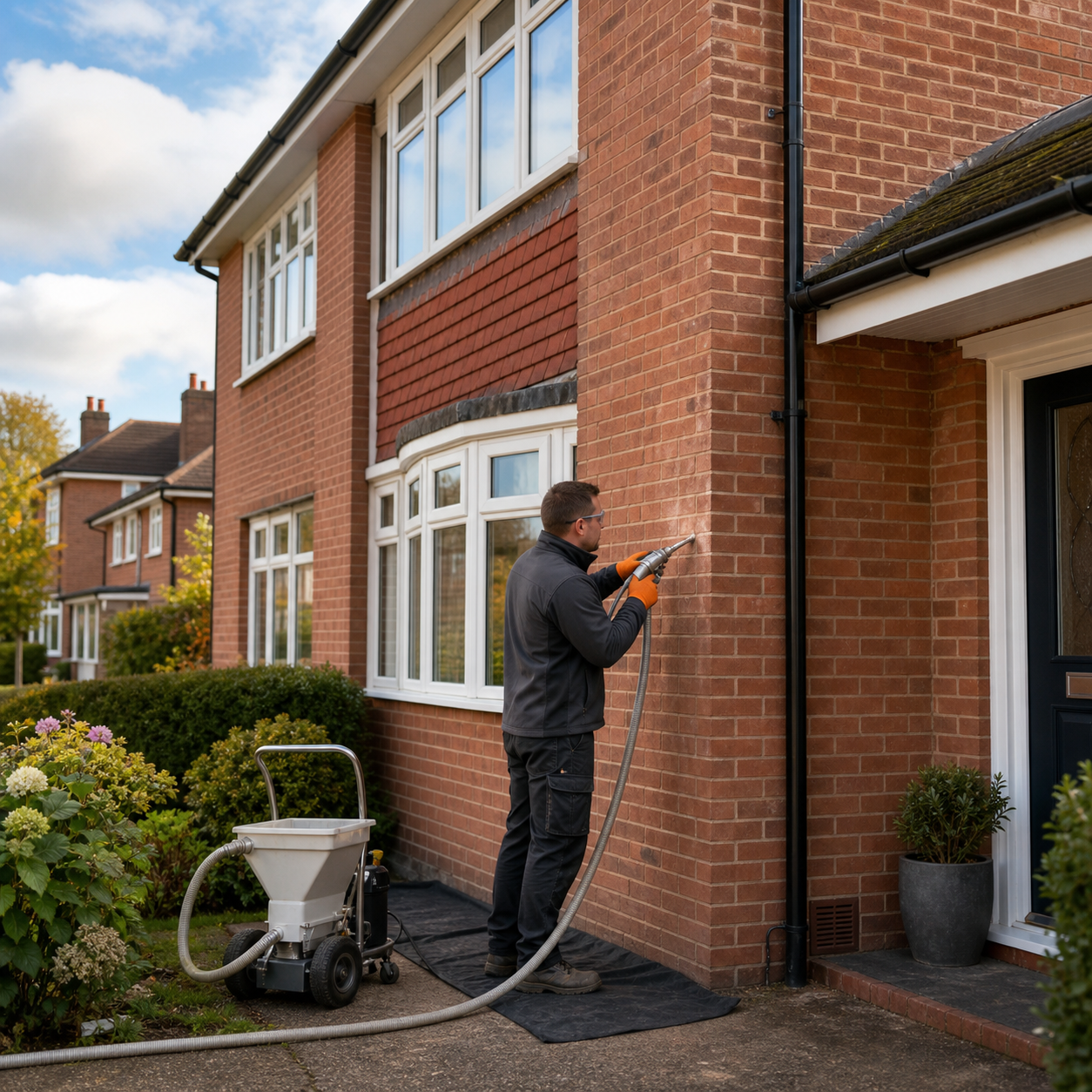
The installation is usually done from outside. The installer drills small holes in the external wall, blows or injects insulation into the cavity, then seals the holes with mortar. Energy Saving Trust says the holes are around 22mm and are usually drilled at intervals of around 1m. For a suitable average home with easy access, the work can often be completed in about two hours.
The most common materials are bonded bead systems, mineral fibre and foam products. The right choice depends on the cavity width, exposure to driving rain, property condition, guarantee route and the installer specification. The material matters, but the survey matters more. A poor survey can turn a sensible measure into a damp risk.
Why it matters in 2026
Ofgem has set the price cap for 1 April to 30 June 2026 at £1,641 per year for a typical dual fuel household paying by Direct Debit. The average Direct Debit unit rates for that period are 24.67p per kWh for electricity and 5.74p per kWh for gas, with standing charges of 57.21p per day for electricity and 29.09p per day for gas.
Those figures mean heat loss still has a direct cost. If a home leaks heat through empty cavity walls, the boiler or heat pump has to run longer to keep rooms comfortable. Cavity wall insulation does not make energy free, but it reduces demand. That is important whether the home uses gas, electricity, oil, LPG, storage heaters or a heat pump.
It also matters for grant work. Warm Homes Local Grant surveys look at the home as a whole, not just one product. If wall insulation is missing, it may be one of the first improvements recommended before low carbon heating is considered. A heat pump in a leaky home can still work, but it may need larger emitters, higher flow temperatures and more electricity than it would in a better insulated property.
Which homes usually have cavity walls
Energy Saving Trust says homes built after the 1920s are likely to have cavity walls. Homes built from the 1990s onwards are more likely to already have wall insulation, although this still needs checking rather than guessing.
If the outside brickwork is visible, the brick pattern can help. Cavity walls often show a regular pattern where the long face of each brick is visible. Solid walls often show an alternating pattern with some smaller brick ends visible. Wall thickness can also help. Energy Saving Trust says a brick wall between 260mm and 350mm thick is likely to be a cavity wall, while a narrower wall is more likely to be solid.
An EPC can also give clues. It may describe the wall type and whether insulation is assumed, present or recommended. The safest route is still a professional survey using a borescope, because EPC assumptions can be wrong and some older homes have unusual construction.
When cavity wall insulation is suitable
A home is usually a good candidate when the external walls are unfilled cavity walls, the cavity is at least 50mm wide, the cavity is clear, the brickwork and mortar are in good condition, the home is not heavily exposed to driving rain, and there is no existing damp problem that needs fixing first.
The survey should check the whole envelope. That means brickwork, pointing, render, gutters, downpipes, roof edges, air bricks, vents, damp signs, wall ties, cavity rubble and exposure. If defects are found, they should be fixed before insulation is installed. Insulation should not be used to hide a maintenance problem.
For terraced and semi detached homes, the installer may need to use cavity barriers so insulation stays within the correct property. For flats, an individual flat usually cannot be insulated on its own. The building owner and other residents may need to agree to a whole block approach.
When it may be the wrong upgrade
Cavity wall insulation is not right for every home. Energy Saving Trust warns against installation where the home is exposed to extreme weather, exposed to flooding, in poor condition, at risk of overheating, or built with narrow cavities of less than 50mm, which is common in some older homes.
It can also be unsuitable where there is existing damp, defective pointing, cracked render, blocked drainage, failed gutters, contaminated cavities or wall tie problems. In these cases, the answer may be repair first, choose a different insulation method, or leave the cavity alone.
The damp question is important. Properly specified cavity wall insulation should not create damp in a suitable home. Problems usually arise when water can already get into the wall, when ventilation is blocked, when the cavity is too narrow, or when the property is too exposed for the chosen material. A good installer should be willing to say no.
What cavity wall insulation costs in 2026
Energy Saving Trust gives a typical installed cost of around £2,700 in Great Britain and around £1,000 in Northern Ireland. That is a useful benchmark, but real quotes vary by house size, wall area, access, region, material, survey result, existing defects and whether removal of old failed insulation is needed.
Trade cost guides in 2026 commonly show lower figures for simple mid terrace or semi detached jobs and higher figures for larger detached homes or difficult access. The key is not to chase the lowest quote. The cheapest job is poor value if the installer skips the survey, uses the wrong material, blocks ventilation or fails to provide a recognised guarantee.
As a practical guide, expect a proper quote to include survey findings, material type, wall area, preparation works, ventilation protection, cavity barriers where needed, guarantee details and what happens if the survey finds the home is unsuitable. If the quote is just a price and a start date, ask for more detail.
How much can it save
The saving depends on the home. A larger detached property with empty cavities, high heat demand and long heating hours will usually save more than a small terrace with moderate heating use. Energy Saving Trust says wall heat loss can account for about 33% of heat loss in an uninsulated home, which explains why the measure can feel noticeable as well as financial.
The saving also depends on fuel. Avoided electric heating costs are usually worth more per kWh than avoided gas costs because electricity has a higher unit price. For heat pumps, the saving shows up as lower heat demand and fewer running hours. For gas homes, the saving shows up as lower gas use. For oil and LPG homes, it depends on current fuel price and system efficiency.
Comfort is part of the return. Cavity wall insulation can reduce cold wall surfaces, improve room stability and reduce the feeling that heat disappears soon after the heating turns off. That matters for older residents, children, people with health conditions and anyone trying to keep bills down without living in a cold home.
Can cavity wall insulation improve an EPC
Yes, it can help an EPC, although the exact impact depends on the starting point. An EPC is a model of the home, not a direct measurement of comfort. If the certificate currently says cavity walls are uninsulated, adding insulation can improve the fabric assumptions and may lift the rating.
This is especially relevant for landlords. The Warm Homes Plan confirms the direction of travel for higher minimum energy standards in the private rented sector by 2030. Landlords should not treat cavity wall insulation as the whole answer, but it is often one of the more practical first measures where the wall type is suitable.
For homeowners, the EPC point is also useful because grant routes often start with EPC D to G homes. A home that is cold, expensive to heat and rated D, E, F or G may be a strong candidate for a funded package if the household also meets the income, benefit or postcode route.
Warm Homes Local Grant and cavity wall insulation
The Warm Homes Local Grant is the key funded route for cavity wall insulation in England in 2026. GOV.UK says the scheme can support free energy saving improvements for eligible households on a low income, receiving certain benefits or living in certain postcode areas.
The home must be in England, privately owned by the occupier or landlord, and have an EPC rating of D, E, F or G. Household income must usually be £36,000 a year or less, although a household may still qualify through a postcode route or benefit route. GOV.UK says councils will usually contact applicants within 10 working days to get more information and arrange a home survey.
GOV.UK lists wall, loft and underfloor insulation, air source heat pumps, smart controls and solar panels as examples of measures that may be recommended. The council organises and pays for agreed work, although landlords may need to contribute for some improvements.
Warm Homes Plan and why fabric comes first
The Warm Homes Plan is the broader programme behind the next phase of home upgrades. GOV.UK says the government will invest £15 billion over this Parliament to cut energy bills, upgrade up to 5 million homes, support up to 180,000 additional jobs by 2030 and reduce emissions from buildings.
For cavity wall insulation, the important point is sequencing. The Warm Homes Plan is not just about swapping heating systems. It is also about improving the building fabric so homes need less energy in the first place. For many homes, wall insulation, loft insulation, draught control, ventilation and heating controls are the sensible first layer before solar panels or a heat pump.
This is also why a survey should not feel like a sales visit. A good retrofit survey asks what the home needs, what the residents need, what the building can safely accept and what order the work should happen in.
BUS and cavity wall insulation
The Boiler Upgrade Scheme does not fund cavity wall insulation. It funds eligible low carbon heating systems. GOV.UK currently lists £7,500 for an air source heat pump, £7,500 for a ground source heat pump, £5,000 for a biomass boiler and £2,500 for an air to air heat pump. It also says hybrid heat pump systems are not eligible.
That does not make BUS irrelevant to cavity wall insulation. If you are thinking about a heat pump, fabric work can affect the system design. Lower heat loss can mean lower flow temperatures, better seasonal efficiency, less strain on radiators and a more comfortable home.
In many projects, the right question is not whether to choose insulation or a heat pump. The right question is what order makes the home cheaper to run and easier to heat.
How the installation should work
A responsible process starts with an eligibility and suitability check. The installer should confirm wall type, cavity width, exposure, damp risk, cavity condition, access, ventilation, adjacent properties and guarantee route. If the project is grant funded, there may also be EPC checks, income checks and whole house assessment requirements.
The installer then drills small holes in the outside wall, injects the insulation material, checks coverage and seals the holes. The work is normally external, so disruption inside the home is limited. You may still need clear access around walls, moved garden items, safe working space and permission for scaffold or ladders where needed.
After completion, you should receive paperwork. Keep the invoice, product details, guarantee certificate, survey notes and any grant documents. Energy Saving Trust says CIGA or an independent insurance backed guarantee may provide cover, and it references 25 years for CIGA backed cavity wall insulation work.
The checks to make before saying yes
Before you agree to the work, ask these questions.
- What wall type do I have and how was this confirmed
- What is the measured cavity width
- Is the cavity clean and free from rubble
- Is the property exposed to heavy driving rain
- Are the brickwork, pointing, gutters and damp proofing sound
- Which insulation material is being used and why
- How will vents and air bricks be protected
- Is a cavity barrier needed at a boundary wall
- What guarantee will I receive
- What happens if the survey finds the home is unsuitable
If the answers are vague, pause. Cavity wall insulation is a good upgrade when the property is right. It is not a product that should be pushed into every wall.
Common problems to avoid
The main mistake is treating cavity wall insulation as a universal quick fix. It is quick only after the home has passed the survey. Exposed locations, narrow cavities, cracked render, old failed insulation, damp patches, blocked air bricks and missing guarantees should all slow the decision down.
Another mistake is ignoring ventilation. Warmer walls are helpful, but homes still need controlled airflow. Blocking underfloor grilles, wall vents or trickle vents can create moisture problems elsewhere.
The third mistake is doing upgrades in the wrong order. If gutters are leaking, pointing is failing or render is cracked, fix those first. If loft insulation is missing, consider whether it should be done at the same time. If a heat pump is planned, use the insulation result in the heat loss calculation rather than designing the heating system around the old fabric.
Is cavity wall insulation worth it in 2026
For a suitable home with empty cavity walls, cavity wall insulation is often worth serious consideration. It tackles a large source of heat loss, improves comfort, can support EPC improvement and may be fully funded for eligible households through the Warm Homes Local Grant.
It is not right for every property. A damp, exposed or poorly maintained wall should not be filled just because funding exists. The best outcome comes from a proper survey, a clear specification, a recognised guarantee and a whole house view of what the property needs next.
If your home is EPC D to G, has uninsulated cavity walls and is expensive to heat, start with the EPC and a suitability survey. If you qualify for Warm Homes Local Grant, the council may be able to arrange and pay for the work. If you are planning a heat pump through BUS, cavity wall insulation may be the fabric upgrade that helps the system run better once installed.
In 2026, the case for cavity wall insulation is simple. Do it when the building is suitable, fund it where you can, and treat it as part of a wider plan for a warmer, cheaper and more resilient home.