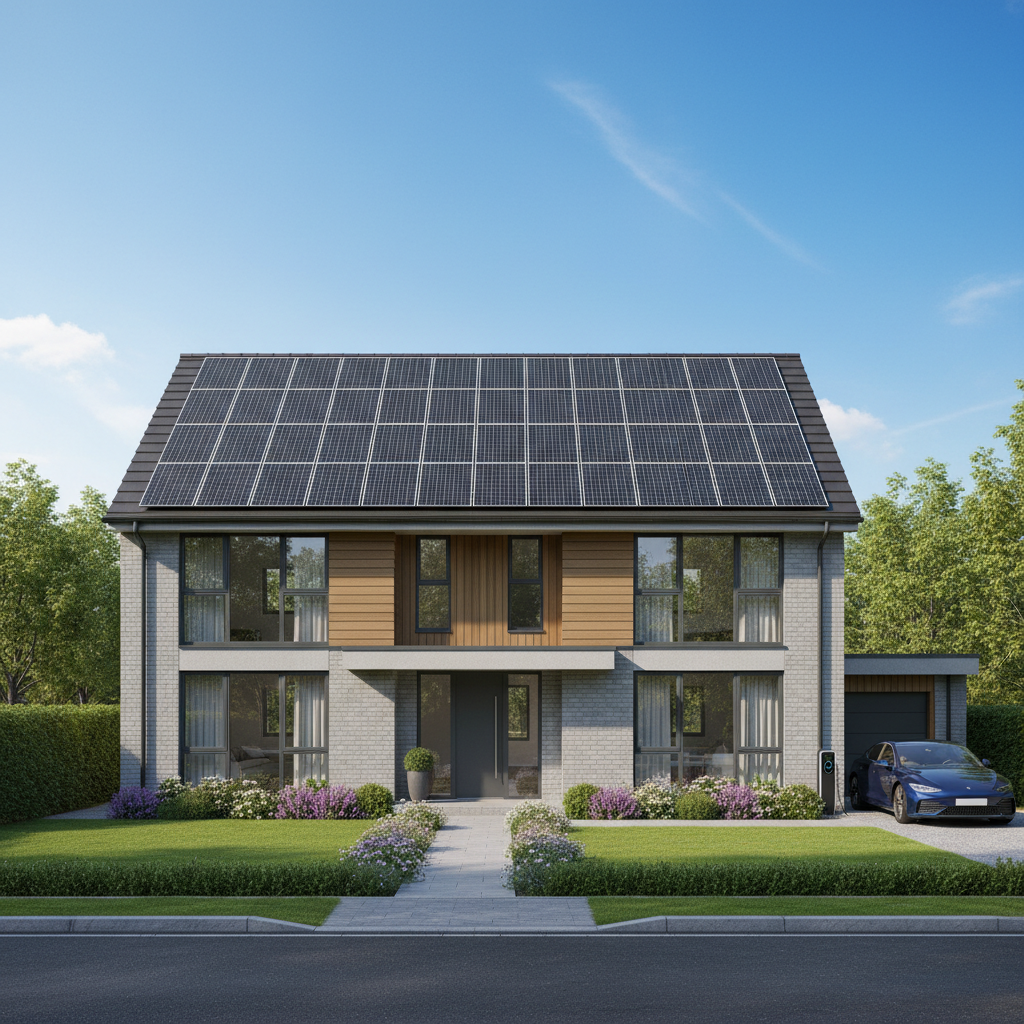
A complete 2026 guide to home solar PV in the UK. Covers installed costs, realistic annual savings at the April 2026 price cap, the best Smart Export Guarantee tariffs, the 0 percent VAT window closing in March 2027, MCS certification, G98 and G99 grid connection rules, and how the Warm Homes Plan and Warm Homes: Local Grant fund solar for eligible households.
What this guide covers
If you are looking at solar panels in the UK in 2026, you have a lot of moving pieces to make sense of. The April 2026 price cap dropped electricity to 27.7p per kWh, but that is still expensive enough that self generated solar is one of the most reliable ways to cut a household bill. The 0 percent VAT rate on solar and battery installations is still in place. Export tariffs have shifted, with some suppliers cutting their fixed rates and others holding steady. And the Warm Homes Plan and Warm Homes: Local Grant routes now include solar panels and batteries for eligible low income households for the first time at scale.
This is a complete 2026 guide to what solar panels cost, what they save, how to pay for them, the rules around grid connection and planning, and how to tell whether a quote you have been given is genuinely competitive. Every figure has been cross referenced against primary sources including Ofgem, MCS, gov.uk, and current installer cost data.
How much do solar panels cost in 2026?
A typical home solar panel installation in 2026 sits in the £5,500 to £8,500 range fully installed, with the average cost of a 4 kW system on a three bedroom UK house coming in at roughly £7,505 as of April 2026. That price includes panels, inverter, mounting, cabling, scaffolding, certification, and the installer's labour and overhead. It does not include a battery. A few benchmark figures to anchor expectations:
- 3 kW system: around £4,500 to £6,500 installed (smaller homes, two bedroom or modest three bedroom)
- 4 kW system: around £5,500 to £8,500 installed (the most common size for an average UK home)
- 5 kW to 6 kW system: around £8,000 to £12,000 installed (larger detached homes or homes with high daytime usage)
- 8 kW to 10 kW system: around £12,000 to £17,000 installed (large detached, multi generational, or homes pairing solar with EVs and heat pumps)
These figures come from a blend of Renewable Energy Hub, Eco Experts, Checkatrade 2026 cost guides, and Solar ROI Calculator's April 2026 dataset. Prices for the same 4 kW system can swing by £1,500 to £2,500 between installers and roof types, which is why getting at least three MCS certified quotes is essential.
Why panel prices have stabilised
After several years of falling module prices, the panels themselves are no longer the biggest part of the bill. In 2026 the cost of a typical residential install is roughly 25 percent panels, 20 percent inverter and electrical, 15 percent battery if fitted, 15 percent labour and scaffolding, and 25 percent installer margin, certification, and admin. That mix matters because chasing the cheapest panel price almost never moves the total cost meaningfully. The bigger savings come from picking an installer with efficient working practices, sensible margins, and a clean install design.
What you can actually save in a year
The savings from a solar PV system come from two places. The first is self consumption, which means electricity you use directly from your panels instead of buying from the grid. The second is exporting surplus to the grid through the Smart Export Guarantee.
At Ofgem's April to June 2026 price cap of 27.7p per kWh for electricity, every kWh you generate and use is worth 27.7p back. A typical 4 kW to 6 kW system on a UK home produces around 3,400 to 5,200 kWh per year, depending on roof orientation, pitch, and shading. Realistic annual savings for an average household look like this:
- 4 kW system without a battery: £450 to £700 per year, with a 6 to 9 year payback
- 4 kW system with a 5 kWh battery: £900 to £1,200 per year, with an 8 to 11 year payback
- 6 kW system with a 10 kWh battery: £1,100 to £1,400 per year, with a 9 to 12 year payback
Households with high daytime usage, such as anyone working from home, running a heat pump, charging an EV at home, or with multiple in home occupants during the day, sit at the upper end of these ranges. Households that are out all day with no battery sit at the lower end because more of the generation gets exported at SEG rates rather than consumed at the full import price.
Smart Export Guarantee in 2026
Every solar installation has to be registered for the Smart Export Guarantee, the scheme that pays you for surplus electricity sent to the grid. In 2026 the best fixed export tariffs available are:
- E.ON Next Export Premium v3: 17.5p per kWh, only if E.ON installed your system and supplies your import
- E.ON Next Export Exclusive: 16.5p per kWh fixed for 12 months
- British Gas Export and Earn Plus: 15.1p per kWh
- OVO Smart Solar Export: 15p per kWh
- EDF Export 12m: 15p per kWh
- Octopus Outgoing Fixed: 12p per kWh, reduced from 15p in March 2026
Variable smart tariffs, such as Octopus Intelligent Flux and Cosy Octopus, can pay considerably more during peak windows but require a smart meter recording half hourly export data and benefit most from a battery you can dispatch into the grid at the right times. To register for SEG you need an MCS certificate, a SMETS2 smart meter capable of half hourly export readings, and either a G98 or G99 grid connection notification on file.
Battery storage in 2026
Adding a battery transforms the economics of solar by letting you store daytime generation for evening and overnight use. In 2026 typical battery costs installed alongside a new solar system are:
- 5 kWh battery: £3,000 to £4,500 fitted with solar
- 10 kWh battery: £5,500 to £7,500 fitted with solar
- 15 kWh battery: £8,000 to £11,000 fitted with solar
Retrofitting a battery to an existing solar array typically adds £1,000 to £2,000 to those figures. Lithium iron phosphate (LFP) chemistry now dominates the residential market because of its safety, depth of discharge, and longer cycle life. Useful warranties run to ten years or 6,000 cycles for the better brands. Battery additions usually shorten the overall payback period for a household with high evening use because they eliminate the daily pattern of generating cheap solar in the day and buying expensive grid electricity at night.
The 0 percent VAT window closes in March 2027
Solar panels and battery storage installed in residential properties in Great Britain currently benefit from a 0 percent VAT rate. This zero rate applies to both retrofitted batteries (added to an existing solar array) and to new combined solar plus battery installs. The zero rate is set to end on 31 March 2027 and revert to 5 percent VAT thereafter. For a typical £8,500 install, the 0 percent VAT window saves you £425 against the post 2027 rate. Any household considering solar in the next 12 months should factor in the closing window when deciding when to commission their install.
Permitted development and planning rules
Most domestic solar installations in England are permitted development under Part 14, Class A of the Town and Country Planning (General Permitted Development) (England) Order 2015, meaning no planning application is needed if the install meets the following conditions:
- Roof mounted panels do not protrude more than 200mm beyond the roof plane
- Panels do not extend above the highest part of the roof, excluding the chimney
- On flat roofs, panels do not extend more than 0.6m above the roofline (rule updated November 2023)
- Ground mounted arrays do not exceed 9 square metres in area
- Listed buildings, conservation areas, AONBs, and World Heritage Sites carry additional restrictions on principal or side elevations visible from a highway
Installations in conservation areas remain permitted development but only on rear elevations not visible from the road. Listed buildings always require listed building consent regardless of permitted development status. Wales, Scotland, and Northern Ireland operate broadly similar rules with minor variations.
Grid connection: G98 and G99 explained
Every solar installation has to be notified to or approved by your local Distribution Network Operator before commissioning. The threshold sits at 16 amps per phase, which equates to 3.68 kW on a single phase property. The two routes are:
- G98: applies to systems up to 3.68 kW on single phase. The installer can fit and commission first, then notify the DNO within 28 days. This is the route most 4 kW systems with export limiting take.
- G99: applies to anything above 3.68 kW or any installation on three phase. Pre approval from the DNO is required before installation begins. Processing typically takes two to eight weeks but can stretch longer in capacity constrained areas.
Reputable MCS installers handle both applications as part of the install. Refused G99 applications are increasingly common in some areas because of local network capacity limits, particularly in the South East and parts of the South West, so it is worth asking any installer how they would handle a refusal before signing a contract.
Why MCS certification matters
To register for the Smart Export Guarantee, claim 0 percent VAT, and stay eligible for any future grant funding routes that come through the Warm Homes Plan, your installer must be MCS certified. MCS is the company level certification scheme run by Microgeneration Certification Scheme Service Company Ltd. Individual electricians cannot hold MCS status independently. The Solar PV Installation Standard MIS 3002 was updated for 2025 with a transition period ending 18 June 2026, after which all installs must follow the new requirements.
Beyond compliance, the practical reasons MCS matters are:
- Without an MCS certificate, you cannot register a SEG export tariff, so you would lose the ongoing income from surplus generation.
- Without MCS, the 0 percent VAT scheme does not apply, adding £400 to £700 to a typical install.
- Insurance and mortgage providers often require MCS documentation for energy efficiency related underwriting.
- Future grant routes through the Warm Homes Plan and Warm Homes: Local Grant require MCS certified installers.
When checking installer credentials, verify the company directly on the public MCS Certified register at mcscertified.com rather than taking a logo on a website at face value.
Funded routes for solar in 2026
Three publicly funded routes touch on solar in 2026, but only one funds it directly.
Warm Homes: Local Grant
The Warm Homes: Local Grant offers up to £15,000 of fully funded upgrades for low income households on EPC D to G properties. Insulation, heat pumps, solar panels, and battery storage are all in scope. Eligibility is administered by local councils and typically requires either a household income at or below £36,000, a qualifying postcode (IMD deciles 1 to 2), or a qualifying benefit. The exact income threshold varies by council, ranging from £23,000 in some authorities to £38,000 in others. If you think you qualify, your starting point is your local council's Warm Homes Local Grant page on gov.uk.
Warm Homes Plan
The £13.2 billion Warm Homes Plan committed to upgrading five million UK homes by 2030. The plan includes free or subsidised solar loans for households not eligible for the fully funded Local Grant route. Loan terms and providers were still being finalised through early 2026 but the broad structure is low interest finance repaid over the lifetime of the install.
Boiler Upgrade Scheme
The Boiler Upgrade Scheme covers heat pumps and biomass boilers only. It does not fund solar panels. If you are considering both solar and a heat pump, the heat pump grant is claimed separately under BUS while the solar element is paid for either privately, through the Warm Homes Plan loan route, or through the Local Grant if you qualify.
How long do solar panels last?
Modern monocrystalline solar panels carry product warranties of 12 to 25 years and performance warranties guaranteeing typically 90 percent of original output at 10 years and 80 percent at 25 years. Real world degradation rates in the UK sit between 0.3 and 0.8 percent per year, with the National Renewable Energy Laboratory's 2024 study finding a median performance loss of 0.75 percent per year. A 4 kW system installed in 2026 with median degradation will still produce around 83 percent of its rated output at year 25.
The inverter is the more limited component. String inverters typically last 10 to 15 years and are replaceable for £700 to £1,500. Hybrid inverters paired with batteries often carry 10 year warranties. Battery cycle life sits at 6,000 cycles or roughly 12 to 15 years for a household using one cycle per day.
Monocrystalline is the only sensible choice in 2026
Polycrystalline panels, which dominated the residential market a decade ago at 13 to 16 percent efficiency, are no longer manufactured at meaningful scale. Monocrystalline panels with TOPCon technology now account for roughly 75 percent of global production and reach 20 to 25 percent module efficiency in current generation residential products. The practical implication is that a typical 400 W to 440 W panel in 2026 fits well on a standard UK home roof and produces enough output to make sub 4 kW systems sensible on smaller roofs that would not have been viable five years ago.
What to ask any solar installer
Whether you are buying a £6,000 install or a £15,000 install, the questions that separate good installers from average ones are:
- Show me your MCS certificate number and I will verify it on mcscertified.com.
- Which Consumer Code do you operate under, RECC or HIES.
- What inverter brand and model are you proposing, and what is its warranty.
- Are you applying G98 or G99, and how do you handle a DNO refusal.
- What is your commissioning and SEG registration process.
- What are the workmanship and product warranties.
- What is included in the price and what is excluded, including scaffolding, extras, and certification.
A good installer will answer all of these without hesitation and provide written confirmation in the quote.
Should you fit solar in 2026?
Solar still makes financial sense for most owner occupied UK homes with reasonable south facing or east plus west roof space, especially if you are home during the day, run a heat pump, charge an EV, or are willing to add a battery. The combination of the 27.7p per kWh April 2026 price cap, 0 percent VAT until March 2027, and SEG rates of up to 17.5p per kWh creates one of the strongest payback environments since the Feed in Tariff era. Households on low incomes should check the Warm Homes: Local Grant route first, because the up to £15,000 of fully funded upgrades it offers can pay for solar, batteries, and the insulation needed alongside.
For everyone else, the practical advice in 2026 is to get three MCS certified quotes, verify all certifications independently, plan around the closing 0 percent VAT window in March 2027, and be realistic about your daytime electricity usage when sizing the system and deciding whether to add a battery. Solar in the right home with the right install delivers a return that few other home upgrades can match.