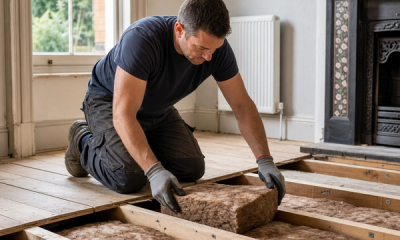
Solid walls are found in the majority of UK homes built before 1920, and they lose heat at almost twice the rate of a modern cavity wall. This guide covers everything you need to know about internal and external wall insulation in 2026: what it costs, how much you can save on energy bills, and how to access the generous grant funding now available through the Warm Homes Plan and other schemes.
If your home was built before 1920, there is a strong chance it has solid walls rather than the cavity construction that became standard in the decades that followed. Solid walls conduct heat away from your home far more readily than a modern insulated cavity wall, and that means you are spending more on heating than you need to. The good news is that 2026 is one of the best years on record to tackle the problem, because government funding has never been more accessible.
What Are Solid Walls and How Do You Identify Them?
A solid wall is exactly what it sounds like: a wall built from a single continuous layer of brick or stone, with no gap in the middle. The cavity wall, which features two separate leaves of brick with an air gap between them, was not widely adopted in the UK until the 1920s and 1930s. That means the majority of Victorian and Edwardian terraces, semis, and detached properties rely entirely on the thermal mass of their solid masonry to retain heat.
You can often identify a solid wall from outside. Look at the pattern of the brickwork at a corner of the house. If you can see bricks laid lengthways and then bricks laid widthways alternating in a regular pattern, this is known as English bond or Flemish bond and it is a strong indicator of solid construction. A cavity wall, by contrast, will show only the long face of bricks (known as stretchers) on the outer leaf.
You can also measure the wall thickness from a window or door reveal. A solid brick wall is typically around 220mm thick. A cavity wall is usually 270mm to 300mm or more because of the gap. If your wall is thinner than 250mm and the property dates from before 1930, you almost certainly have solid walls.
Internal Wall Insulation vs External Wall Insulation: Which Is Right for Your Home?
There are two main approaches to insulating a solid wall: internal wall insulation (IWI), which adds insulation on the inside face of the external walls, and external wall insulation (EWI), which wraps the outside of the building in an insulation layer topped with a new render or cladding system. Each approach has distinct advantages and trade-offs.
Internal Wall Insulation
IWI involves fixing insulation boards or constructing a stud wall filled with mineral fibre or spray foam directly against the internal face of exterior walls. It is the more common choice for terraced and semi-detached properties in conservation areas, or where the external appearance must be preserved, because it leaves the outside of the building entirely unchanged.
The main drawback of IWI is that it reduces the floor area of each room by a small amount, typically 100mm to 150mm per treated wall. Skirting boards, window sills, architraves, radiators, sockets, and light switches all need to be repositioned. This makes IWI a more disruptive installation than EWI, and it is best undertaken during a wider renovation or between tenancies.
External Wall Insulation
EWI wraps the home in an insulation layer, typically expanded polystyrene (EPS) or mineral wool boards, which is then protected by a reinforced render finish, brick slip system, or a ventilated cladding system. Because the work is all external, there is virtually no internal disruption. Residents can remain in the property throughout the installation, and room sizes are unaffected.
EWI also delivers additional benefits beyond thermal performance. It refreshes the external appearance of the building, protects the masonry from weather, and can improve resistance to driving rain. The trade-off is that planning permission may be required in conservation areas or for listed buildings, and the appearance of the property will change noticeably.
In practice, the choice between IWI and EWI often comes down to planning constraints, the condition of the existing external fabric, whether the property is in a terrace (where EWI on a party wall is not possible), and the preferences of the occupant. A Cucumber Eco surveyor can assess your specific property and make a recommendation based on all of these factors.
How Much Does Solid Wall Insulation Cost in 2026?
Solid wall insulation is not the cheapest home improvement you can undertake, but it is among the most impactful. The following cost ranges are for a typical UK semi-detached property and are based on current market rates in 2026.
Internal Wall Insulation Costs
For a semi-detached property, IWI typically costs between £8,000 and £15,000 for a full installation covering all external walls. The wide range reflects differences in the number of rooms treated, the insulation system chosen (rigid board systems tend to cost more than stud and mineral fibre), the level of internal making good required, and regional labour rates.
For a larger detached property, costs can rise to £20,000 or beyond. For a smaller mid-terraced house where only the front and rear walls are external, costs can fall towards the lower end of the range.
External Wall Insulation Costs
EWI for a semi-detached property typically costs between £9,000 and £22,000. The higher end of this range reflects premium render finishes, brick slip systems, or the additional complexity of working around extensions, conservatories, and bay windows. The lower end reflects a straightforward render finish on a simple box form property.
EWI on a detached property can reach £30,000 or more for a large Victorian villa with complex external geometry. For a detached bungalow with a simple footprint, costs are typically more modest.
It is worth noting that both IWI and EWI projects can attract significant grant funding in 2026, which can reduce or in some cases eliminate the cost to the homeowner entirely. We cover the available schemes in detail below.
How Much Will You Save on Your Energy Bills?
The Energy Saving Trust publishes savings figures for solid wall insulation based on typical gas-heated properties at current energy prices. These figures give a useful benchmark for what homeowners in standard property types can expect.
For a semi-detached property, solid wall insulation can save up to £310 per year on heating bills. For a detached property, the saving rises to up to £450 per year. These figures assume a gas boiler and average occupancy, and savings can vary depending on the existing fabric of the building, the heating system in use, and the occupant behaviour.
Homes that switch to a heat pump after solid wall insulation is installed may see even greater ongoing savings, since a well-insulated fabric allows a heat pump to operate at lower flow temperatures and therefore at higher efficiency. This combination of fabric first and low carbon heating is at the centre of the government's Warm Homes Plan.
The Impact on Your EPC Rating
Solid wall insulation is one of the most powerful single measures available for improving an Energy Performance Certificate rating. A typical Victorian semi-detached home rated E or F can expect to gain two full EPC bands after solid wall insulation is installed, which often means reaching a C rating. This is significant for several reasons.
First, many mortgage lenders now offer preferential green mortgage rates to properties rated C or above, which can translate into meaningful interest savings over the life of a mortgage. Second, a higher EPC rating makes a property more attractive to buyers and tenants. Third, the proposed Minimum Energy Efficiency Standards (MEES) for the private rented sector are expected to require all rented properties to reach EPC C by 2030, meaning landlords with solid-walled properties face a clear deadline.
The Home Energy Model and the Future of EPC Assessments
The government plans to replace the existing Standard Assessment Procedure (SAP) with the new Home Energy Model (HEM) in the second half of 2027. HEM is designed to be a more accurate representation of actual energy performance, and one key change is that it will assess the thermal performance of the building fabric as a standalone metric, separately from the heating system score.
This means that solid walls, which are currently one of the biggest drags on a SAP score, will be assessed in a way that makes the fabric improvement from insulation even more visible and valuable in the rating. If you are planning to install solid wall insulation, doing so before HEM is introduced will mean your property will be well positioned when the new framework arrives.
MEES 2030 and the Challenge for Landlords
For landlords, solid wall insulation is at the centre of the MEES 2030 compliance challenge. The proposed regulations would require all privately rented properties to achieve EPC C by 2030, and solid-walled properties are disproportionately represented among the stock that currently sits at D, E, F, and G ratings.
For many landlords, solid wall insulation will be the single most important measure in a compliance strategy, because it delivers the largest single improvement in EPC rating of any available measure. The challenge is that it is also among the most expensive, which is precisely why the government has designed its grant schemes to prioritise properties with the lowest ratings and the greatest improvement potential.
Landlords who act early, taking advantage of current grant funding before demand for installers increases as the 2030 deadline approaches, are likely to face less competition for installation slots and more flexibility in the timing of works.
Grant Funding Available in 2026
There are currently three main routes to funded solid wall insulation in England in 2026. The right scheme for you will depend on your income, your property's EPC rating, and the area you live in.
The Warm Homes Plan
The Warm Homes Plan is the flagship government scheme for home energy upgrades in 2026. It provides grants of up to £30,000 per property for a package of improvements that can include solid wall insulation, heat pumps, solar panels, and other measures. Eligibility is based on two criteria: either the household has a combined income below £36,000 per year and the property has an EPC rating of D or below, or the property is located in one of the first or second most deprived deciles according to the Index of Multiple Deprivation (IMD).
For households with a solid-walled property and a low EPC rating, the Warm Homes Plan can fund the entirety of the insulation works with no contribution required from the homeowner. This makes it the most generous funding route available.
The Warm Homes Local Grant
The Warm Homes Local Grant is administered by local authorities and is currently funded through to March 2028. It targets low income households in the owner occupied and private rented sectors and provides grants for a range of insulation and heating measures. Because it is locally administered, the specific eligibility criteria, the measures covered, and the grant levels can vary between local authority areas. Cucumber Eco works with local authorities across the regions we serve and can advise on whether your property falls within a funded area.
The Boiler Upgrade Scheme
The Boiler Upgrade Scheme (BUS) provides a grant of £7,500 towards the cost of installing an air source or ground source heat pump. It is not a grant for insulation directly, but it is highly relevant for solid-walled properties because the combination of insulation and a heat pump is the most cost-effective route to a low EPC rating and low running costs. BUS has no income test, meaning it is available to all homeowners regardless of income, and it can be used alongside other grants for the insulation element of the project.
How to Get Started with Cucumber Eco
Cucumber Eco offers a free, no-obligation consultation for homeowners and landlords considering solid wall insulation. During your consultation, one of our energy advisers will review your property's EPC certificate and any available survey data, confirm whether your property has solid walls, identify the most appropriate insulation approach (IWI or EWI), assess your eligibility for the Warm Homes Plan, Warm Homes Local Grant, and BUS, and provide a clear, itemised cost estimate showing any grant deductions.
If you decide to proceed, we manage the entire project from grant application through to installation and post-works EPC assessment, using our network of accredited installers. There is no pressure to commit at the consultation stage.
Frequently Asked Questions
Does solid wall insulation require planning permission?
IWI does not require planning permission because it involves no external changes to the property. EWI may require planning permission if the property is in a conservation area, is a listed building, or falls within an area where permitted development rights have been withdrawn. Your Cucumber Eco adviser will confirm this at the consultation stage.
How long does the installation take?
A full IWI installation on a semi-detached property typically takes five to ten working days. EWI on a similar property typically takes seven to fourteen working days depending on the complexity of the external geometry and the finish specified. Your installer will provide a detailed programme before works begin.
Will there be disruption to my home during IWI installation?
IWI is one of the more disruptive home improvements because it requires work in every room with an external wall. Furniture will need to be moved, skirting boards and architraves will be removed and refitted, and there will be dust and noise during the installation period. However, the works are typically complete within two weeks and the finished result is a noticeably warmer and more comfortable home. Most households choose to remain in the property during IWI installation, though some prefer to arrange alternative accommodation for the first few days.
Is solid wall insulation suitable for all pre-1920 properties?
The vast majority of solid-walled properties are suitable for either IWI or EWI, but a pre-installation survey is always required to check for any damp issues, structural concerns, or other factors that might affect the installation. Damp must be diagnosed and treated before insulation is installed, since trapping moisture within a wall can cause damage and reduce the effectiveness of the insulation. Our surveyors check for all of these issues as part of the free consultation process.
Can I install solid wall insulation on just one or two rooms?
Technically yes, but a partial installation is less effective and can create thermal bridging at the junctions between treated and untreated areas. Grant funding schemes generally require a whole-house approach to ensure the maximum benefit is achieved. If budget is a concern, your adviser can help you identify a phased approach that still meets the requirements of any applicable grant scheme.
How long does solid wall insulation last?
A properly installed IWI or EWI system will last for the lifetime of the building when correctly maintained. EWI systems typically come with a manufacturer guarantee of 25 years or more. IWI board systems are equally durable provided the internal finishes are maintained and any leaks from above are addressed promptly. The payback period at current energy prices is typically 25 to 35 years without grant funding, and under ten years with the levels of grant funding currently available.
To find out whether your property qualifies for grant funding and to get a no-obligation cost estimate for solid wall insulation, book your free consultation with Cucumber Eco today.