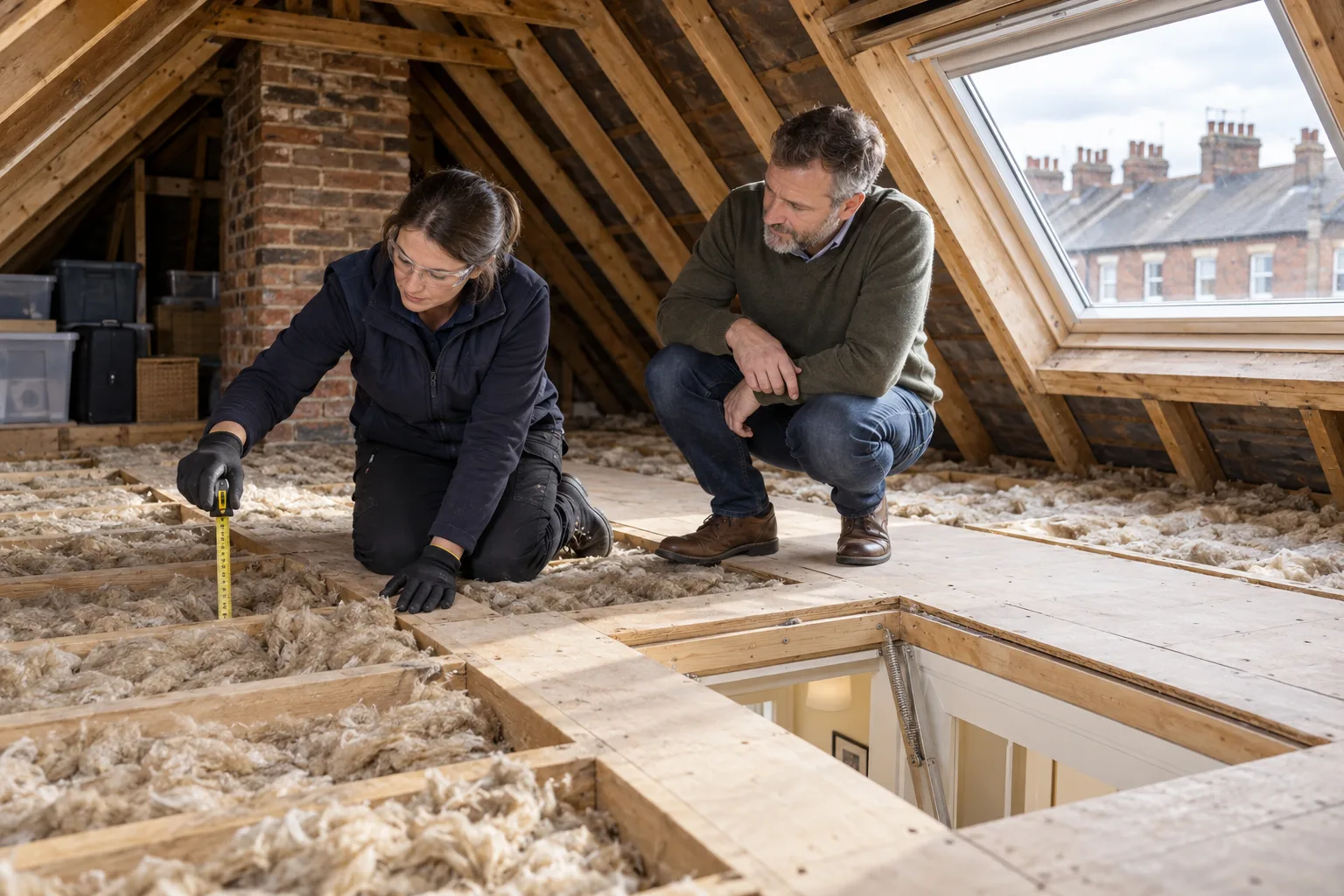

A practical 2026 guide to room in roof insulation for UK homes. It explains what the measure includes, how Warm Homes Local Grant eligibility works, how BUS fits into heating plans, and what to check before agreeing the work.
Can room-in-roof insulation be grant funded?
Room-in-roof insulation may be included when an active scheme covers the measure and the household, property and delivery area meet its rules. Funding is not automatic: a survey must confirm the converted roof space, insulation design, moisture and ventilation strategy are suitable before work is approved. For an explanation of the measure itself, read what room-in-roof insulation means.
Room in roof insulation in 2026 is one of the upgrades most easily missed during a home energy survey. A standard loft is usually simple to inspect because the insulation sits across the loft floor. A room in roof is different. Heat can escape through the sloping ceiling, flat ceiling, dwarf walls, party wall edges, storage voids and small gaps around access doors.
That matters because the roof can account for around 25 percent of heat loss in an uninsulated home. If the heated room sits inside the roof structure, the insulation has to wrap the room properly. A small roll of insulation in the eaves does not usually solve the whole problem.
For Cucumber Eco customers, this is often relevant in dormer bungalows, converted loft rooms, older terraces with attic bedrooms, and houses where a previous owner created a usable roof room without modern insulation standards. It can also affect heat pump design, because a leaky roof room can make the whole house harder to heat at lower flow temperatures.
What room in roof insulation means
Room in roof insulation means insulating the heated room that sits within the roof slope. The installer is not just topping up mineral wool on a flat loft floor. They are treating the surfaces around a habitable or semi habitable roof space.
That can include the sloping rafters above the room, the small flat ceiling at the ridge, the dwarf walls at the sides, the triangular eaves areas, dormer cheeks, dormer roofs and access doors into side voids.
In a good installation, the thermal line is continuous. In plain English, there should be no easy path for warm air to escape around the side of the insulation. If the main slope is insulated but the dwarf wall doors are left thin and draughty, the room can still feel cold.
Why it is a 2026 priority
There are three reasons this topic matters in 2026.
- Energy prices are still high enough for fabric upgrades to matter. Ofgem lists the April to June 2026 typical direct debit cap at £1,641, with average electricity at 24.67p per kWh and gas at 5.74p per kWh.
- Warm Homes Local Grant funding is now live in England. The GOV.UK household page says eligible homes may receive free agreed improvements such as wall, loft and underfloor insulation, air source heat pumps, smart controls and solar panels.
- Heat pump design is becoming more sensitive. The Boiler Upgrade Scheme can support low carbon heating, but insulation defects still affect comfort, radiator sizing and running cost.
Room in roof insulation sits across all three points. It is not glamorous, but it can change how warm the highest room in the house feels and how hard the heating system has to work.
Which homes usually need it
The obvious candidates are dormer bungalows and loft conversions. The less obvious ones are older houses where the attic room was created before current retrofit standards, or where the walls and roof slopes were lined but not insulated properly.
Signs worth checking include a bedroom that cools quickly after the heating turns off, cold sloping ceilings, cold cupboards behind dwarf walls, condensation near eaves spaces, draughts around small access doors, mould at ceiling edges, and a noticeable temperature difference between the roof room and the floor below.
An EPC may also give clues. If the certificate mentions roof room insulation as limited, unknown or assumed, that is worth investigating. It does not prove the room is uninsulated, but it does flag uncertainty.
The main surfaces that need attention
A room in roof is not one surface. It is a small building envelope inside the bigger roof.
- Sloping ceilings. These are the pitched parts of the ceiling that follow the roof line.
- Flat ceiling area. Many roof rooms have a short flat ceiling under the ridge.
- Dwarf walls. These are the low walls at the edge of the room, usually with eaves space behind.
- Eaves voids. These can be cold spaces outside the heated room and need the thermal line to be clear.
- Dormer cheeks and dormer roof. Dormers often leak heat because the side and top panels are thin.
- Access doors. Small doors into side voids can undo a lot of good insulation work if they are left unsealed.
- Junctions. Corners, floor edges, party wall returns and roof light reveals need careful detailing.
The aim is continuity. The installer should be able to explain where the warm side is and how every edge connects.
How much does it cost
Room in roof insulation is more variable than loft insulation, so a fixed price can be misleading. The cost depends on access, roof shape, existing boarding, room finish, dormers, headroom, ventilation, fire safety details, and whether the work is done from inside the room, from side voids, or during a wider refurbishment.
A simple loft top up is usually straightforward. Room in roof insulation is more like a small retrofit project. It may involve rigid insulation boards, mineral wool, insulated plasterboard, air control layers, draught sealing and making good to internal finishes.
When comparing quotes, ask for the detail rather than just the total.
- Which surfaces are included.
- What insulation material is being used.
- What target U value is being designed for.
- How ventilation will be maintained.
- How access doors and hatches will be insulated and sealed.
- What making good is included.
- Whether Building Control involvement is needed.
- What guarantee, certification and paperwork will be provided.
The cheapest quote is not always the best quote. A roof room with poor ventilation detailing can create expensive moisture problems later.
What savings can you expect
Savings depend on the home. The clearest verified point is that an uninsulated roof can lose around 25 percent of a home’s heat. Room in roof insulation reduces that loss where the heated room sits inside the roof structure.
The actual bill saving depends on how much of the roof is currently uninsulated, what fuel you use, how warm you keep the room, how airtight the rest of the house is, and whether the upgrade changes how often you heat the space.
The comfort gain is often easier to notice than the exact bill line. A cold attic bedroom may stop feeling like a separate climate zone. Radiators may recover the room faster. The floor below may also feel more stable because less heat is escaping through the roof structure above it.
For a heat pump home, better roof room insulation can also help the system run at lower flow temperatures. That does not mean insulation automatically pays for the whole heating system. It means the fabric condition affects how efficiently the heating system can do its job.
Warm Homes Local Grant and room in roof insulation
The Warm Homes Local Grant is the main 2026 route to check for many low income private homes in England. GOV.UK says the scheme is for privately owned homes in England, including owner occupied and privately rented homes, with EPC ratings of D, E, F or G. Household income must usually be £36,000 a year or less, although postcode and benefit routes can also apply.
If eligible and if the local council has funding available, the council arranges a home survey and agrees suitable measures. GOV.UK says councils usually contact applicants within 10 working days.
The public household page lists wall, loft and underfloor insulation among possible measures. The local authority guidance describes energy performance upgrades and low carbon heating, with insulation as a measure family. Room in roof insulation should therefore be treated as a survey led insulation measure rather than a simple online purchase.
For private rented homes, landlord consent may be needed and the landlord may have to contribute to some improvements. The grant route is local authority led, so the process and measure mix can vary by area.
Warm Homes Plan and why insulation comes first
The Warm Homes Plan is wider than one grant. It covers the government direction of travel on warmer homes, energy performance and low carbon heating. GOV.UK states that support through Warm Homes Local Grant and Warm Homes Social Housing Fund includes improvements such as double glazing, draught proofing, heating controls, wall insulation and loft insulation, tailored to the building.
Room in roof insulation fits that logic. It is a fabric first measure. If the roof room leaks heat, spending money on a larger heating system can hide the problem instead of fixing it.
For a homeowner, the practical order is simple.
- Check the EPC and roof room notes.
- Survey the room and side voids.
- Fix moisture and ventilation risks.
- Improve insulation and draught sealing.
- Then size heating upgrades against the improved fabric.
That order is especially important if you are thinking about an air source heat pump.
How the Boiler Upgrade Scheme fits in
The Boiler Upgrade Scheme does not fund room in roof insulation. It supports eligible low carbon heating installations in England and Wales.
The current GOV.UK notice says grant values effective from 28 April 2026 include £7,500 for an air to water heat pump, £7,500 for a ground source heat pump, £2,500 for an air to air heat pump and £5,000 for a biomass boiler where eligible.
That means BUS is relevant as a heating grant, not an insulation grant. The connection is sequencing. If your roof room is cold and draughty, the heat loss calculation for a new heat pump may be higher. That can affect radiator upgrades, comfort and running cost.
A good retrofit plan asks what the home needs before choosing the grant route. Some homes need insulation first. Some can move to heating design quickly. Some need both.
Building Regulations and U values
Approved Document L is the Building Regulations guidance for conservation of fuel and power. The 2026 edition was published on GOV.UK on 24 March 2026 and applies in England.
For existing homes, roof and wall upgrades are normally assessed against target U values and practical constraints. The Approved Document L material refers to a roof target around 0.16 W per m2 K for upgraded roof elements, with notes that practical limits such as headroom and structure may affect what can reasonably be achieved.
This is where survey quality matters. A room in roof may have limited rafter depth, awkward dormers, roof lights, cables, pipes and tight corners. The design must balance thermal performance, moisture risk, ventilation, fire safety and usable space.
If an installer cannot explain the intended U value or how moisture will be managed, ask more questions before approving the work.
The 25 percent thermal element trigger
Planning Portal guidance for external walls explains a wider Building Regulations principle for thermal elements. Where 25 percent or more of an external wall is re rendered, re clad, re plastered, re lined internally, or rebuilt externally, the regulations would normally apply and the thermal insulation would normally have to be improved.
For roof room projects, the same practical lesson applies. Once you are opening up a meaningful part of the building fabric, it is often the best time to improve insulation properly rather than simply replacing old linings.
Do not assume a cosmetic refurbishment is separate from energy performance. If you are stripping a roof room, changing plasterboard, replacing dormer linings or doing a major make good, ask Building Control or a competent retrofit professional what standard applies.
Moisture and ventilation risks
Room in roof insulation can go wrong when insulation blocks ventilation paths or traps moisture in timber. The roof still has to manage rain, vapour and air movement.
A proper design should cover ventilation at eaves and ridge where needed, vapour control on the warm side, avoidance of cold bridges, safe treatment around downlights and cables, and a plan for roof timbers that already show damp staining or decay.
Spray foam should be treated with caution. It is not the default answer for a roof room. It can make future roof inspection harder and may create problems with mortgage or survey concerns if installed badly. For many homes, a designed board or mineral wool system with clear ventilation is easier to inspect and explain.
What a good survey should include
A good room in roof survey should not be a quick glance from the landing. It should include the heated room, the eaves spaces, the loft access if present, external dormer condition, roof ventilation, signs of damp, existing insulation depth, electrical penetrations and the EPC assumptions.
The surveyor should also ask how the room is used. A bedroom needs a higher comfort standard than a storage room. A child's bedroom in a dormer bungalow deserves proper thermal and moisture design, not a token layer of insulation pushed behind a side wall.
For grant funded work, the survey should connect the measure to the whole house plan. That means it should consider other insulation, heating controls, heating system age, solar potential and whether the home is suitable for a heat pump later.
Questions to ask before agreeing the work
Use these questions before you sign.
- Is this a room in roof measure or a loft insulation measure.
- Which surfaces are included in the quote.
- Will the sloping ceilings, dwarf walls, flat ceiling, dormer cheeks and access doors all be treated.
- What U value is the design targeting.
- How will ventilation be kept open.
- How will vapour and condensation risk be controlled.
- Will any plasterboard, skirting, sockets or joinery need removing.
- What making good is included.
- Is Building Control needed.
- What paperwork will I receive at completion.
If the answer is vague, slow down. Room in roof insulation is not a place for guesswork.
Common mistakes
The first mistake is insulating only the easy bits. If the installer treats the side voids but ignores dormer cheeks, the room may still have cold panels.
The second mistake is blocking ventilation. Warm moist air can reach cold surfaces and cause condensation if the vapour and ventilation strategy is poor.
The third mistake is assuming every roof room is the same. A dormer bungalow, a Victorian attic bedroom and a modern loft conversion can need different details.
The fourth mistake is chasing a heating grant before checking the fabric. A heat pump can perform well in an older home, but the design is much easier when the roof room is not leaking heat.
The fifth mistake is ignoring paperwork. Grant funded and Building Regulations relevant work should leave you with clear completion evidence.
Is it worth it
Room in roof insulation is worth serious consideration if the top room is cold, the EPC flags limited roof room insulation, or you are planning a wider retrofit. It can improve comfort, reduce heat loss and prepare the home for lower temperature heating.
It is not a measure to buy blind. The right answer depends on the roof structure, room use, existing insulation, moisture condition and grant eligibility.
For many households, the best next step is a survey rather than a quote from photos. A competent survey can confirm whether the issue is missing insulation, draughts, ventilation, heating imbalance or a combination of all four.
The bottom line
Room in roof insulation in 2026 is a practical upgrade for homes where the warm room sits inside the roof. It is more complex than a loft top up, but it can solve a real comfort problem.
Check Warm Homes Local Grant eligibility if the home is in England, privately owned and EPC D to G. Remember that BUS helps with eligible heating upgrades, not insulation. Use the Warm Homes Plan logic to get the fabric right before asking a heating system to compensate for heat loss.
The best installations are boring in the right way. They survey properly, insulate every relevant surface, protect ventilation, control moisture, leave paperwork, and make the room feel like part of the home rather than a cold space above it.