Ground source heat pumps are among the most efficient low-carbon heating systems available, and in 2026 the Boiler Upgrade Scheme offers a £7,500 grant to help with installation costs. This guide covers how they work, full installation costs, running cost savings, available grants, and the key questions to ask before deciding if a ground source heat pump is right for your property.
Ground Source Heat Pumps in 2026: Costs, Grants, and Whether They Are Right for Your Home
Ground source heat pumps represent one of the most efficient low-carbon heating technologies available to UK homeowners, yet they remain less well understood than their air source cousins. In 2026, with the Boiler Upgrade Scheme offering £7,500 grants, the Warm Homes Plan providing up to £30,000 for eligible households, and a growing body of installation experience across the UK, it is a good time to take a clear-eyed look at whether a ground source heat pump could be right for your home.
This guide covers what ground source heat pumps are, how they work, what they cost to install and run, what grants are available, and the honest considerations around suitability.
What Is a Ground Source Heat Pump?
A ground source heat pump (GSHP) is a heating system that extracts heat from the ground and uses it to warm your home and provide hot water. It works on the same principle as a refrigerator, but in reverse: a refrigerant circulates through pipes buried in the ground, absorbs heat from the soil, and a heat pump compresses this heat to a higher temperature suitable for your heating system.
Ground temperatures in the UK remain relatively stable throughout the year, typically between 8 and 12 degrees Celsius at a depth of a metre or more. This provides a consistent source of low-grade heat that a ground source heat pump can upgrade to a temperature useful for space heating and hot water.
The key measure of a heat pump's efficiency is its Coefficient of Performance (COP), which is the ratio of heat energy output to electrical energy input. A ground source heat pump with a COP of 3.5 delivers 3.5 units of heat for every unit of electricity it consumes. This makes it significantly more efficient than a gas boiler, which cannot exceed a COP of 1 (i.e., 100 percent efficiency).
Ground source heat pumps typically achieve higher COPs than air source heat pumps because ground temperatures are more stable than air temperatures, particularly in winter when heating demand is highest. This gives them a performance advantage, particularly in colder conditions.
How Does a Ground Source Heat Pump System Work?
A ground source heat pump system has three main components:
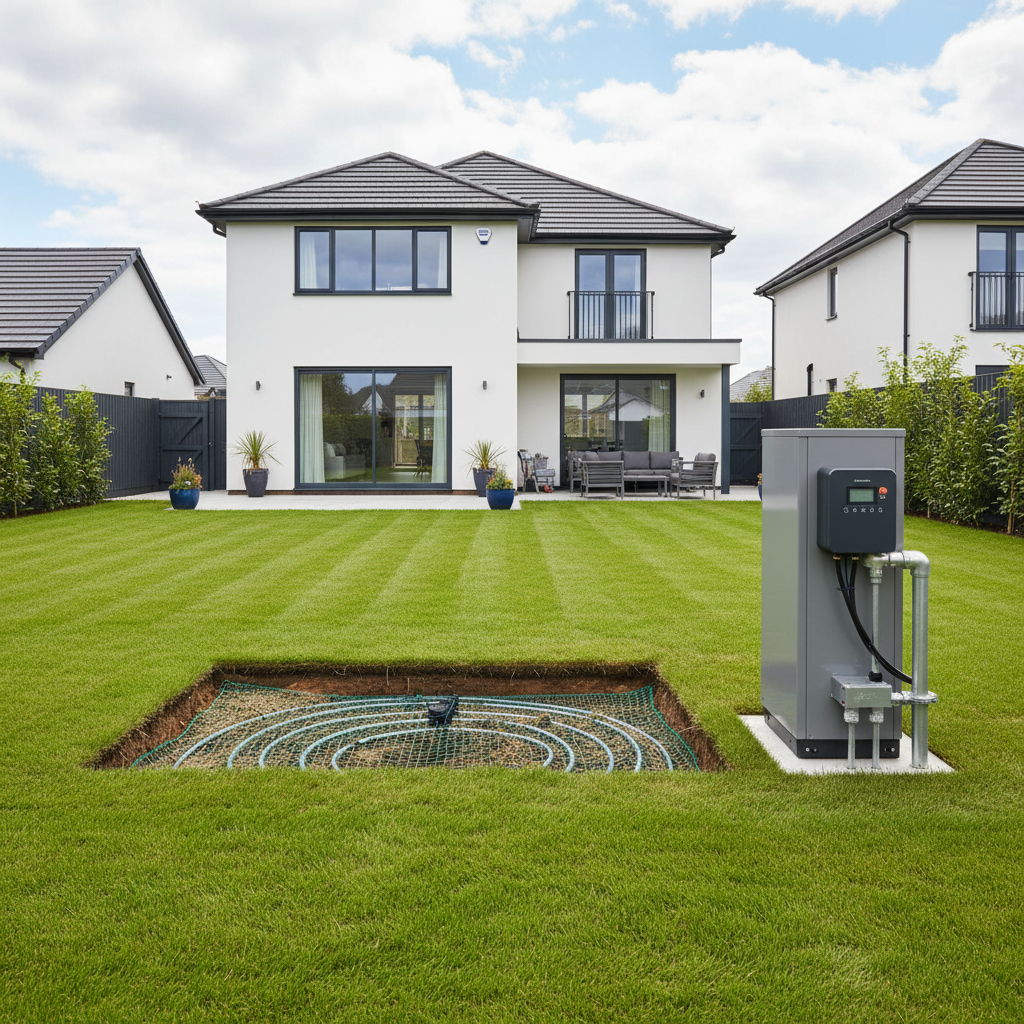
The ground loop: A series of pipes buried in the ground or submerged in a body of water (if available). The ground loop circulates a water and antifreeze mixture that absorbs heat from the ground and carries it back to the heat pump unit.
The heat pump unit: Located inside the building, this extracts heat from the fluid returning from the ground loop, upgrades it to a higher temperature using a compressor, and transfers it to your home's heating and hot water system.
The heat distribution system: This is the radiator or underfloor heating system that distributes heat around your home. Ground source heat pumps work best with larger surface-area heat emitters, because they operate at lower flow temperatures than gas boilers.
Ground loops can be installed in two main ways. Horizontal loops are buried in trenches at a depth of around one to two metres, requiring a reasonable amount of garden space. A typical installation requires around 200 to 300 square metres of ground per 8 to 10 kilowatts of heat output. Vertical boreholes are drilled to depths of 50 to 150 metres or more, requiring much less surface area but significantly higher drilling costs. Boreholes are often the solution for properties with limited garden space.
Is a Ground Source Heat Pump Right for My Home?
Ground source heat pumps are well-suited to some homes and less suitable for others. The key factors to consider are:
Outside space: Horizontal ground loops require sufficient garden area. If you have a smaller garden, a vertical borehole system may be an option, though it adds to the cost. Properties without any significant outdoor space are typically not suitable for ground source heat pumps.
Insulation: Heat pumps operate most efficiently when paired with well-insulated homes. They work at lower flow temperatures than gas boilers, which means your home needs to retain heat effectively. If your home is poorly insulated, improving the insulation before or alongside the heat pump installation is strongly recommended.
Heat distribution system: Ground source heat pumps work best with underfloor heating or with oversized radiators designed for lower flow temperatures. If your existing radiators are standard-sized and were specified for a high-temperature gas boiler system, they may need to be upgraded or supplemented to work effectively with a heat pump.
Hot water demand: Ground source heat pumps provide domestic hot water as well as space heating, but they generally require a hot water cylinder (rather than the instantaneous hot water provided by a combi boiler). If you currently have a combi boiler, the installation will require the addition of a hot water cylinder.
Property type: Ground source heat pumps are typically most suitable for larger properties, particularly detached and semi-detached houses with good outdoor space. They are commonly used in rural properties without access to the gas grid.
How Much Does a Ground Source Heat Pump Cost in 2026?
Ground source heat pumps are one of the more expensive heating system options due to the cost of the ground loop installation. In 2026, typical installed costs are:
- Ground source heat pump with horizontal loop (smaller property): £15,000 to £22,000
- Ground source heat pump with horizontal loop (larger property): £20,000 to £30,000
- Ground source heat pump with vertical borehole (single borehole): £18,000 to £28,000
- Ground source heat pump with vertical borehole (multiple boreholes): £25,000 to £40,000 or more
These figures include the heat pump unit, the ground loop or borehole installation, pipework, controls, and commissioning. They do not include the cost of any radiator upgrades, hot water cylinder installation, or building works that may be required.
The wide range in costs reflects the significant variation between properties and installation types. Getting a detailed survey and quote from a qualified installer is essential for understanding the specific cost for your situation.
Running costs for ground source heat pumps are lower than for gas boilers for most properties, but this depends on electricity prices relative to gas prices. In 2026, electricity remains more expensive per unit than gas, but the heat pump's higher efficiency (COP of 3 to 4 versus a boiler's effective efficiency of around 0.9) means that the overall cost of heat delivered can be comparable to or lower than gas for well-specified systems in well-insulated homes.
How Much Can You Save With a Ground Source Heat Pump?
For properties currently on mains gas, the saving from switching to a ground source heat pump depends on the relative prices of gas and electricity and the COP of the system. In 2026, with typical energy prices, households switching from gas to a well-performing ground source heat pump in a well-insulated property may see modest annual running cost reductions or broadly similar costs.
The bigger financial case for heat pumps currently comes from off-gas-grid properties, which typically heat with oil, LPG, or electric storage heaters. For these properties, switching to a ground source heat pump can deliver meaningful running cost reductions, often of several hundred pounds per year or more.
Over the longer term, the running cost case for heat pumps is expected to strengthen as the electricity-to-gas price ratio improves, which is anticipated as the UK's electricity grid decarbonises and electricity generation costs fall with increasing renewable capacity.
Beyond running costs, there are also carbon savings to consider. Ground source heat pumps produce significantly lower carbon emissions than gas boilers or oil boilers, which matters for homeowners with sustainability goals and will increasingly matter for property ratings and valuations as carbon-based metrics become more prominent.
The Boiler Upgrade Scheme: £7,500 Grant for Ground Source Heat Pumps
The Boiler Upgrade Scheme (BUS) provides a grant of £7,500 for eligible households replacing an existing fossil fuel heating system with a ground source heat pump. This grant is paid directly to your installer and effectively reduces the upfront cost of the system.
To be eligible for the Boiler Upgrade Scheme:
- The property must be in England or Wales.
- The property must have a valid EPC with no outstanding recommendations for loft or cavity wall insulation (or these recommendations must be addressed first).
- The ground source heat pump must be installed by an MCS-accredited installer.
- The property cannot have received a grant from certain other energy schemes within the past year.
The £7,500 grant makes a meaningful difference to the upfront cost of a ground source heat pump. For a system costing £20,000 to £25,000, the grant reduces the net cost to £12,500 to £17,500.
The Boiler Upgrade Scheme is available to homeowners, landlords, and in some cases small businesses. It has been extended and remains available in 2026, though it is worth checking current availability as the scheme operates on a budget and grants are not always immediately available.
The Warm Homes Plan: Up to £30,000 for Eligible Households
The Warm Homes Plan is the government's main programme for improving the energy efficiency of UK homes, with a particular focus on low-income households and those living in less energy-efficient properties. The scheme provides funding of up to £30,000 per household for eligible measures including ground source heat pumps, insulation, solar panels, and other clean energy improvements.
For eligible households, the Warm Homes Plan can cover the majority or all of the cost of a ground source heat pump installation, particularly when combined with accompanying insulation measures.
Eligibility for the Warm Homes Plan is means-tested and property-based. Households on certain qualifying benefits or with lower incomes, living in properties rated EPC D or below, are most likely to be eligible. However, the scheme also has a route for owner-occupied properties above these thresholds in some circumstances.
The Warm Homes Local Grant
The Warm Homes Local Grant is administered by local authorities and provides funding for energy efficiency improvements in privately rented and owner-occupied homes in England. It runs until March 2028.
Ground source heat pumps can be included under the Warm Homes Local Grant, though the specific measures and amounts available vary by local authority. It is worth checking with your local council or an approved scheme provider to understand what is available in your area.
For landlords with properties in the private rented sector, the Warm Homes Local Grant can be a valuable route to funding heat pump installations, helping to improve EPC ratings and meet MEES 2030 requirements.
Ground Source Heat Pumps and MEES 2030
For landlords, the MEES 2030 requirement to achieve EPC C across the rental portfolio is a significant driver of heating system upgrades. In properties that are currently heated by oil, LPG, or older gas boilers, a ground source heat pump can deliver a substantial improvement in EPC rating, often enough to move a property from EPC D or E to EPC C or above.
The combination of the Boiler Upgrade Scheme grant, potential Warm Homes Local Grant funding, and the MEES 2030 compliance benefit makes ground source heat pumps a financially viable option for many landlords with off-gas-grid properties or large detached homes that need to improve their EPC rating.
The Home Energy Model and Heat Pumps
The Home Energy Model, due to replace the Standard Assessment Procedure in the second half of 2027, is expected to assess heat pumps in a more accurate and favourable way than the current SAP methodology. The new model should better reflect the real-world performance of heat pumps, including their interaction with smart controls, variable electricity tariffs, and thermal storage.
This means that properties with ground source heat pumps installed before the new model takes effect may see an improvement in their EPC rating when the Home Energy Model comes into force, which could be beneficial for both resale value and rental compliance.
Choosing a Ground Source Heat Pump Installer
Selecting the right installer is critical for ground source heat pump projects, which are complex and expensive. Key criteria include:
MCS accreditation. Microgeneration Certification Scheme (MCS) accreditation is required for installers to carry out Boiler Upgrade Scheme installations. It also provides a quality assurance framework. Only use MCS-accredited installers for heat pump work.
Experience with ground source specifically. Air source and ground source heat pump installations require different skills and equipment, particularly for the ground loop or borehole installation. Check that the installer has specific experience with ground source systems.
A thorough survey and design process. A good installer will carry out a full heat loss calculation for your property, design the system to meet your specific heating and hot water demands, and size the ground loop or borehole accordingly. Avoid any installer who gives you a price without a proper survey.
References. Ask for references from previous ground source heat pump installations, ideally for properties similar to yours.
Frequently Asked Questions About Ground Source Heat Pumps
How much garden space do I need for a horizontal ground loop?
A rough guide is 200 to 300 square metres of usable garden area per 8 to 10 kilowatts of heat output required. For a typical family home requiring around 8 to 12 kW of heating capacity, you would need between 200 and 400 square metres of accessible, relatively flat ground that is free from large trees and structures. If you have less space, a vertical borehole system may be an option.
Do ground source heat pumps work in cold weather?
Yes. Unlike air source heat pumps, which see their performance decline in very cold weather, ground source heat pumps draw heat from the ground at a relatively stable temperature throughout the year. This means they maintain consistent performance even during cold spells.
Can I keep my underfloor heating with a ground source heat pump?
Yes, and in fact underfloor heating is an ideal heat distribution system for a ground source heat pump. The low flow temperatures at which heat pumps operate are well matched to underfloor heating, which is designed to work at lower temperatures than radiators.
Will a ground source heat pump provide all my hot water?
Yes, a properly specified ground source heat pump system should provide all of your space heating and hot water needs. The system includes a hot water cylinder that stores water heated by the heat pump.
How noisy are ground source heat pumps?
Ground source heat pump units are quieter than air source heat pumps because they do not have an outdoor fan unit. The heat pump unit itself, which sits inside your home (typically in a utility room, garage, or plant room), produces a low level of noise similar to a refrigerator. This is rarely a concern in practice.
What maintenance does a ground source heat pump require?
Ground source heat pumps require relatively little maintenance. An annual service by a qualified engineer is recommended, which typically costs £100 to £200. The ground loop itself generally requires no maintenance. System components such as the heat pump unit are warranted for 5 to 10 years, with the system expected to have a lifespan of 20 to 25 years.
What happens to the ground loop in very cold winters?
The fluid in the ground loop is an antifreeze solution designed to operate at sub-zero temperatures. In practice, the ground temperature at the depth of a horizontal loop or borehole does not fall to zero in UK conditions, so freezing of the loop itself is not a practical concern with a properly installed system.
Take the Next Step With Cucumber Eco
Ground source heat pumps are a significant investment and getting the assessment, design, and installation right is essential. Cucumber Eco offers free, no-obligation consultations for homeowners and landlords across the UK who are considering a ground source heat pump or want to understand whether one is suitable for their property.
We can assess your eligibility for the Boiler Upgrade Scheme £7,500 grant, the Warm Homes Plan, and the Warm Homes Local Grant, and help you understand the full picture of costs, savings, and suitability for your specific situation.
Visit cucumbereco.co.uk to book your free consultation and take the first step toward a lower-carbon, lower-cost heating system.