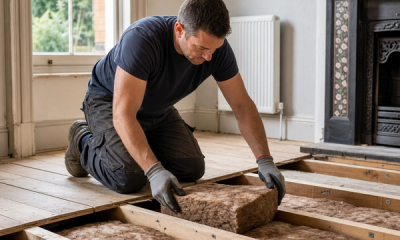
Ofgem has cut the energy price cap to £1,641 per year from April 2026, a fall of 6.6% on the previous quarter. We explain what is driving the drop, why bills are still far above pre-crisis levels, and why this is actually one of the best moments to lock in long-term savings through insulation, heat pumps, and solar.
Ofgem has confirmed that the energy price cap will fall to £1,641 per year from 1 April 2026. That is down from £1,758 in the first quarter of 2026, a reduction of approximately 6.6% or around £10 per month for a typical household. For many people, this will feel like welcome news after years of elevated bills.
But the headline number does not tell the full story. Bills are still around 35% higher than they were before the energy crisis began in 2021 and 2022. The cap resets every three months and can rise again just as quickly as it falls. And two major changes to how properties are measured and regulated are already locked in for the next few years.
This guide explains what is driving the April 2026 price cap reduction, what it means for homeowners and landlords, and why a falling cap is actually one of the better moments to make long-term energy efficiency improvements.
What is the energy price cap?
The energy price cap is set by the energy regulator Ofgem and limits the unit rate and standing charge that energy suppliers can charge customers on default tariffs. It does not cap the total amount you pay. If you use more energy than average, you will pay more. If you use less, you will pay less. The figures quoted (such as £1,641 per year) are based on Ofgem's estimate of typical household consumption.
The cap is reviewed every quarter: January, April, July, and October. It rose sharply during 2022 and 2023 when wholesale gas prices spiked, and has gradually moderated since then. The April 2026 reduction is a combination of two factors.
What is driving the April 2026 fall?
Two things are pushing the April 2026 cap lower than Q1.
The first is the Government's decision to shift £6.9 billion of energy policy costs off household bills and into general taxation. These costs, which previously funded schemes like the Renewables Obligation and feed-in tariffs, were embedded in every unit rate. Moving them off the cap lowers the unit rate directly. This was announced in the Spring Budget and takes effect from April.
The second factor is lower wholesale gas and electricity prices compared to the same period last year. Global demand has eased somewhat, and European gas storage levels going into spring 2026 are healthier than in previous years. This gives Ofgem more headroom to lower the cap without suppliers facing losses.
Together, these two effects produce the 6.6% reduction seen in the April cap.
Why bills are still far higher than before the crisis
It is worth keeping the April 2026 figure in context. Before the energy crisis, a typical household was paying around £1,200 per year. The April 2026 cap of £1,641 is still 37% above that level. The energy crisis effectively repriced household energy at a higher floor, and despite multiple quarterly reductions since the 2022 peak, bills have not returned to pre-crisis norms.
There is also no guarantee that the cap will continue to fall. It rose in Q1 2026 compared to Q4 2025. Wholesale markets remain volatile. A cold winter, a supply disruption, or a reversal in global energy demand can push the cap up again within a single quarter. Households that are dependent entirely on grid gas and electricity remain exposed to that volatility.
What this means for homeowners
For homeowners, the April 2026 cap reduction is genuinely welcome. If your bills are currently set by the cap rate, you will save around £120 per year from April. That is meaningful but modest.
The more important question is what happens next. The Government's £6.9 billion policy cost shift is a one-off structural adjustment. Further reductions from this point depend entirely on wholesale market conditions, which are beyond anyone's control.
Households that have invested in insulation, solar panels, or heat pumps are partially or fully insulated from these swings. A well-insulated home with a heat pump on a smart electricity tariff can have energy costs that are substantially lower than the Ofgem cap suggests, because the household is using far less energy and generating some of its own.
What this means for landlords
For landlords, the energy price cap is relevant but the regulatory picture matters far more than a quarterly rate change.
The Minimum Energy Efficiency Standards (MEES) deadline of October 2030 requires all private rental properties in England and Wales to achieve an EPC rating of C or above before they can be legally let. Properties currently rated D, E, F, or G will require upgrades. The most common measures are loft insulation, cavity wall or internal wall insulation, and a heat pump or other low-carbon heating system.
The Home Energy Model replaces the current A to G EPC system in the second half of 2027. Under the new four-metric system, a property receives separate scores for energy cost, carbon emissions, energy use intensity, and heating system performance. Gas heating, even from a modern efficient boiler, will score poorly on the heating system metric under the Home Energy Model. Landlords who upgrade early avoid the risk of investing in measures under the current SAP methodology, only to find they are still non-compliant under the new one.
A temporarily lower energy price cap changes none of this. The regulatory deadlines are fixed.
Why a falling cap is a good moment to act
This might seem counterintuitive. If bills are falling, why act now?
Three reasons.
First, demand for funded schemes tends to rise when bills are high and fall slightly when bills ease. Right now, demand on the Warm Homes Plan and installer capacity is more manageable than it was during the 2022 and 2023 peak. Assessment and installation waiting times are shorter. If you qualify for funding, this is a better moment to apply than during a price spike when everyone else is also rushing to qualify.
Second, the funded schemes available right now are genuinely generous, and they will not last indefinitely. The Warm Homes Plan runs to March 2028. The Boiler Upgrade Scheme is funded annually and subject to government budget decisions. Acting in 2026 means you access these funds at their current levels, before any future changes.
Third, energy efficiency improvements lock in savings permanently. The cap might fall to £1,641 in April 2026, but it rose again in Q1 2026 from Q4 2025. It will move again. Households and landlords that have reduced their consumption are shielded from whatever direction it moves next.
What funding is available right now
Warm Homes Plan
The Warm Homes Plan provides up to £30,000 of fully funded energy efficiency improvements for eligible households in England. Two routes to qualify: household income under £36,000 and an EPC rating of D, E, F, or G, or living in one of the most deprived postcodes in England (IMD deciles 1 or 2) with no income threshold applied. Funded measures include loft insulation, cavity wall insulation, internal wall insulation, room-in-roof insulation, first-time central heating, air source heat pumps, and smart heating controls.
Warm Homes Local Grant
The Warm Homes Local Grant runs to March 2028 and is delivered by local authorities across England. It targets owner-occupied and private rental properties in the lowest deprivation areas. Eligibility and available measures vary by local authority. This is a separate pot of funding from the main Warm Homes Plan and is worth checking independently if you do not qualify through the income route.
Boiler Upgrade Scheme
The Boiler Upgrade Scheme provides a £7,500 grant towards the cost of installing an air source heat pump. There is no income threshold. The grant is paid directly to your installer and reduces the upfront cost of the system. It is designed for households replacing a gas or oil boiler with a heat pump. The scheme is funded on an annual basis, so applying sooner is advisable.
The most effective improvements for reducing bills
Whatever route you take, the measures that have the greatest impact on energy bills are consistent across property types.
Insulation first. Loft insulation in an uninsulated property can reduce heat loss by up to 25% and costs very little relative to its impact. Cavity wall insulation addresses around 35% of heat loss in properties with suitable cavities. Internal or external wall insulation is required for solid wall properties and is more expensive but highly effective. Getting insulation right is the foundation of everything else.
Heat pump over boiler replacement. A heat pump combined with a smart electricity tariff can achieve running costs comparable to or below gas in a well-insulated home. With the Boiler Upgrade Scheme grant, the upfront premium over a gas boiler is significantly reduced. Heat pumps also protect against future gas price volatility in a way that a new gas boiler does not.
Solar panels with battery storage. A 4kW solar system generates enough electricity to cover a significant proportion of a typical household's daytime demand. Adding battery storage increases self-consumption from around 45% to 75%. Pairing solar with a heat pump creates a home that generates and uses its own electricity for both lighting and heating.
How Cucumber Eco can help
Cucumber Eco provides free energy consultancy to homeowners and landlords across England. Our advisors assess your property, identify which funded schemes you qualify for, and coordinate the full installation process from survey through to completion.
We work with the Warm Homes Plan, Warm Homes Local Grant, and Boiler Upgrade Scheme. The consultation is free. There is no obligation.
Frequently asked questions
Does the April 2026 price cap apply to me automatically?
If you are on a standard variable tariff (the default tariff most households are on), the new cap rate applies automatically from 1 April 2026. If you are on a fixed tariff, your rate is locked until the end of your fixed term, regardless of cap movements.
Will the energy price cap continue to fall?
Nobody can predict with certainty. The cap is set quarterly based on wholesale energy market conditions. Wholesale prices are influenced by global demand, weather, geopolitical events, and energy storage levels across Europe. The April fall is real, but so is the risk of a future rise. The only reliable protection against cap movements is to reduce your household's dependence on energy at the cap rate.
How do I know if I qualify for the Warm Homes Plan?
You qualify through one of two routes: household income under £36,000 with an EPC rating of D, E, F, or G, or living in one of the most deprived postcodes in England (IMD deciles 1 or 2) regardless of income. The quickest way to check is to contact a registered scheme provider for a free assessment.
Can landlords access the Warm Homes Plan?
Yes. Landlords can access the Warm Homes Plan for privately rented properties, subject to eligibility criteria based on the tenant's household income or the property's location in a deprived area. Landlords may be required to contribute a co-payment. The Warm Homes Local Grant also covers private rental properties in some local authority areas.
Is the Boiler Upgrade Scheme still available?
Yes. The Boiler Upgrade Scheme is currently providing £7,500 towards the cost of a new air source heat pump. There is no income test and no requirement to have a specific EPC rating. The scheme is funded annually so availability can change. Applications are made through your chosen heat pump installer.