remove bg1

Latest News

Air Source Heat Pumps Explained: A Complete Guide for UK Homeowners

Air source heat pumps (ASHPs) are increasingly recognised as a key technology in the future of home heating in the UK. Rising energy prices, the need to reduce carbon emissions, and government policy aimed at phasing out fossil fuel heating systems have all contributed to growing interest in heat pumps.


Once considered a niche or experimental option, air source heat pumps are now a proven, widely deployed technology across Europe and the UK. When correctly designed and installed, they can provide reliable space heating and hot water while significantly reducing carbon emissions and long-term energy consumption.


This guide provides a detailed explanation of air source heat pumps, how they work, their suitability for UK homes, running costs, installation requirements, and the government support available.

What Is an Air Source Heat Pump?

An air source heat pump is a heating system that extracts low-grade heat from the outside air and upgrades it to a higher temperature suitable for heating a building and supplying hot water. Even in cold weather, outdoor air contains thermal energy that can be captured and reused.


Unlike gas or oil boilers, which generate heat by burning fuel, air source heat pumps move heat from one place to another. This fundamental difference allows them to operate with much higher efficiency than conventional heating systems.


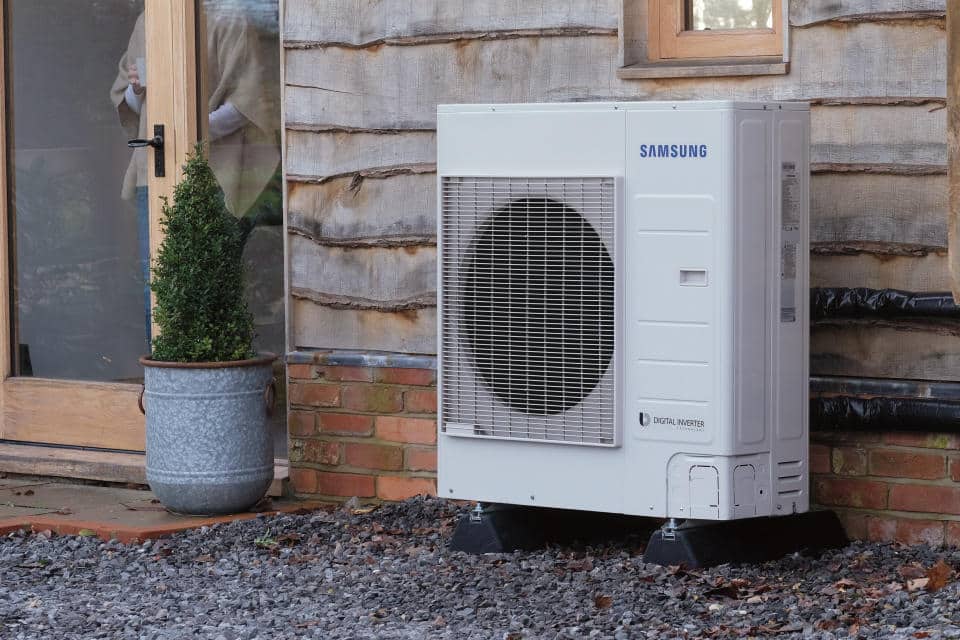
Air source heat pumps are typically installed outside a property and connected to an internal heating system. They can provide space heating through radiators or underfloor heating, as well as hot water via a dedicated cylinder.

How Air Source Heat Pumps Work

Air source heat pumps operate using a closed-loop refrigeration cycle. An external fan draws ambient air across a heat exchanger that contains a refrigerant with a very low boiling point. As the refrigerant absorbs heat from the air, it evaporates into a gas.

This gas is then compressed, which significantly raises its temperature. The heat is transferred into the home’s heating system through another heat exchanger, warming the water that circulates through radiators, underfloor heating, or a hot water cylinder.


After releasing its heat, the refrigerant cools, condenses back into a liquid, and the cycle begins again. This process runs continuously and efficiently, allowing the system to deliver several units of heat for every unit of electricity consumed.


Because heat pumps move heat rather than create it, their efficiency is measured as a coefficient of performance (COP). A COP of 3, for example, means the system produces three units of heat for every unit of electricity used.

heat pump

Are Air Source Heat Pumps Suitable for the UK Climate?

Air source heat pumps are well suited to the UK climate and are widely used in countries with colder winters. Modern systems are designed to operate efficiently at sub-zero temperatures and can continue to extract heat from the air even during cold spells.


However, overall performance depends heavily on property characteristics. Homes with good insulation, minimal heat loss, and low-temperature heat distribution systems typically achieve the best results. Poor insulation can increase running costs and reduce efficiency, making energy efficiency improvements an important consideration.


With appropriate design and installation, air source heat pumps can provide consistent and comfortable heating throughout the year.

Benefits of Air Source Heat Pumps

One of the most significant benefits of air source heat pumps is their high energy efficiency. By using electricity to move heat rather than generate it, they can deliver substantially more heat energy than they consume.

From an environmental perspective, air source heat pumps can significantly reduce carbon emissions, particularly when replacing gas, oil, or LPG systems. As the UK electricity grid continues to decarbonise, the environmental benefits of heat pumps are expected to increase further.


Air source heat pumps also provide steady, even heating rather than the rapid on-off cycles typical of boilers. This can improve comfort and reduce temperature fluctuations within the home. In addition, they reduce reliance on fossil fuels and align with future energy and housing regulations.

Running Costs and Energy Efficiency

The running costs of an air source heat pump depend on several interrelated factors, including electricity tariffs, insulation levels, system design, and household heating behaviour. In well-insulated homes, running costs can be competitive with or lower than gas heating.


Heat pumps operate most efficiently at lower flow temperatures, meaning they are best paired with underfloor heating or appropriately sized radiators. Smart controls, weather compensation, and zoning can further optimise performance and reduce energy use.


Although electricity prices are higher per unit than gas, the high efficiency of heat pumps helps offset this difference. Accurate system sizing and professional installation are essential to achieving expected performance.

Government Grants and Financial Support

To support the transition to low-carbon heating, the UK government offers financial incentives to reduce the upfront cost of air source heat pump installations.


In England and Wales, the Boiler Upgrade Scheme provides a grant toward the cost of replacing an existing fossil fuel heating system with an air source heat pump. This grant can significantly reduce initial installation costs for eligible households.


In Scotland, support is available through Home Energy Scotland, which offers a combination of grants and interest-free loans. Additional local or regional schemes may also be available, depending on location and funding availability.


Eligibility typically depends on property suitability, insulation standards, and the type of heating system being replaced. As schemes and criteria can change, homeowners are advised to check current guidance before proceeding.

Installation Requirements and Considerations

Installing an air source heat pump requires careful planning and assessment. The external unit must be positioned to allow sufficient airflow and comply with noise and permitted development regulations. Most domestic installations do not require planning permission, provided specific criteria are met.


Internally, space is required for a hot water cylinder and associated equipment. A professional heat loss calculation is essential to ensure the system is correctly sized for the property.


Because system design has a significant impact on performance, installations should always be carried out by MCS-certified installers with experience in heat pump systems. Proper commissioning and user guidance are also critical to long-term performance.

Air Source Heat Pumps vs Gas Boilers

Air source heat pumps differ fundamentally from gas boilers in how they deliver heat. Boilers generate high-temperature heat quickly, while heat pumps provide lower-temperature heat over longer periods.


Although installation costs for heat pumps are higher, they offer lower carbon emissions, compatibility with renewable electricity, and improved long-term sustainability. As policy continues to move away from fossil fuels, heat pumps are increasingly seen as a future-proof alternative to gas boilers.


For many households, the transition requires an adjustment in heating habits but can result in improved comfort and stability.

The Role of Air Source Heat Pumps in the UK’s Energy Future

Air source heat pumps are expected to play a central role in decarbonising domestic heating as the UK works toward net-zero emissions targets. Government policy, building regulations, and infrastructure investment increasingly support the adoption of low-carbon heating technologies.


As installer capacity grows and public understanding improves, heat pumps are likely to become a standard feature of new-build homes and an increasingly common retrofit option for existing properties.

Final Thoughts

Air source heat pumps represent a mature, efficient, and environmentally responsible heating solution for UK homes. When installed in suitable properties and supported by appropriate insulation and system design, they can deliver reliable heating, reduced emissions, and long-term energy savings.


With government grants helping to offset upfront costs and a clear policy direction favouring low-carbon heating, air source heat pumps are an increasingly viable option for homeowners planning for the future. Careful assessment and professional installation remain key to achieving the full benefits of the technology.

About Author

I’m a Second Class Honours, Upper Division Graduate of English Literature and Film Studies student at the University of Manchester, passionate about storytelling, media, and communication. I currently work as a Multi-Channel Marketing Apprentice at Cucumber Eco Solutions Ltd.

Recent Posts

Categories

Tag Cloud